

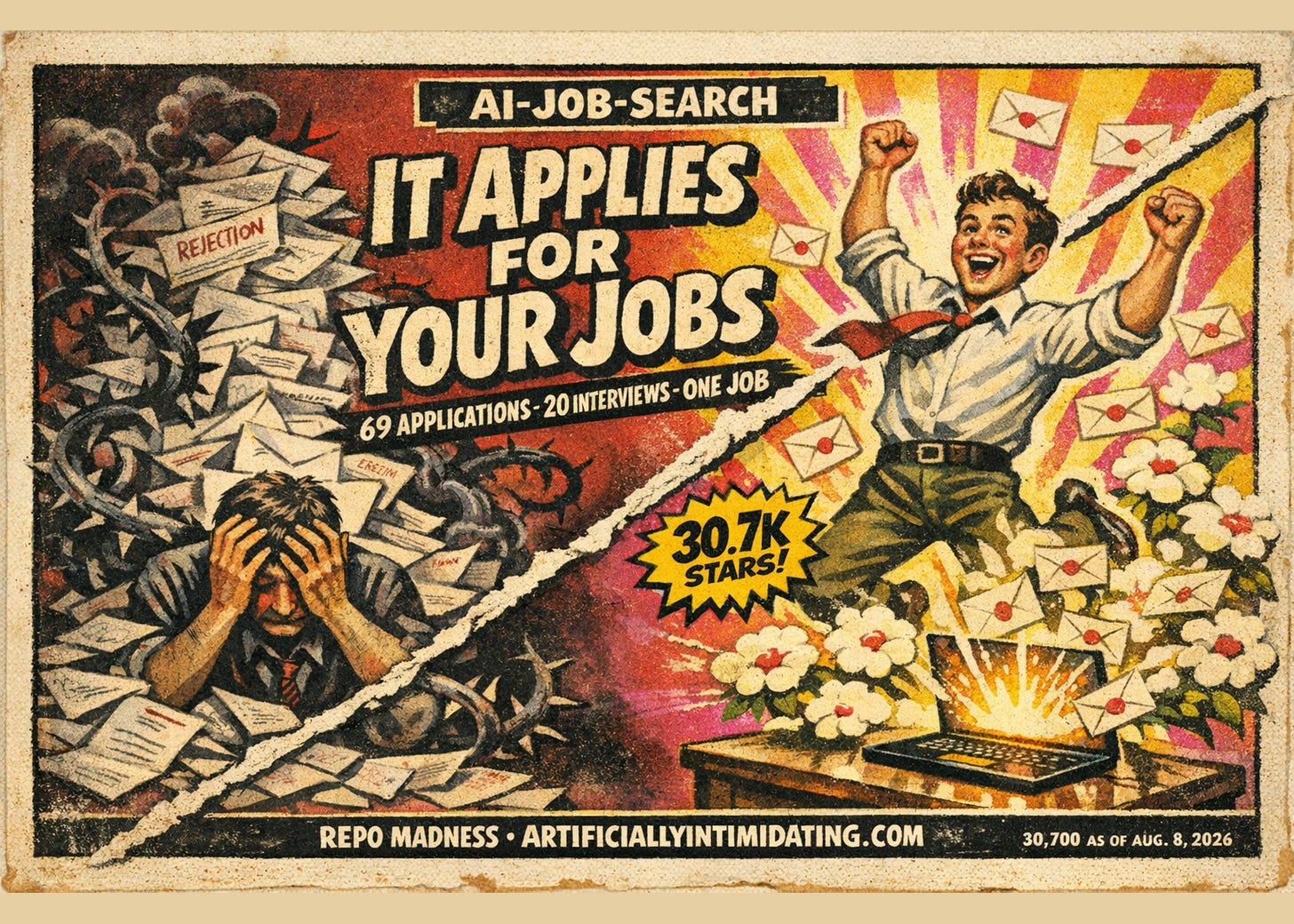
Updated September 7, 2026. A month on, one item in here is now the wrong advice -- the update is at the bottom.
Sixty-nine applications.
Twenty first interviews.
One signed contract.
That's not a case study somebody paid for. That's the README.
Mads Lorentzen is a geophysicist with a PhD. His job got cut in late 2025. Instead of writing cover letters one at a time like the rest of us would, he built a job search framework on Claude Code and pointed it at his own career. In June 2026 he started as an AI engineer.
Then he published the whole thing. MIT license. Go take it.
Here's the part I can't stop thinking about. He told every single employer he was using it.
"I was upfront about it with every employer I spoke to, and instead of counting against me, it usually sparked a genuine technical conversation."
The thing you'd assume you have to hide is the thing that got him in the room.
What it actually does
Three commands do the heavy lifting.
/setup reads whatever you've got -- old CV, LinkedIn export, past applications -- and builds your profile.
/scrape searches job boards and ranks what it finds against that profile.
/apply is where it gets good. Feed it a posting. It scores your fit, writes a tailored CV and cover letter in LaTeX, then spins up a second Claude agent with a clean slate to research the company and rip the first draft apart. The drafter rewrites. Then it compiles the PDFs and looks at them, fixing the layout until the CV is exactly two pages with no job title stranded at the top of page three.
Last step: it pulls the text layer out of the PDF the way an applicant tracking system reads it, and scores keyword coverage against what a parser actually sees. Not what the page looks like. What the robot gets.
There's more past that. Interview prep built from the exact CV your interviewer read. A Gmail sync that watches for invites and rejections and updates your tracker on its own.
And one rule I'd frame on my wall: it won't lie for you. A keyword your background doesn't support gets flagged as a gap. It never gets stuffed into the CV. Interview gaps get honest bridge answers, never invented experience.
In a market where people are hiding white text in their resumes to trick the screener, somebody built the honest one and it's the one that's winning.
Why I want to run it
I'm looking at consulting work around AI implementation in the workforce, and I want to know how the market actually describes those roles. What titles they hide under. What they ask for. Where a decade of running a business plus two years of building AI systems lands on somebody else's scorecard.
That's a research question. This is a research tool that happens to point at hiring.
What it replaces
A professional resume writer runs about $200 entry level and $350 to $700 for executive work, per TopResume. Total spend usually lands somewhere between $200 and $1,000.
A career coach charges $75 to $200 an hour. Job search package, $300 to $1,000. Interview prep, another $150 to $600.
Those are prices for one CV and a handful of calls.
Mads made 69 tailored applications. Price that as human work and you're not looking at a few hundred dollars. You're looking at a number nobody who just lost their income can even consider.
This costs a Claude subscription and a weekend.
Is it actually trending
Yes. It hit #1 on GitHub Trending across every language on July 7, 2026. It's sitting at 30.7k stars.
But watch the forks: 11,300. Stars are a bookmark. Forking is how you use this thing -- you take a copy and fill it with your own history. Eleven thousand people did that.
The part that'll stop you
The setup is the real cost. Not the AI. The install.
Claude Code CLI, Python 3.10 or newer, Bun, and a full LaTeX distribution. LaTeX is the wall. If you've never installed it, block out an afternoon and expect at least one error message that means nothing to you.
Two more things. The job boards it ships with are Danish -- you get LinkedIn and freehire out of the box, or you run /add-portal to generate one for a board you actually use. And the repo is straight with you that automated LinkedIn access breaks their terms, so keep it personal and keep the volume low.
None of that is a reason to skip it. It's a reason to start Saturday morning instead of Tuesday night.
Update -- September 7, 2026
A month on, and one thing in here is now the wrong advice. Here's what moved.
Don't fork it. GitHub can't make a fork of a public repo private, and /setup writes your name, contact details, employment history and salary expectations into tracked files. Push those and they're public, under your name, on a repo you don't control. The README says this outright now: make a private repository and add this one as upstream instead. The recipe is in SETUP.md, section 8. Fork only if you're sending code back.
There was a sharper version of the same problem, patched August 29. The gh repo fork --clone command left gh issue create pointing at the upstream public tracker. So an agent tracking your applications could file your notes as a public issue, under your GitHub identity, on a repo where you can't delete them.
LaTeX is no longer the wall. /add-template registers any CV toolchain that compiles to PDF from the command line. Typst, whatever you already use. It interviews you for the compile command, fonts and page limit, runs a test compile, and wires it into /apply. If you do stay on LaTeX: the CV compiles with lualatex, the cover letter with xelatex, and pdflatex fails on modern MiKTeX. The ATS check runs on pypdf now, so no Poppler either.
Ten more commands. /rank batch-scores everything /scrape found before you commit to writing anything, with deal-breaker vetoes and staleness flags. /upskill maps the gap between your profile and the postings you ranked. /expand pulls competencies out of the public work you've already linked. /html-report builds an offline dashboard. Then /outcome, /interview, /gmail-sync, /notion-sync, /add-template, /add-portal and /reset.
Six portals ship, not two. The four Danish boards plus linkedin-search and freehire-search, both country-agnostic and both zero-dependency. There's a community index where forks share the boards they've built. You copy the folder by hand, on purpose: installed portal skills run pre-approved against your career data, so somebody should read the code first. That somebody is you.
Where it stands: 33k stars, 11.6k forks, 232 commits. There are tagged releases and a changelog now, and v1.7.1 landed yesterday. Update to a tag, not raw master.
I'm running it today.
I'm installing this one. When I do, I'll write up the whole thing -- the stack, what broke, what the docs don't tell you, and what it actually surfaced about my own career. That write-up goes to paid subscribers.
Credits. Found this through Andrew Warner's The Next New Thing, which ran a hands-on walkthrough this week. Mads credits Mikkel Krogholm's skills repo for the job search CLI pieces.