

Good day, humans. OpenAI just launched three real-time audio models and declared its voice API officially ‘generally available’ — developer-speak for ‘stop treating this like a demo.’ Meanwhile, the White House floated mandatory pre-release vetting for AI models, briefed the industry, then walked it back and called the whole thing speculation. ElevenLabs crossed $500M ARR with NVIDIA and Jamie Foxx on the cap table. And the US — home of ChatGPT, Claude, and Gemini — ranked 21st in global AI adoption. Happy Friday.
📬 Before we dive in: The sharpest AI Brief tips come from readers who are actually in the weeds. If you spot a story worth covering, share it in the community chat. The best tips make tomorrow’s edition.
OpenAI’s Voice Models Go Live — All Three at Once
OpenAI
What happened: OpenAI released three new models through its Realtime API: GPT-Realtime-2 (a voice agent with GPT-5-class reasoning and a 128K context window), GPT-Realtime-Translate (live speech-to-speech translation), and GPT-Realtime-Whisper (streaming transcription as you speak). The Realtime API simultaneously exited beta and became generally available.
Why it matters: This is the infrastructure that lets developers build products that actually listen. Think voice-driven customer service, real-time translation earpieces, or an AI that transcribes and acts on what you’re saying as you say it. ‘Generally available’ means companies can ship production products on this — not just proofs of concept.
What everyone’s saying: Developers are particularly excited about GPT-Realtime-2’s 128K context window — voice models with persistent memory across a long conversation are rare, and it closes a gap that made voice agents feel forgetful and frustrating in practice.
My read between the lines: OpenAI dropped three voice models on the same day its voice API graduated from beta. That’s not a coincidence — it’s a market signal. ElevenLabs just crossed $500M ARR on voice alone (more on that below). OpenAI looked at that number, did the math, and apparently decided the voice market is actually theirs to claim.
You spend all week reading about AI. WisprFlow is the one I actually use. It’s voice dictation that works across every app on your Mac — speak, and it writes. No switching, no copying, no friction. If you’re still typing everything, this is the upgrade. Try WisprFlow free →
ElevenLabs Hits $500M ARR and Invites NVIDIA, BlackRock, and Jamie Foxx
Futurum Group / TechCrunch
What happened: ElevenLabs crossed $500 million in annual recurring revenue, growing from $350M to $500M+ in just the first four months of 2026. The company also closed a Series D extension with institutional investors BlackRock, NVIDIA’s NVentures, D.E. Shaw, and Wellington — plus celebrity backers Jamie Foxx, Eva Longoria, and Squid Game creator Hwang Dong-hyuk. ElevenLabs is now valued at roughly $11 billion.
Why it matters: $500M ARR puts ElevenLabs on a clear IPO trajectory. Voice AI has moved from ‘cool demo’ to ‘real enterprise category’ faster than most predicted — Deutsche Telekom, Revolut, Klarna, Meta, and Salesforce are all customers. This is what an AI vertical looks like when it actually scales.
What everyone’s saying: Most coverage is fixated on the celebrity investors (Jamie Foxx!), but the NVIDIA NVentures stake is the structural signal. Jensen Huang’s venture arm tends to back companies whose growth requires a lot of GPU capacity — which is a forward bet on scale, not just a financial one.
My read between the lines: ElevenLabs now shares a cap table with the world’s largest asset manager, the dominant AI chip company, and the man who played Django. Either this is savvy brand diversification or the most chaotic Series D in venture history. Either way, when BlackRock writes a check, a quiet IPO countdown clock usually starts ticking.
Trump’s White House Considered Regulating AI. Then Didn’t. Then Reconsidered.
Tom’s Hardware
What happened: “Yesterday we called it ‘The president who killed AI safety rules just brought them back’ — today’s the full story.” The White House briefed executives from Anthropic, Google, and OpenAI on plans for a working group to vet AI models before public release. Within days, officials walked it back, calling the reports “speculation” and emphasizing they want “partnership not regulation.” The apparent catalyst: Anthropic’s Mythos model, which can map software security vulnerabilities at scale — and was withheld from public release over cybersecurity concerns.
Why it matters: This is the administration that revoked Biden’s AI safety executive order within hours of taking office. When even a deregulatory government starts muttering about pre-release reviews, something has shifted. The fear is concrete: a model that can map software vulnerabilities at scale could compress the window between zero-day discovery and exploitation down to hours.
What everyone’s saying: The rapid walk-back suggests the White House floated a trial balloon and watched it pop in real time. Industry pressure against “mandatory government review” is intense and immediate — the FDA drug-approval analogy that Kevin Hassett floated landed especially badly with tech executives.
My read between the lines: The administration spent 16 months being Silicon Valley’s deregulatory best friend. Then Anthropic built a model too dangerous to release and Washington remembered it has regulators. The working group that hasn’t been created yet will produce a framework that doesn’t exist for a threat they won’t define. Meanwhile, GPT-5.5 is already on three clouds.
📖 Further reading: The president who killed AI safety rules just brought them back — the backstory on how Anthropic’s Mythos model quietly triggered a regulatory rethink in Washington, and why this week’s U-turn was inevitable.
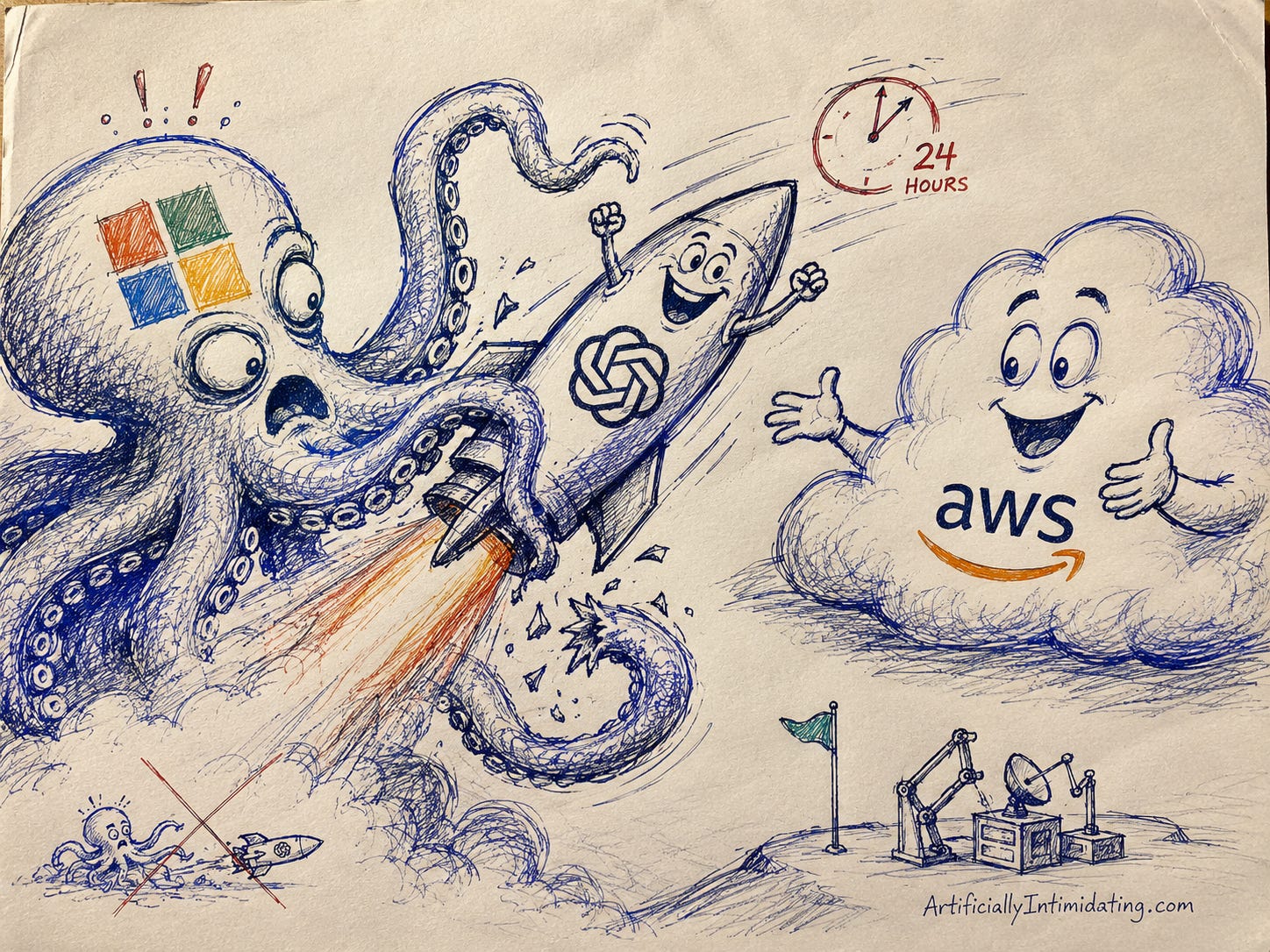
OpenAI Escaped Microsoft’s Orbit. AWS Was Ready in 24 Hours.
Forbes
What happened: OpenAI’s six-year exclusive arrangement with Microsoft formally ended April 27. Within 24 hours, OpenAI models — including GPT-5.5 and GPT-5.4 — appeared on Amazon Bedrock, the result of a deal that had been in motion for six to nine months. Amazon previously agreed to invest up to $35 billion in OpenAI, tied to a requirement that OpenAI deploy two gigawatts of Amazon Trainium accelerators.
Why it matters: Companies on AWS can now access GPT-5.5 without switching cloud providers. For OpenAI, multi-cloud distribution is critical ahead of a potential 2026 IPO — a lab exclusive to one cloud has a far smaller addressable enterprise market than one available everywhere.
What everyone’s saying: The consensus is that AWS comes out ahead — Microsoft keeps its primary relationship, but Amazon gets the wave of enterprise customers who held off because of the Azure requirement. OpenAI wins the most: it’s now available wherever enterprise IT already lives.
My read between the lines: OpenAI was exclusive to Microsoft for six years. It took 24 hours to get on AWS. That’s not a transition — it’s a jailbreak. Microsoft retains technical primacy, but OpenAI is now its own distribution layer, and Azure is one cloud of several. Six years of partner loyalty, dissolved in a business day.
📖 Further reading: Musk Is in Court While Anthropic Uses His Data Center — the same week OpenAI escaped Microsoft’s orbit, Anthropic signed a compute deal with SpaceX. Everybody is racing to lock down infrastructure.

The US Is #21 in AI Adoption. The UAE Is #1.
Microsoft AI Economy Institute
What happened: Microsoft’s AI Economy Institute published its global adoption report: 17.8% of the world’s working-age population now uses generative AI, but the gap between wealthy and developing nations widened by 1.5 points in just six months. The UAE leads at 70.1%, followed by Singapore, Norway, Ireland, and France. The United States — home of ChatGPT, Claude, and Gemini — ranked 21st at 31.3%. China came in at 16.4%.
Why it matters: The country that built the dominant AI models isn’t using them as much as Norway. This gap points to structural inequalities in AI literacy, access, and language coverage that will determine which economies actually capture the productivity gains — and which ones built the engines but missed the race.
What everyone’s saying: The UAE number is getting most of the attention as a headline surprise, but Microsoft identified three root causes for the developing-world gap: inadequate internet infrastructure, lack of digital literacy, and AI models that still underperform in non-European languages.
My read between the lines: America built the engines and ranked 21st in the race. There’s a version of this story where the US catches up — it has the talent, the capital, and the models. There’s another version where the countries with strong digital infrastructure and government adoption incentives stay ahead indefinitely, and America’s lead in building AI doesn’t translate into a lead in benefiting from it.
That’s your AI Brief for Friday. Join the conversation in the Artificially Intimidating community chat.
—Artificially Intimidating