

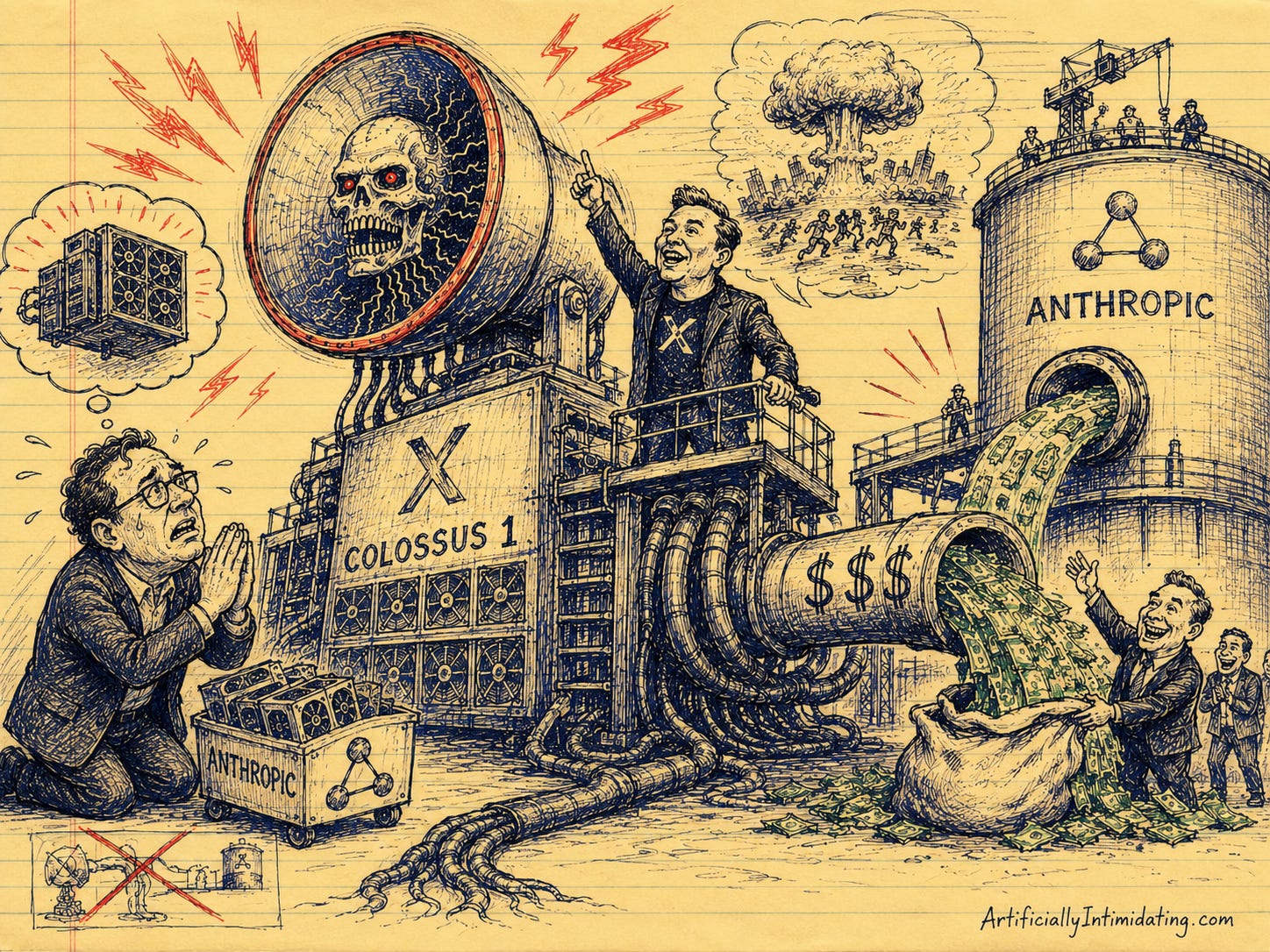
Good day, humans. Elon Musk spent Wednesday testifying that AI could kill us all — while his company cashed a check from Anthropic for use of its data center. Meanwhile, an AI chip maker is IPO-ing on Nasdaq today, the EU is already revising its landmark AI law, and Anthropic's agents got something resembling a sleep cycle. It's one of those days.
📬 Before we dive in: The sharpest AI Brief tips come from readers who are actually in the weeds. If you spot a story worth covering, share it in the community chat. The best tips make tomorrow's edition.
Anthropic Borrowed Elon's Data Center and Doubled Its Limits — Ars Technica
- What happened: Earlier this week we covered Anthropic launching its $1.5B enterprise JV with Goldman and Blackstone — today's the full product story: at its "Code with Claude" developer conference in San Francisco, Anthropic announced a deal to use all of SpaceX's Colossus 1 data center in Memphis — 220,000+ Nvidia GPUs, 300 megawatts of power. Claude Code limits for Pro and Max subscribers doubled immediately, peak-hours reductions were removed, and Opus API limits were raised.
- Why it matters: Compute is the oil of the AI era. By buying out Colossus 1 in one move, Anthropic expanded its capacity without waiting 18 months for its own data centers to come online. If you've ever hit Claude's rate limits, this deal is the direct reason they're going up — right now.
- What everyone's saying: xAI built Colossus 1 at record speed, then moved to Colossus 2 before Colossus 1 was fully occupied — and is now monetizing spare capacity by renting it to a competitor. Some see this as xAI quietly pivoting toward a compute-infrastructure business model. Others see it as extremely pragmatic capitalism.
- My read between the lines: Elon Musk is suing OpenAI for abandoning its safety mission. Simultaneously, his company is cashing rent checks from Anthropic. The AI industry's ability to hold ideological positions and business incentives in the same hand without noticing the contradiction is, at this point, a core competency.
📖 Further reading: Carry Claude Code in Your Pocket — Anthropic just doubled Claude Code's compute headroom; here's how to run it anywhere without a server or a subscription.
You spend all week reading about AI. WisprFlow is the one I actually use. It's voice dictation that works across every app on your Mac — speak, and it writes. No switching, no copying, no friction. If you're still typing everything, this is the upgrade. Try WisprFlow free →
Cerebras Files for $3.5B IPO — Nvidia, Meet Competition — Bloomberg
- What happened: Cerebras Systems, the AI chip startup pitching itself as the alternative to Nvidia, is listing on Nasdaq today at $115–$125 per share — a $3.5B raise targeting a $26.6B valuation. The IPO book is reportedly oversubscribed at roughly $10 billion in orders, more than 2.8x covered.
- Why it matters: Nvidia controls 80%+ of the AI chip market. Cerebras is betting the market is big enough for real challengers — and its wafer-scale chip architecture, which eliminates many of the memory bottlenecks Nvidia's GPU clusters struggle with at scale, is genuine technical differentiation. A strong IPO gives Cerebras runway to take on enterprise contracts Nvidia can't fill.
- What everyone's saying: Wall Street is ravenous for AI infrastructure bets. Blackstone's data center acquisition vehicle is also IPO-ing next week, and Bloomberg reports half a dozen more are in the pipeline. The AI IPO wave has officially started, and 2026 is shaping up to be its biggest year.
- My read between the lines: Cerebras's chip design is legitimately interesting — wafer-scale is real innovation. But a book that's 2.8x oversubscribed, on listing day, during peak AI hype, is also a setup for a painful first year of earnings calls when the company has to justify a $26.6B valuation with actual revenue.
EU Blinks First: The AI Act Gets Rewritten Before It Launches — EU Council
- What happened: The EU Council and Parliament reached a provisional deal today to simplify the AI Act before its strictest provisions even take effect. Key changes: a 16-month extension for high-risk AI rules (medical devices, hiring software, critical infrastructure); extended regulatory exemptions from SMEs to small mid-cap companies; broader allowance to process sensitive data for bias testing; and expanded powers for the EU AI Office. The high-risk rules were due August 2, 2026.
- Why it matters: If you build or use AI in healthcare, hiring, or critical infrastructure in Europe, you just got more runway to comply. More broadly: this signals the EU is willing to adjust its landmark AI law on the fly — a meaningful shift for a regulatory body that usually moves like a glacier.
- What everyone's saying: Supporters say this is smart sequencing — wait for technical standards and enforcement tools to mature before enforcement begins. Critics say Europe caved to industry lobbying right before the finish line. The AI Office getting more power is the least-discussed but potentially most consequential change.
- My read between the lines: The EU wrote the world's most comprehensive AI law, then needed a patch before it went into production. That's not necessarily failure — software ships with bugs too. The real test is whether the AI Office gets actual enforcement power, or whether "simplified and streamlined" is just Brussels-speak for "we're not really doing this yet."
The Musk-OpenAI Trial Has Become a Referendum on AI's Soul — AP News
- What happened: The trial pitting Elon Musk against OpenAI CEO Sam Altman is in its second week in Oakland, and despite the judge's reminder that this is a breach-of-contract case, AI safety fears are dominating. Musk testified for 7+ hours over three days, describing AI as a "double-edged sword" that could "kill us all," and framing the lawsuit as a defense of OpenAI's original nonprofit mission. Altman has not yet testified. A Musk win could derail OpenAI's planned IPO.
- Why it matters: Under oath, some of the most powerful people in AI are being asked whether their technology is dangerous. Whatever the verdict, this testimony will be cited in regulatory hearings, congressional debates, and academic research for years. The stakes aren't just legal — the trial is becoming a public record of how the AI industry thinks about its own risks.
- What everyone's saying: The AI safety community is watching carefully, with expert witnesses on existential risk already having testified. It's also simply the most dramatically entertaining courtroom story in tech in years — the cast of characters (Musk, Altman, Brockman, and a judge who keeps telling them to stop discussing the apocalypse) is extraordinary.
- My read between the lines: Musk testified he built OpenAI as a nonprofit so no single person would control dangerous AI. His company just rented a data center to Anthropic. Altman is defending OpenAI's mission to safely benefit humanity, while rushing toward an IPO. Both of them are right about the dangers of AI. Neither of them should probably be the one deciding what happens next.
Claude Managed Agents Can Now "Dream" — Here's What That Actually Means — Ars Technica
- What happened: Also at the Code with Claude conference, Anthropic introduced "dreaming" for Claude Managed Agents — a scheduled background process where agents analyze recent sessions and extract important patterns into long-term memory for future tasks. It's in research preview and limited to Managed Agents on Claude Platform, Anthropic's hosted multi-agent system for hour-long, multi-step workflows.
- Why it matters: Memory is the missing piece in most AI agents today — they start fresh every session, which means they can't learn from past mistakes or remember context from last week. Dreaming is Anthropic's first attempt to give agents something like persistent experiential learning, improving future task performance without retraining the underlying model.
- What everyone's saying: The name borrows from neuroscience — memory consolidation happens during human sleep, and Anthropic is leaning into that metaphor. Some researchers find it a reasonable analogy; others think it overstates what is essentially a scheduled summarization and indexing job running on a timer. Either way, the memory architecture direction is widely considered significant.
- My read between the lines: Anthropic named their memory system "dreaming," their conference "Code with Claude," and their model "Claude" — a first name, like a person. The anthropomorphization is intentional product strategy. The more your AI feels like a collaborator who remembers your work and learns from experience, the harder it is to switch. Whether that's great UX or a slow-motion lock-in experiment is probably both.
That's your AI Brief for Thursday. Join the conversation in the Artificially Intimidating community chat.
—Artificially Intimidating