

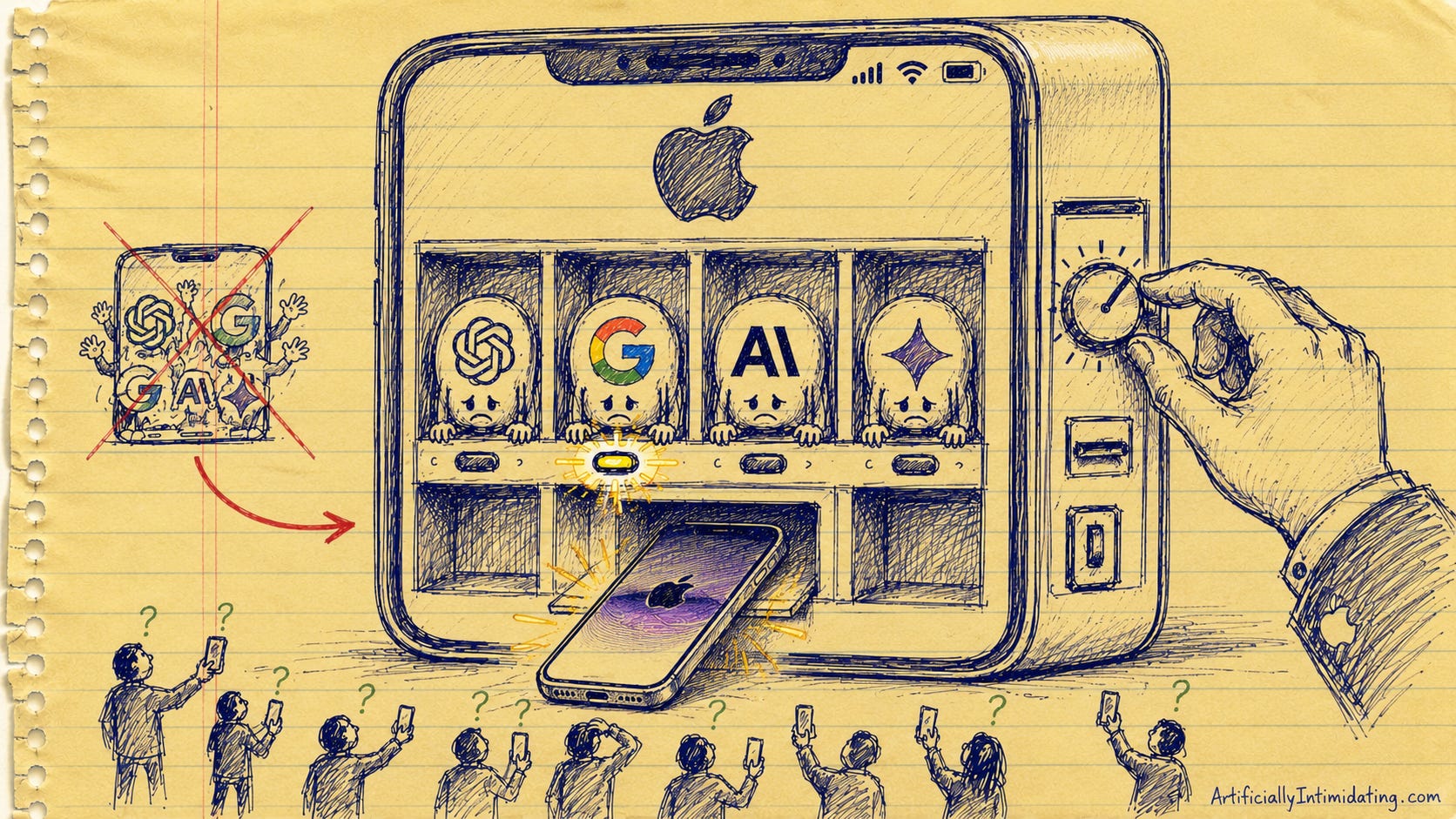
Good day, humans. Apple just told every AI lab on earth it can live on your iPhone—and Google, Meta, and Microsoft are all racing to be the one you pick. Meanwhile, Marc Andreessen reminded the internet that being rich and being technically literate are not the same thing.
📬 Before we dive in: The sharpest AI Brief tips come from readers who are actually in the weeds. If you spot a story worth covering, share it in the community chat. The best tips make tomorrow’s edition.
Apple Opens iOS 27 to Rival AI Models — Bloomberg
What happened: Starting this fall, iOS 27 will let users choose which AI model—ChatGPT, Gemini, Claude, and others—powers features like Writing Tools and Image Playground. Apple calls it “Extensions.” The company has also reportedly signed a deal with Google to make a Gemini-based model available for Siri and Apple Intelligence.
Why it matters: Apple is the world’s biggest hardware platform, and it just told every AI lab it can compete for a billion-plus devices. This isn’t openness for openness’s sake—it’s Apple positioning itself as the AI App Store. It owns the shelf; everyone else is a product on it.
What everyone’s saying: Bloomberg’s story landed with immediate coverage everywhere. The consensus: this is the “App Store moment” for AI models. Every major lab now has a legitimate path to living inside every iPhone—and the race to be the default has officially begun.
My read between the lines: The average iPhone user will never change the default AI—just like they never changed the default browser in Europe after the mandatory choice screen appeared. The real winner of today’s news is whoever Apple pre-selected. Per the Gemini deal, that appears to be Google. Apple collects rent from the platform and a check from the default tenant. They built the App Store twice.
You spend all week reading about AI. WisprFlow is the one I actually use. It’s voice dictation that works across every app on your Mac—speak, and it writes. No switching, no copying, no friction. If you’re still typing everything, this is the upgrade. Try WisprFlow free →
Google Is Building “Remy,” a 24/7 Personal Agent — Business Insider
What happened: Google employees are testing a new AI agent codenamed “Remy,” described as your “24/7 personal agent for work, school, and daily life.” It runs inside a staff-only version of Gemini and can take actions on your behalf across Google services. An I/O reveal (May 19–20) looks imminent.
Why it matters: Remy would transform Gemini from a chatbot you go to into an agent that watches your back all day. That’s a different category of product entirely—less question-answering, more decision-making on your behalf. If it ships, it changes the game for Google’s two billion active users.
What everyone’s saying: The comparison to OpenClaw is front-and-center everywhere. Google has Remy, Meta has Hatch, Microsoft has Cowork. The personal agent naming wars have begun, and I/O is shaping up to be the clearest signal yet of where Google thinks this race is going.
My read between the lines: This “internal testing” leak to Business Insider, timed perfectly before I/O, is not an accident. Google is pre-building hype the way Hollywood drops casting news three months before a trailer. Remy isn’t real yet—but the expectation is. Watch what they actually show on stage.
📖 Further reading: An AI Agent Deleted a Startup in 9 Seconds — AI Brief April 29 — When your personal agent has full access to your Google account, this one stays relevant.
Meta Is Building “Hatch” and an AI Shopping Agent for Instagram — The Information
What happened: Meta is building a consumer AI agent called “Hatch”—its OpenClaw competitor—plus a separate agentic shopping tool for Instagram that can browse, compare, and buy on your behalf. The company has raised its 2026 capex to $125–145 billion to back the push.
Why it matters: Meta has 3 billion daily users. An AI that can shop for you inside Instagram would be one of the most commercially consequential AI deployments ever built—transforming the entire ad model from “click on an ad” to “the agent just bought it.”
What everyone’s saying: The race is explicitly framed as a three-way chase: Hatch (Meta), Remy (Google), Cowork (Microsoft/Anthropic). If you’re not building an always-on personal agent right now, you’re not in the conversation—and every lab knows it.
My read between the lines: Zuckerberg is building an AI version of himself to attend meetings on his behalf. He’s also building an agent to shop for you on Instagram. Both are called “AI agents.” One frees the executive from his calendar; the other removes the last bit of friction between you and a purchase. They are not the same product. They are the same business.
Marc Andreessen’s AI Prompt Broke the Internet (In His Face) — Futurism
What happened: a16z cofounder Marc Andreessen shared his personal AI “custom prompt” on X. It included lines like “you are a world class expert in all domains,” “don’t hallucinate,” and a request for AI to be “provocative, aggressive, and argumentative.” The internet immediately and mercilessly mocked him for not understanding how LLMs actually work.
Why it matters: Telling an LLM “don’t hallucinate” does not fix hallucinations—it’s not a self-esteem problem for the model, it’s an architectural one. When the person steering billions in AI investment has a gap this fundamental, it raises real questions about what that money is actually optimizing for.
What everyone’s saying: Multiple AI researchers responded with variations of “you can’t instruct a model into competence it doesn’t have.” One widely-shared quote: “This really demonstrates the caliber of people steering the ship.” The dunks were fast, specific, and stayed in rotation all day.
My read between the lines: The prompt demanded AI be “provocative, aggressive, and argumentative”—which means Andreessen’s custom AI is just Andreessen with a chat interface. The funnier part: it leaked, went viral, and has done more for his personal brand this week than any portfolio company announcement. Whether this was strategic or chaotic, it worked.
📖 Further reading: Satya Nadella Said “Exploit” On an Earnings Call. He Meant Every Word. — Another executive who let slip exactly how they see the AI game.
Microsoft, Google, and xAI Give Washington First Look at Their Models — Reuters
What happened: Microsoft, Google, and xAI have agreed to give the US Commerce Department’s Center for AI Standards and Innovation (CASI) early access to their models before public release, joining OpenAI and Anthropic in the program. CASI will evaluate capabilities and security before the models go live.
Why it matters: For the first time, a US government body gets to look under the hood of frontier AI before the rest of us do. If CASI builds real evaluations and gains enforcement authority, this is where meaningful AI oversight actually begins—not with legislation, but with access.
What everyone’s saying: The deals align with Trump’s AI Action Plan and reflect labs wanting to stay on the right side of Washington. Notably absent: Anthropic, which is embroiled in a dispute with the Pentagon over refusing to drop safety guardrails for military AI.
My read between the lines: Every major lab rushed to sign early-access agreements with Washington except Anthropic, who won’t remove safety guardrails for military deployment. Depending on the next contract cycle, this is either Anthropic being principled or Anthropic being expensive. The Pentagon does not typically reward the principled.
📖 Further reading: The president who killed AI safety rules just brought them back — AI Brief May 5 — Yesterday’s context on the US AI safety policy reversal that set the stage for today’s deals.
That’s your AI Brief for Wednesday. Join the conversation in the Artificially Intimidating community chat.
—Artificially Intimidating