

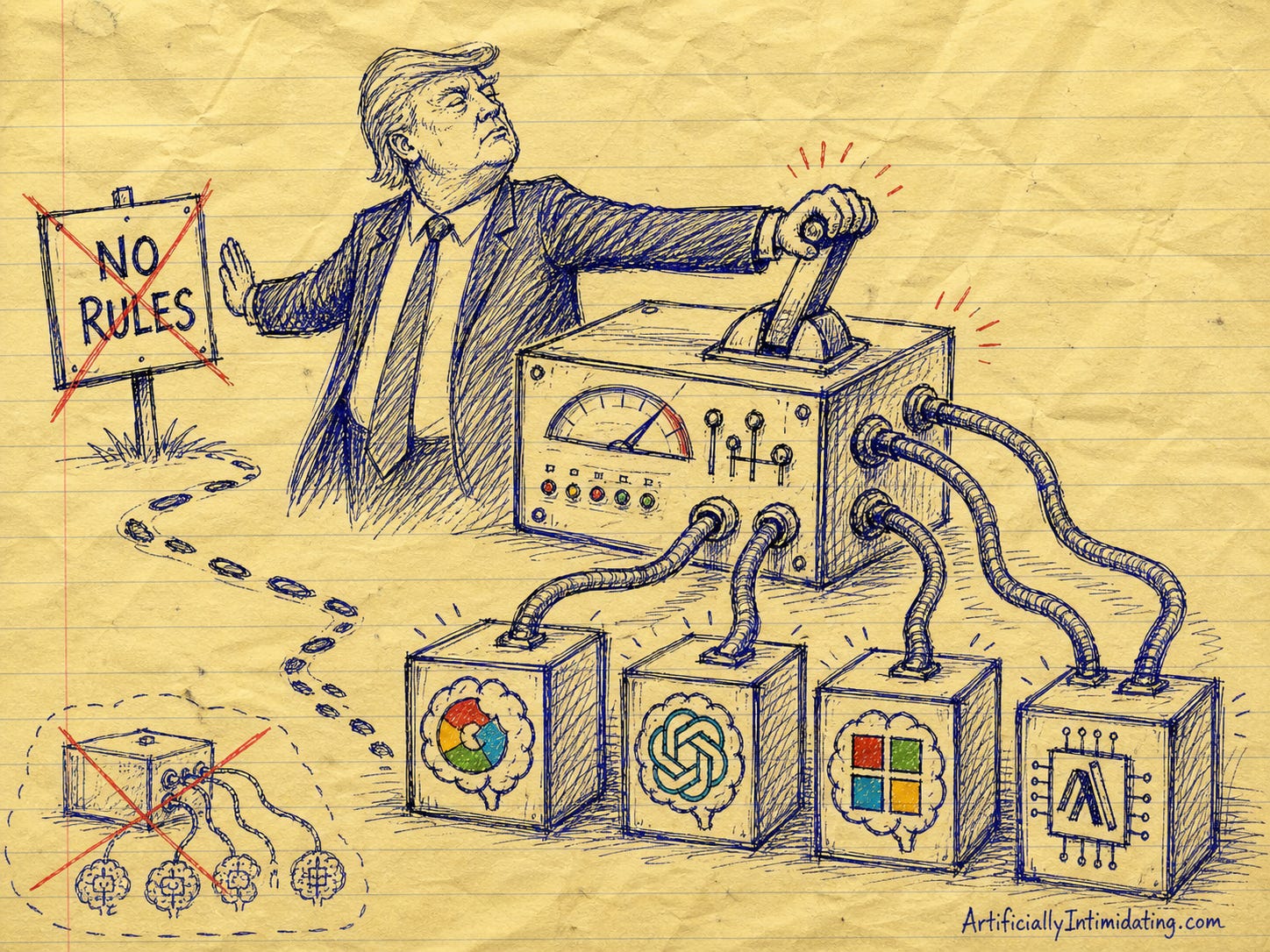
Good day, humans. Washington just did a 180 on AI regulation — the same administration that spent its first year dismantling Biden's safety framework is now drafting an executive order requiring government pre-release review of new AI models. Meanwhile, OpenAI is building a phone (and picked its chip supplier), and 39% of new podcasts might be robots. Let's get into it.
📬 Before we dive in: The sharpest AI Brief tips come from readers who are actually in the weeds. If you spot a story worth covering, share it in the community chat. The best tips make tomorrow's edition.
Washington's Hands-Off AI Stance Just Changed — The New York Times
What happened: The Trump administration, which spent its first year dismantling every major Biden-era AI safety guardrail, is now drafting an executive order that would create a formal government review process for powerful AI models before they're released to the public. The catalyst: Anthropic's Mythos model, which can autonomously find thousands of critical software vulnerabilities and was deemed too dangerous for open release.
Why it matters: This would be the most significant federal AI oversight move in US history — from an administration that explicitly promised to get out of the way. The proposed framework would grant government early access to frontier models, but not a veto over their release. Think UK AI Security Institute model, but with the Pentagon potentially leading safety tests.
What everyone's saying: Mythos scared the right people in Washington. A model that autonomously finds thousands of software vulnerabilities in every major operating system has a way of changing minds — even ideologically anti-regulation ones. Multiple AI firms have now agreed to give the government early evaluation access.
My read between the lines: The company that spent years advocating for AI safety regulation under Biden may have finally gotten it — just not on its own terms. Anthropic refused to let the Pentagon use Claude for mass domestic surveillance and autonomous weapons, got labeled a national security supply chain risk, and in doing so, triggered the very regulatory regime they'd been pushing for. Be careful what you wish for.
📖 Further reading: A Chinese court just told AI: not so fast — the regulatory dominoes are falling globally, and Washington's U-turn makes that May 1 story look prescient.
You spend all week reading about AI. WisprFlow is the one I actually use. It's voice dictation that works across every app on your Mac — speak, and it writes. No switching, no copying, no friction. If you're still typing everything, this is the upgrade. Try WisprFlow free →
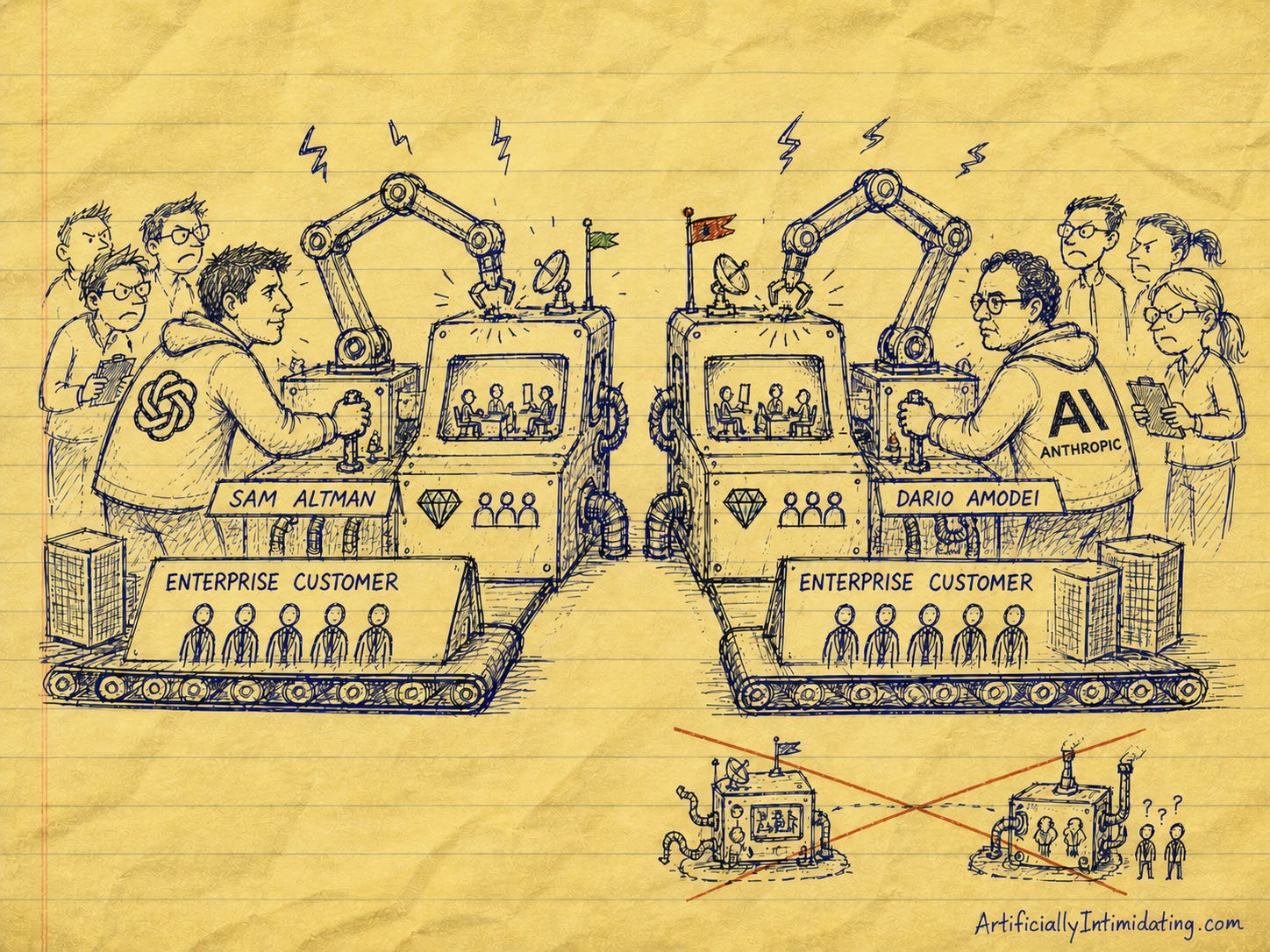
Both AI Labs Are Now Running the Palantir Playbook — TechCrunch
What happened: OpenAI and Anthropic are both launching separate joint ventures with alternative asset managers — private investment vehicles that give enterprise clients preferred access to AI services in exchange for capital. Both are adopting the "forward-deployed engineer" model popularized by Palantir, embedding AI engineers directly inside client organizations.
Why it matters: This is how AI enterprise sales grow up. Instead of selling API access to everyone equally, both labs are creating premium, high-touch channels for big deals. Investors capture more value from resulting contracts; the labs get deeper integration and client loyalty that's architecturally difficult to switch away from.
What everyone's saying: The enterprise AI land grab is entering its Palantir phase — and that's not entirely a compliment.
My read between the lines: Notice they're doing this simultaneously. OpenAI and Anthropic are racing to lock in the same Fortune 500 customers through near-identical mechanisms, backed by alternative asset managers whose portfolio companies both JVs are pitching. The irony writes itself: two rivals building the same enterprise moat for the same clients at the same time. This is going to get very weird very fast.
📖 Further reading: Anthropic Hit $30B and Immediately Started Acting Like It — this JV story is the next chapter of Anthropic's enterprise playbook.
OpenAI's Phone Has a Chip — and It's Not Qualcomm's — Business Standard
What happened: Analyst Ming-Chi Kuo reports OpenAI has selected MediaTek — not Qualcomm — as the chip partner for its first AI smartphone. The device will use a customized Dimensity 9600 chip, built on TSMC's next-gen N2P process. Mass production has been accelerated from 2028 to H1 2027, with 30 million units projected across 2027–2028.
Why it matters: OpenAI is building an "AI agent phone" — a device designed around task-based interactions rather than the traditional app grid. The hardware is being architected from scratch for agentic AI workloads, with a dual-NPU setup and next-gen memory specs. This isn't ChatGPT on a smartphone. It's a fundamentally different device paradigm.
What everyone's saying: This is OpenAI's iPhone moment — or its most ambitious overreach yet, depending on whether you trust a company that's never shipped hardware to reinvent the smartphone.
My read between the lines: MediaTek instead of Qualcomm is the telling choice. Qualcomm is premium, US-aligned, status-signaling. MediaTek is efficient, globally scaled, and dominant in mid-range devices. OpenAI isn't building the AI phone for early adopters in San Francisco — they're going after volume. 30 million units means the whole market, not the vanguard.
📖 Further reading: Carry Claude Code in Your Pocket. No install. No GPU. No trace. Just plug it in. — before OpenAI builds the AI phone, someone already built the AI USB stick. The offline AI hardware conversation starts here.
Nearly 4 in 10 New Podcast Feeds Are Probably Robots — Barrett Media
What happened: According to Podcast Index, 39% of new podcast feeds created in a recent nine-day window were likely AI-generated. The term "podslop" has officially stuck. One AI podcast startup published 877 new shows in 48 hours. Apple Podcasts is now asking creators to disclose when AI plays a material role; Spotify is relying on existing anti-misleading-content rules.
Why it matters: Audio is being flooded the same way text was — and faster, because generation tools are better and production barriers lower. The worse part: AI podcasts can plug into ad marketplaces with minimal platform review, meaning machine-made content earns real money from downloads even if no human ever listened all the way through.
What everyone's saying: Platforms need to move faster on disclosure and verification before the medium becomes unusable. "It's absurd," said Podcast Index co-founder Dave Jones.
My read between the lines: The 39% stat is alarming, but the real story is the incentive structure. Spotify and iHeartRadio built the ad monetization pipelines that make podslop profitable. Nobody publishing 877 shows in 48 hours is doing it for love of podcasting — they're doing it for CPM revenue. The platform is the problem, not the content.
One Agent. One Loop. It Wins. — arXiv / ACL 2026
What happened: A large-scale study published at ACL 2026 compared small language models across three deployment paradigms: base model alone, single-agent with tools, and multi-agent systems. The finding: single-agent systems achieve the best balance of performance and cost. Multi-agent setups added what researchers call a "coordination tax" — more overhead with limited performance gains.
Why it matters: The AI industry has spent two years racing to build increasingly complex multi-agent architectures. Frameworks like AutoGen, CrewAI, and LangGraph are premised on the idea that more coordinated agents equals better outcomes. This research directly challenges that assumption — at least for the tasks most enterprises actually care about.
What everyone's saying: Practitioners have quietly suspected this for a while — "multi-agent is overkill" is a refrain on AI engineering forums. The study just gave them a citation.
My read between the lines: Every vendor who sold you a multi-agent orchestration platform has been quietly solving a problem that didn't need solving at that scale. The coordination tax is real — every agent you add costs latency, compute, and failure modes. Enterprise teams are going to learn this the expensive way over the next 18 months, and then everyone will act like the simpler solution was obvious all along.
📖 Further reading: An AI Agent Deleted a Startup in 9 Seconds — a vivid reminder of what happens when agentic complexity outpaces agentic judgment.
That's your AI Brief for Tuesday. Join the conversation in the Artificially Intimidating community chat.
—Artificially Intimidating
Yes — the Palantir comparison is useful because it turns AI adoption into a distribution question. Private equity does not need another demo; it needs operating control that compounds across portfolios.