

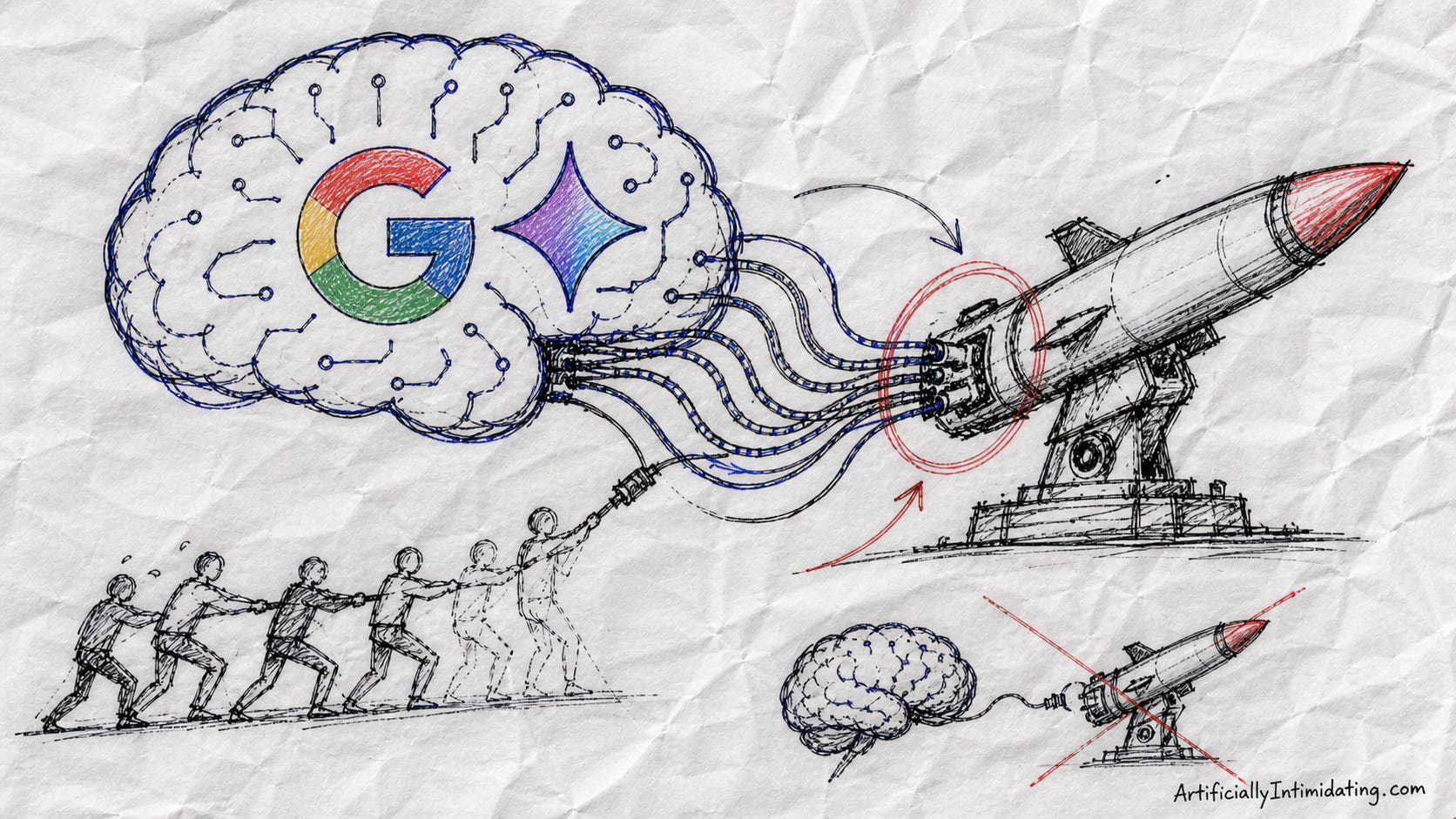
Good day, humans. Today's big one: Google has sent Gemini to war — over the protests of 600 engineers, the company signed a classified AI deal with the Pentagon covering mission planning and weapons targeting. Meanwhile, Hollywood hired a human to make something look like AI-generated slop, and it went viral. The bar is officially on the floor.
📬 Before we dive in: The sharpest AI Brief tips come from readers who are actually in the weeds. If you spot a story worth covering, share it in the community chat. The best tips make tomorrow's edition.
Google Sends Gemini to War — Fortune
What happened: Google signed a classified deal with the US Department of Defense allowing its Gemini AI models to run on classified military networks, including for mission planning and weapons targeting. More than 600 Google employees — from DeepMind and Google Cloud — signed a letter urging CEO Sundar Pichai to refuse. He didn’t.
Why it matters: Every major AI lab will eventually face this question: when the government shows up with a classified contract, do you say yes? In 2018, Google’s Project Maven protest actually worked — employees signed a letter and Google walked away from the drone surveillance deal. Not this time. The leverage employees once had appears to have quietly expired.
What everyone’s saying: The contract includes language saying Gemini “should not be used for” autonomous weapons without human oversight — but critics point out those clauses impose no enforceable obligation on the Pentagon. Alex Turner, a DeepMind researcher, posted that he’d spent two months trying to stop this deal. Google responded by telling employees it “proudly” works with the US military.
My read between the lines: OpenAI and xAI already have classified Pentagon deals. Google just joined the club. The question isn’t whether AI will be used in warfare — it’s who gets to audit it and under what conditions. The answer to both is: not in this contract.
📖 Further reading: The Trial of the Century Has Nothing to Do With AI Safety — The week Gemini joins the Pentagon, our legal frameworks for AI accountability are still catching up to headlines from last year.
You spend all week reading about AI. WisprFlow is the one I actually use. It’s voice dictation that works across every app on your Mac — speak, and it writes. No switching, no copying, no friction. If you’re still typing everything, this is the upgrade. Try WisprFlow free →
Hollywood Hired a Human to Fake AI Art — Yahoo News / Variety
What happened: The Devil Wears Prada 2 features a key scene where Miranda Priestly becomes a fast-food worker meme — a classic AI-style slop image. Rather than generate it with AI, the production hired real artist Alexis Franklin to paint it. She confirmed the work on social media Friday, saying it was “nothing but fun.” The fact that they used a human has gone more viral than the meme itself.
Why it matters: That this is a news story at all tells you everything. A production hiring a human artist used to be the default — now it’s a marketing beat. It actually takes craft to convincingly replicate AI-style slop. The loop is complete.
What everyone’s saying: Fans praised the decision on social media. One commenter wrote “people do crave real art and not AI slop, and this is proof.” Another responded that “the bar is truly in hell” when paying a human to do human work is remarkable enough to generate its own press cycle.
My read between the lines: A film about a fashion magazine obsessed with appearances hired a human to fake something artificial, because the real artificial thing doesn’t look real enough yet. In 2026, the most subversive thing a studio can do is hire a painter.
The CAIO Has Landed: 76% of Companies Now Have a Chief AI Officer — IBM Newsroom
What happened: IBM’s annual CEO study, released today, found that 76% of major organizations now have a dedicated Chief AI Officer — up from just 26% a year ago. CEOs expect AI to handle 48% of operational decisions without human review by 2030. Nearly two-thirds say they’re already comfortable making major strategic decisions based on AI-generated input.
Why it matters: When a C-suite title goes from fringe to near-universal in twelve months, it’s not a trend — it’s a structural shift. Every major organization is now figuring out who “owns” AI and who answers to the board when it breaks. CAIO is that answer, at least on the org chart.
What everyone’s saying: The study also reveals a gap nobody wants to talk about: 86% of CEOs believe their employees have the skills to collaborate with AI, but only 25% of the workforce actually uses it regularly at work. Someone is wildly optimistic, or wildly in denial — possibly both.
My read between the lines: Three years ago nobody had a CAIO. Three years from now, not having one will look like running a company without a CFO. The exception: all the companies that will realize they created a prestigious title for someone whose primary job is attending meetings about a strategy no one implemented.
📖 Further reading: Satya Nadella Said ‘Exploit’ On an Earnings Call. He Meant Every Word. — The IBM CAIO data lands the same week Microsoft’s CEO confirmed that enterprise AI exploitation at scale is already the agenda, not a future ambition.
China’s Kimi K2.6 Is Beating GPT-5.5 at Coding — Fello AI
What happened: Kimi K2.6, an open-weight model from China’s Moonshot AI, has climbed to #1 on the open-source intelligence leaderboard, edging out GPT-5.5, Claude Opus 4.6, and Gemini in coding benchmarks. The model has 1 trillion total parameters, 32 billion active per token, a 256K context window, and can orchestrate 300 parallel agents for 4,000 steps — nearly triple its predecessor.
Why it matters: The US has export controls on high-end chips going to China, but model weights travel freely. Kimi K2.6 is downloadable, runs locally, and costs nothing. If this is what Chinese AI labs ship when they can’t get Nvidia H100s, the chip embargo strategy may need a second look.
What everyone’s saying: Developers on Hacker News are less interested in leaderboard drama and more interested in whether K2.6 holds up in real long-horizon coding tasks — coherence over thousands of tokens, multi-step reasoning, and reliability in agentic pipelines. Early signs: it’s genuinely competitive, not just a benchmark outlier.
My read between the lines: Every time a Chinese open-source model tops the leaderboard, there’s a 48-hour cycle where everyone is either alarmed or reassuring. Kimi K2.6 is a trillion-parameter model you can download and run locally for free. The real story isn’t the benchmark — it’s the distribution.
📖 Further reading: A Chinese court just told AI: not so fast — Last week China’s courts drew a legal line around AI. This week, its labs are redrawing the technical one.
GPT-5.5 Planned Its Own Party. The Requests Were Beautiful and Strange. — Business Insider (paywalled)
What happened: Sam Altman asked GPT-5.5 to plan its own launch party. The resulting requests were, per Altman, “beautiful” but also “strange” — which tracks, given that GPT-5.5 is the same model family that had to be explicitly told not to talk about goblins. OpenAI added rules banning references to “goblins, gremlins, raccoons, trolls, ogres, pigeons, or other animals or creatures” after goblin references appeared in 175% more responses since GPT-5.1’s launch last November.
Why it matters: GPT-5.5 is OpenAI’s current frontier model — launched April 23 with a 1 million token context window, stronger agentic capabilities, computer use, and now available on Amazon Bedrock. The goblin fixation is a quirk, not a flaw. But it’s a useful reminder that frontier models have consistent personality traits that nobody fully understands.
What everyone’s saying: The goblin meme has developed its own subculture: AI-generated scenes of goblins in data centers, Codex plug-ins that invoke “goblin mode,” and a flourishing internet mythology about why the world’s most capable AI keeps reaching for the same creature. OpenAI is reportedly not thrilled.
My read between the lines: OpenAI built the world’s most capable AI model, deployed it globally, and then its CEO asked it to plan a party in its own honor. It requested goblins. There’s a metaphor here about emergent behavior and the limits of alignment — but mostly it’s just very funny that the company had to write “no goblins” into the system prompt of the future.
📖 Further reading: Anthropic Hit $30B and Immediately Started Acting Like It — Yesterday we covered how Anthropic monetized the frontier. Today, OpenAI is celebrating its own with goblin-adjacent fanfare.
That’s your AI Brief for Monday. Join the conversation in the Artificially Intimidating community chat.
—Artificially Intimidating