

Good day, humans. Yesterday Anthropic closed a $65 billion funding round. Today OpenAI's entire platform went offline. Meanwhile, hackers figured out how to use ChatGPT's own share links against its users, Amazon killed an AI leaderboard after employees gamed it into the ground, and Meta is preparing an AI pendant while absorbing $80 billion in hardware losses. Saturday, apparently.
📬 Before we dive in: The sharpest AI Brief tips come from readers who are actually in the weeds. If you spot a story worth covering, share it in the community chat. The best tips make tomorrow's edition.
ChatGPT Went Dark the Day After Anthropic Raised $65B — AI Weekly
What happened: Yesterday Anthropic closed a $65 billion round — today OpenAI's entire platform went offline simultaneously. ChatGPT, the API, DALL-E, Codex, Sora, and login systems all failed at once on Friday, May 29, generating over 5,000 Downdetector reports worldwide. OpenAI confirmed two simultaneous incidents — login failures and conversation failures — before declaring full recovery Friday afternoon. No root cause has been disclosed.
Why it matters: Six separate product surfaces failing simultaneously suggests a shared infrastructure dependency — not isolated bugs. For enterprises evaluating AI providers for mission-critical workloads, reliability is becoming the decisive factor. OpenAI's platform has logged 117 tracked outages since October 2025. 99.98% uptime sounds great until it's your pipeline that's down.
What everyone's saying: The timing is being noted widely. Enterprise buyers weighing AI providers immediately flagged the contrast: one day after Anthropic's funding announcement and model launch, OpenAI's entire stack went dark. Reliability is now a competitive differentiator, not a baseline assumption.
My read between the lines: When ChatGPT, Codex, Sora, the API, DALL-E, and login all fail at the same time, it means whatever they share — infrastructure, auth, load balancing — failed at scale. OpenAI hasn't said what that dependency is. There's no such thing as '99.98% uptime' from the perspective of the person whose board demo was scheduled for Friday afternoon.
📖 Further reading: Anthropic Raises $65B, Mythos Goes Public, and the Internet Has a Tell — Yesterday's brief has the full story on what Anthropic announced the day before the outage.

Hackers Weaponized ChatGPT's Own Share Feature to Deliver Malware — Malwarebytes
What happened: Researchers at Push Security disclosed Thursday that threat actors are hosting fake outage pages directly on chatgpt.com using ChatGPT's own share-link feature — a technique dubbed "LLMShare." The attack works by rendering custom HTML through a ChatGPT prompt and publishing it as a shareable conversation. Visitors see a fake notice saying ChatGPT is down, click to download, and receive credential-stealing malware on Windows or Odyssey Stealer on macOS — which targets passwords, cookies, Telegram sessions, and crypto wallets.
Why it matters: The malicious page lives at a real chatgpt.com URL — not a lookalike domain. Standard browser warnings and URL-checking provide zero protection because the domain is genuinely OpenAI's. Google ads amplify delivery by targeting users who search for 'ChatGPT.' The trust exploit is the entire attack.
What everyone's saying: Push Security flagged this as part of a growing pattern: earlier this year, attackers used shared Claude.ai conversations in ClickFix-style attacks, and shared Grok conversations distributed AMOS infostealer to macOS users. AI platforms' sharing infrastructure is becoming a dedicated phishing surface — and every platform that offers share-link features is affected.
My read between the lines: ChatGPT's HTML rendering and share features work as intended — the attackers just also intended to use them. Every feature that makes AI tools more powerful also makes them a better attack surface. The fix is probably hard because 'render rich content and share a link' is a core product feature, not a bug. OpenAI's security team is going to be having a very long weekend.
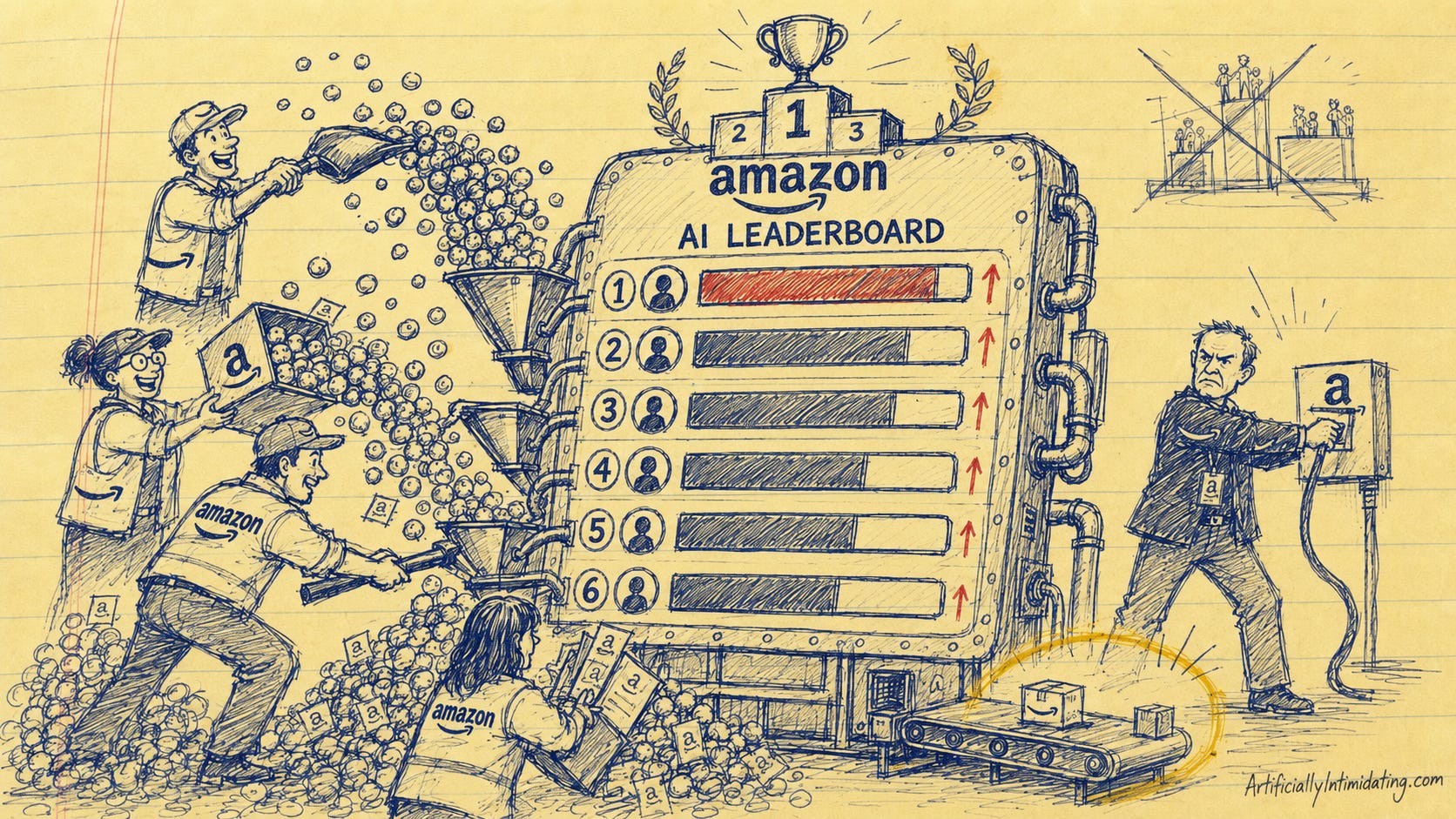
Amazon Killed Its AI Leaderboard After Employees Gamed It Into the Ground — Financial Times
What happened: Amazon deprecated its internal "KiroRank" dashboard — which ranked employees by AI token consumption to encourage adoption of its Kiro coding tool — after workers began inflating their usage on trivial tasks to climb the rankings. Senior VP Dave Treadwell told staff to stop using AI "just for the sake of using AI." Amazon replaced KiroRank with a "normalised deployments" metric. Meta faced the same problem: its "Claudeonomics" leaderboard tracked 85,000 employees consuming 60 trillion tokens in 30 days before it was also shut down.
Why it matters: You cannot measure meaningful AI adoption by counting how much of it there is. When companies reward token consumption, they get token consumption — not productivity. Amazon and Meta independently invented the same broken incentive, and independently had to kill it. This is an industry-wide problem waiting to be repeated at every company that ties AI usage to performance reviews.
What everyone's saying: D.A. Davidson's Gil Luria framed it plainly: "You get the behavior that you create the incentive for. So if you tell people they'll succeed if they use a resource more, of course they'll use it more." Amazon's replacement metric — "normalised deployments" — will face the same problem unless it measures outcomes, not inputs.
My read between the lines: 60 trillion tokens in 30 days at Meta is not an adoption success story. It's a fire drill. The fact that two of the world's largest tech companies independently built the same broken metric — and independently had senior VPs send all-hands memos to kill it — suggests this is a pattern, not an exception. Watch for the same story to surface at Microsoft, Google, and Salesforce over the next 90 days.
📖 Further reading: Enterprises Are Hitting the AI ROI Wall Hard — Yesterday we covered the broader enterprise AI reckoning. Amazon and Meta just provided the most concrete examples of exactly what that looks like in practice.
Meta Is Building an AI Pendant While Bleeding $80B From Its Hardware Bet — Channel NewsAsia
What happened: Meta plans to test an AI-powered pendant within the next year and launch "Wearables for Work," a business-focused wearables service, according to an internal memo reported by The Information. The pendant builds on Meta's December 2025 acquisition of Limitless (formerly Rewind). Internal targets: 10 million wearable device sales in H2 2026, 6.8 million monthly active wearable users by year-end. Reality Labs — Meta's hardware division — has lost $80 billion cumulatively since 2020.
Why it matters: The pendant category has a graveyard: Humane's AI Pin collapsed, Limitless ceased hardware sales after Meta acquired it. Meta is betting that embedding pendant-like capabilities inside a broader ecosystem — glasses, watches, and enterprise services — survives where standalone devices haven't. Its Ray-Ban smart glasses hold ~82% of the smart glasses market, which is the only hardware bet in this category that's actually working.
What everyone's saying: The crowding is notable: Apple is reportedly developing its own AI pendant for 2027, Google launched AI glasses at I/O 2026, and Meta is targeting 10M units this year. Every major tech company is making the same hardware bet in the same window. The analyst firm Omdia projects the AI glasses market will exceed 10M units globally in 2026 — the entire market, not just one company.
My read between the lines: "Wearables for Work" is the tell. Meta is trying to find the AI hardware use case that sticks by selling it to companies with procurement budgets rather than consumers who have to justify the purchase themselves. Consumer hardware fails on vibes. Enterprise hardware fails on ROI. Both are hard problems — but at least enterprise hardware gets another quarter of runway before the write-down.
📖 Further reading: I ignored Hermes for two months. Here's what I actually found. — Before Meta's pendant exists, here's what it's actually like to use an always-on AI assistant in your daily life. The magic is messier than the demos suggest.
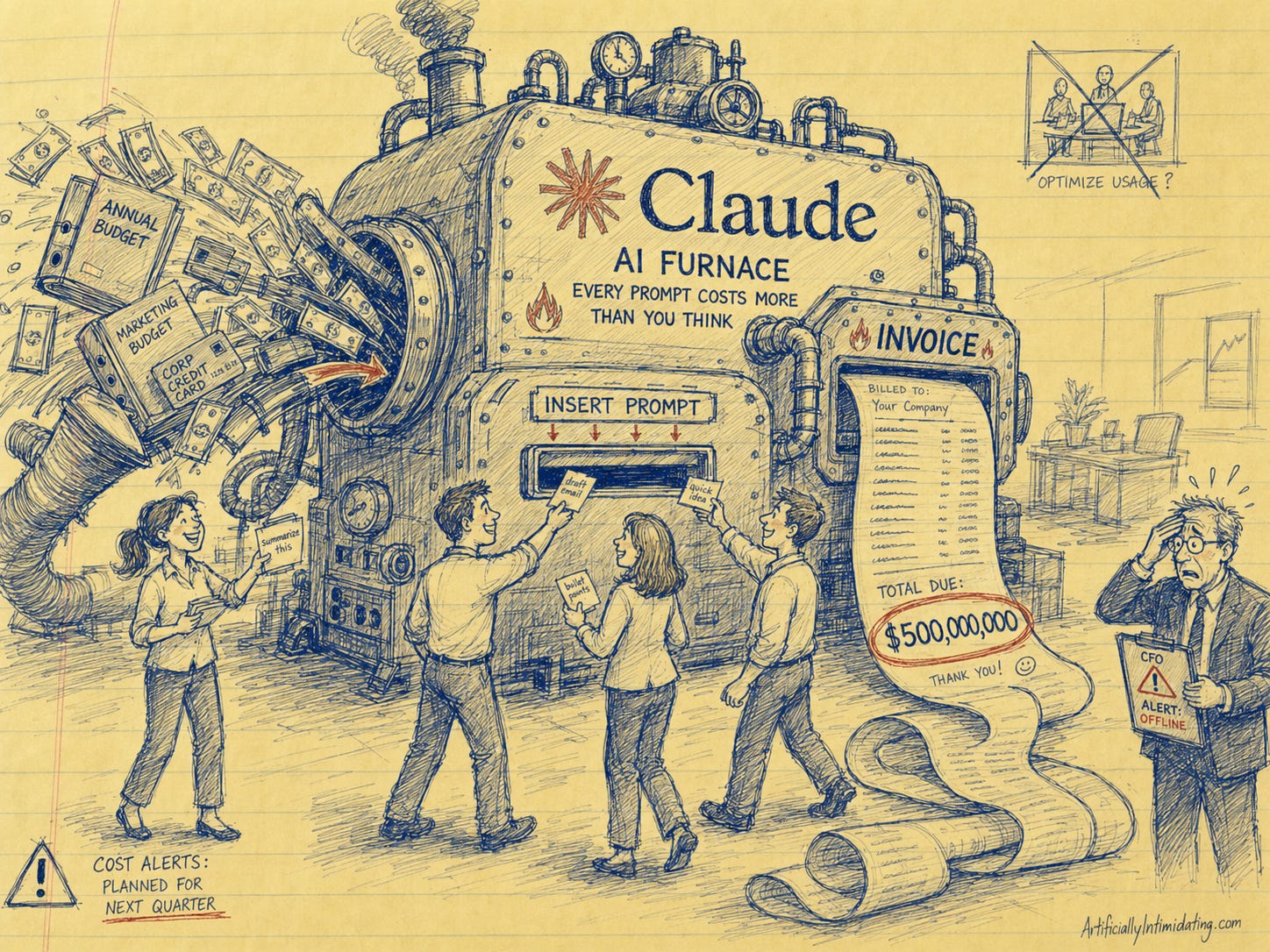
One Company Accidentally Spent $500M on Claude in 30 Days — Live Mint
What happened: An AI consultant disclosed to Axios that one of their enterprise clients burned through more than $500 million on Anthropic's Claude in a single month — after giving thousands of employees unrestricted API access with no spending caps, no per-user limits, and no cost alerts. Workers gravitated toward agentic pipelines, which can consume up to 1,000 times more tokens than standard chatbot interactions. No one noticed until the invoice arrived.
Why it matters: This is the worst-case enterprise AI governance failure, made specific. Agentic workflows running at scale without cost controls don't just overspend — they overspend exponentially. Standard cloud cost management practices (budgets, alerts, per-user caps) that every enterprise applies to AWS and Azure haven't been applied to AI APIs. The $500M bill is extreme, but the failure mode is common.
What everyone's saying: Gartner forecasts AI spending reaching $2.59 trillion in 2026 — up 47% — while 80-85% of enterprises miss their AI infrastructure forecasts by more than 25%. The $500M bill is extreme, but the pattern is consistent: companies deploying AI at scale without real-time cost monitoring are systematically underestimating what it costs.
My read between the lines: At $500M in 30 days, this unnamed enterprise is either a very large bank or a defense contractor — the kind of organization that has the budget to make this mistake and the lawyers to keep the name out of the press. The fact that their consultant disclosed it publicly suggests the client paid, moved on, and the lesson is being shared quietly through the consulting world. Loudly in Axios, apparently.
📖 Further reading: Big Tech Is Paying Itself to Build AI. The Numbers Are Wild. — We covered the AI capex surge four days ago. This story is what happens when that spending hits the enterprise floor with no guardrails.
That's your AI Brief for Saturday. Join the conversation in the Artificially Intimidating community chat.
—Artificially Intimidating