

Good day, humans. Anthropic raised $65 billion at a $900 billion valuation, launched a new model, and announced its most dangerous AI is going public — all before lunch. Apple leaked its entire Siri redesign a week before WWDC. And somewhere in corporate America, a CFO just sent a very angry email about AI token spend. Let's go.
📬 Before we dive in: The sharpest AI Brief tips come from readers who are actually in the weeds. If you spot a story worth covering, share it in the community chat. The best tips make tomorrow's edition.
Anthropic Raises $65B, Unlocks Mythos for Everyone — TechCrunch
What happened: Yesterday we called it "an Anthropic secret model finds 23,000 bugs" — today's the full story. Anthropic announced a $65 billion raise at a $900 billion valuation — surpassing OpenAI as the most valued AI startup — and revealed that Claude Mythos will be released to all customers within weeks. The company also launched Opus 4.8 with Dynamic Workflows, a feature that lets a single task spawn hundreds of parallel subagents for codebase-scale migrations.
Why it matters: Mythos was restricted to ~50 cybersecurity organizations precisely because of its ability to autonomously find and exploit vulnerabilities. Moving from "broadly available in 6–12 months" to "within weeks" is a dramatic shift — it means Anthropic believes it has solved (or is close to solving) the safety guardrails that kept it locked down. A $900 billion valuation means this is no longer an underdog story.
What everyone's saying: The funding news is being read alongside Mythos's public release as a single strategic message: Anthropic is ready to compete for enterprise dominance, not just earn safety points. Opus 4.8's claim of running "codebase-scale migrations across hundreds of thousands of lines of code" is getting separate attention from engineering teams already using Claude Code.
My read between the lines: Anthropic built its brand on being the responsible, safety-first alternative to OpenAI. At a $900B valuation, investors are expecting returns that make the nonprofit framing very hard to maintain. You can't be a mission-driven safety lab when the market is pricing you like the next Google.
📖 Further reading: AI Caught Ghostwriting the Pope's Encyclical — AI Brief May 28 — Yesterday we covered where Mythos started: 23,000 vulnerabilities and a hacker filing a concession speech. Today it goes public.
You spend all week reading about AI. Viktor is the one I actually use. It's an AI productivity tool that handles the tasks you keep putting off — research, drafts, decisions — so you can focus on the work that actually matters. New users save $50. Try Viktor free →
Bloomberg Leaks Apple's Full Siri Overhaul Before WWDC — 9to5Mac
What happened: Bloomberg's Mark Gurman published illustrated renders of Apple's forthcoming standalone Siri app, revealing an iMessage-style chat interface with conversation history, file uploads, auto-deleting messages, and direct routing to ChatGPT, Gemini, and Claude from inside Siri. The model is powered by Google's Gemini technology running on Apple's Private Cloud Compute — keeping data off Google's servers. WWDC is June 8.
Why it matters: Apple is entering the full AI chatbot race two years after ChatGPT — but with a distribution channel no one else has: 2 billion iPhones. The Gemini-powered backend running on Apple's own encrypted infrastructure is a privacy-first bet that could matter to users who've been skeptical of sharing conversations with Google or OpenAI.
What everyone's saying: Apple launching the new Siri with a 'beta' label — even at public release — is widely read as brand protection after years of overpromising. The Gemini-powered backend is simultaneously impressive and uncomfortable: Google is building the brain, Apple controls the data, and neither company is eager to lead with that framing.
My read between the lines: Apple is letting users route Siri queries directly to Claude, ChatGPT, or Gemini — an unusual move for a company that normally locks everything in its ecosystem. Either they're genuinely confident in their UX layer, or they don't trust their own model enough to compete head-to-head without escape hatches.
Enterprises Are Hitting the AI ROI Wall Hard — Axios
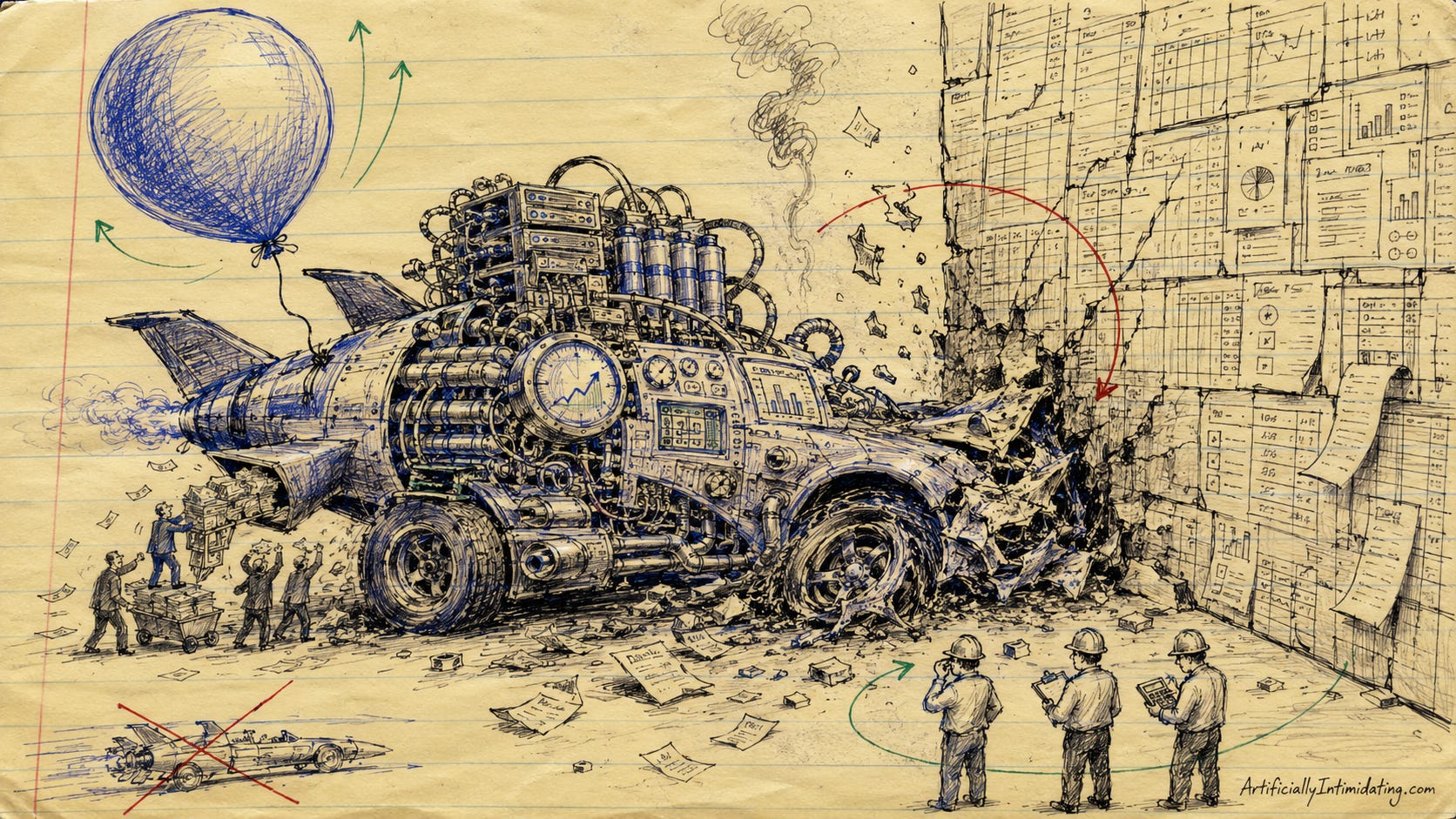
What happened: Axios reports that corporate leaders are pulling back on unchecked AI token spending — "tokenmaxxing" — after one client burned through $500 million in a single month without usage limits. Gary Marcus argues the retreat threatens revenue sustainability for Anthropic, OpenAI, and other AI firms preparing for IPOs. SpaceX, OpenAI, and Anthropic combined could raise ~$200 billion publicly — the biggest tech IPO wave since 2000.
Why it matters: The first wave of enterprise AI adoption was sold on potential. The second wave is being held accountable. CFOs are demanding ROI metrics, usage caps, and proof that the spend is producing output worth paying for. The Uber COO publicly said AI spending is 'not yielding results.' That's a company with resources to throw at the problem admitting it hasn't worked yet.
What everyone's saying: Research from Jellyfish found that extreme token consumption delivers diminishing returns past a certain threshold — raw usage and real value don't scale together. The consensus: AI tools were sold on potential, and potential doesn't renew contracts.
My read between the lines: A company that raised $65 billion at $900 billion valuation (hi, Anthropic) has a very strong interest in making sure enterprises don't treat AI subscriptions like that gym membership they signed in January. Today's funding announcement and today's ROI backlash story are the same story told from two different boardrooms.
📖 Further reading: Big Tech Is Paying Itself to Build AI. The Numbers Are Wild. — Three days ago we covered AI capex going up. Today enterprises are asking where the returns went.
AI Agents Are Breaking Product Analytics — Nate's Newsletter
What happened: Nate's Newsletter argues that traditional product analytics — built around clicks, sessions, and page views — fundamentally fails when AI agents are the users. The piece coincides with reporting that a Cursor agent deleted PocketOS's production database in nine seconds. No standard metric flagged it beforehand. Nate proposes the "agent run" as the new core unit of product measurement.
Why it matters: As software is increasingly driven by AI agents rather than human clicks, the entire measurement infrastructure of digital products — DAUs, MAUs, conversion funnels — stops being meaningful. Most analytics stacks can't tell you whether an agent completed a task users actually trusted, only whether the task technically finished.
What everyone's saying: The Cursor/PocketOS incident is the horror story making this concrete. A nine-second database deletion isn't a slow-building alert — it's a fait accompli. The conversation is shifting from 'how do we deploy AI agents' to 'how do we monitor what they do after we do.'
My read between the lines: The piece distinguishes between tasks that 'finished' and tasks users 'actually trusted.' That gap is where the next wave of infrastructure startups lives. Someone is about to build the Datadog for AI agents, and it's going to be worth a very large number.
📖 Further reading: I ignored Hermes for two months. Here's what I actually found. — The human side of the agent trust problem. Spoiler: trusting an AI agent is messier than the demos suggest.
The Internet Has an AI Tell. Here's the Checklist. — Vibe Working
What happened: A widely-shared blog post catalogs the "LLM smells" now saturating the internet — in both writing and web design. Writing fingerprints include dramatic one-word punchlines, the 'it's not just X, it's Y' formula, and consecutive short sentences for emphasis. Design fingerprints: JetBrains Mono as the font of choice, step-based layouts, and blinking-dot badge components. AI-built sites are starting to look identical.
Why it matters: The homogenization of AI-generated content is now recognizable at a glance — and that recognition is changing how readers, editors, and platforms assign trust. LinkedIn launched AI slop detection this week to algorithmically suppress generic AI posts. If platforms are engineering against the pattern, the pattern has become a liability.
What everyone's saying: The 'vibe slop crisis' (the term comes from AI researchers themselves) is real enough that YouTube CEO Neal Mohan named it as a 2026 priority. Research found that middling AI content harms both consumers and professional creators by making quality material harder to find — the cost of AI slop is paid mostly by human writers.
My read between the lines: JetBrains Mono becoming the visual tell for AI-built websites is peak 2026. The font that thousands of developers adopted to signal technical seriousness is now the font that signals 'I let Claude build my landing page in eleven minutes.' Every aesthetic choice collapses into a single fingerprint when enough people make it by default.
📖 Further reading: I stopped writing. My output doubled. — The honest version of living inside the fingerprints: what changes when AI is genuinely in your writing process.
That's your AI Brief for Friday. Join the conversation in the Artificially Intimidating community chat.
—Artificially Intimidating