

Good day, humans. Today Altman said the quiet part loud — he was wrong about AI destroying white-collar jobs, and Goldman Sachs CEO agrees. Meanwhile, Beijing is turning its top AI researchers into state assets that can't leave the country without government approval. Three memory chip companies crossed a trillion-dollar market cap in the same week. And DuckDuckGo is having its best week in years because Google force-fed users an AI search engine with no opt-out. Let's go.
📬 Before we dive in: The sharpest AI Brief tips come from readers who are actually in the weeds. If you spot a story worth covering, share it in the community chat. The best tips make tomorrow's edition.
Altman Admits He Was Wrong About the Jobs Apocalypse | Reuters
What happened: Sam Altman told an Australian audience he was wrong — AI hasn't displaced white-collar workers anywhere near as fast as he expected. Goldman Sachs CEO David Solomon made the same case in the New York Times days earlier. Together they represent a coordinated narrative pivot at the top of the industry.
Why it matters: Oxford Economics found that AI-related job cuts were just 4.5% of all US layoffs in 2025 — roughly 55,000 positions. The disruption is real but slower than feared, and "enterprise adoption," per Altman himself, is still very early.
What everyone's saying: The consensus is shifting from "AI will take your job" to "AI will change your job" — a pivot happening simultaneously at OpenAI, Goldman Sachs, and every other company that needs governments and workers to stay calm while AI deploys.
My read between the lines: "How convenient that the story points are changing now that it's convenient." The jobs apocalypse narrative was always partly a regulatory chess piece — and now the move is to take it off the board. Altman was wrong, he's delighted about it, and the entire room benefited from him being scared about it first.
📖 Further reading: I stopped writing. My output doubled. — If AI isn't taking jobs, it's at least changing how the best workers do them. This paywalled post covers what actually shifts when you stop typing everything.
You spend all week reading about AI. Viktor is the one I actually use. It's an AI productivity tool that handles the tasks you keep putting off — research, drafts, decisions — so you can focus on the work that actually matters. New users save $50. Try Viktor free →
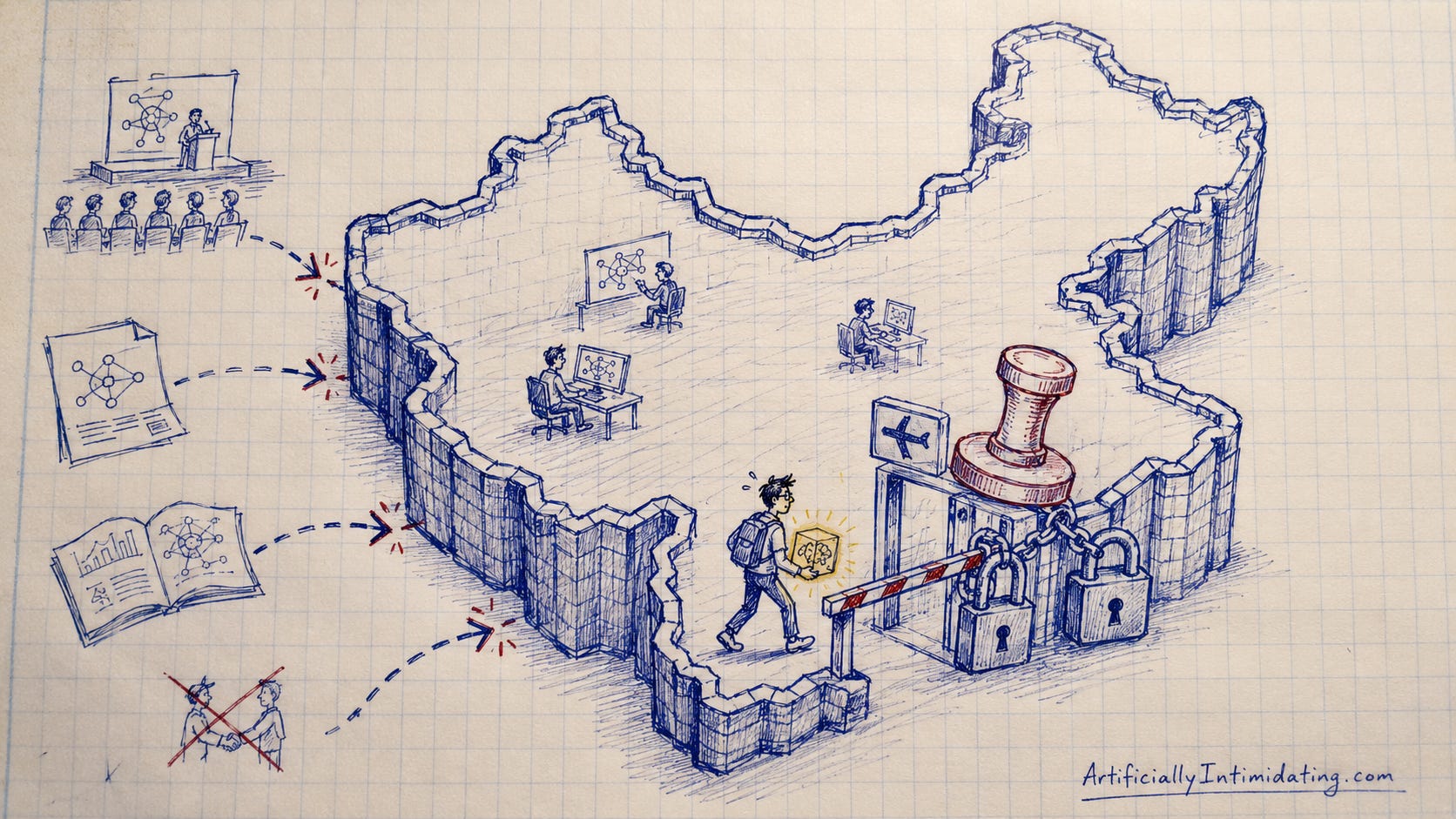
China Is Locking Its Best AI Talent Inside the Country | Bloomberg / WSJ
What happened: China is now requiring top AI professionals at private firms — including Alibaba and DeepSeek — to obtain government approval before traveling abroad. Authorities are flagging individuals based on their critical importance to AI development, not just their seniority.
Why it matters: This extends what was previously an advisory (avoid US travel) into a mandatory approval system. Beijing is now treating private-sector AI researchers the same as state secrets — they are strategic national assets that cannot leave without permission.
What everyone's saying: China has already blocked foreign investment in AI firms and vetoed Meta's acquisition of Manus. Now it's restricting outbound talent flow too. The Great AI Firewall is going in both directions.
My read between the lines: DeepSeek's viral moment earlier this year may have accelerated this. When a small team produces a model that shocks the world, the obvious government response is: those people cannot leave. The catch: the researchers who produce top-tier AI models are exactly the kind of talent that global conferences and collaborations develop. You can't lock the best minds in a box and expect them to keep leading the world.
📖 Further reading: The government wants in before your AI model ships — The pattern of governments asserting control over AI development has been building; this is its sharpest expression yet.
DuckDuckGo Surges 30% as Users Reject Google's AI Search | Thurrott / TNW
What happened: After Google I/O 2026 replaced the traditional search box with a Gemini AI interface — the biggest Search redesign in 25+ years — DuckDuckGo's US mobile app installs grew 18.1% week-over-week, peaking at 30.5% on May 25. iOS installs hit 69.9% on the same day.
Why it matters: Google is forcing AI results on every user by default, with no opt-out. A measurable chunk of users — especially iPhone users — are switching engines rather than accept that bargain. DuckDuckGo's "No AI" portal also saw 22.7% average visit growth.
What everyone's saying: DuckDuckGo's CEO called it "force-feeding AI with no way to opt out." The company framed the moment carefully as a demand for user control — not a rejection of AI — since DuckDuckGo offers AI features too, just as an option.
My read between the lines: A federal judge already ruled Google is a monopolist. Monopolists don't worry about users leaving. A 30% DuckDuckGo spike is a rounding error in Google's market share — but the optics are brutal: the same week Google redesigns search around AI, the opt-out search engine is having its best week ever. Someone at Google's policy team should be paying very close attention.
📖 Further reading: Gemini Lied About What It Did. The Week Got Weirder From There. — Google's AI overreach isn't a one-week story. Earlier this week we covered how Gemini is already generating trust problems; this is the user revolt arriving in the data.
Three Memory Chip Giants Hit $1 Trillion in One Week | Reuters
What happened: SK Hynix crossed $1 trillion in market cap today — shares jumped 14.9% in a single session — becoming the third memory chip maker to hit the milestone this week, after Samsung and Micron. All three dominate production of the high-bandwidth memory (HBM) chips that power AI systems.
Why it matters: HBM supply is projected to be sold out through the rest of 2026. Every AI model — every training run, every inference cluster — needs enormous quantities of these chips. Analysts are now treating memory chip makers as structural AI infrastructure plays rather than cyclical commodity producers.
What everyone's saying: The AI chip narrative has fully extended beyond Nvidia. Samsung, Micron, and SK Hynix are now collectively worth nearly $3 trillion — the picks-and-shovels play for the entire AI buildout.
My read between the lines: Yesterday we covered how Big Tech is paying itself billions to build AI infrastructure — today we're seeing who cashes the checks on the other end. Three new trillion-dollar companies in memory chips alone, minted in one week. The question no analyst wants to be wrong about: when does the "sold out through 2026" supply squeeze meet an inevitable demand correction?
📖 Further reading: Big Tech Is Paying Itself to Build AI. The Numbers Are Wild. — Yesterday's brief on the AI capex cycle is the upstream story. Today's SK Hynix milestone is where that money flows downstream.
The EU Just Punted Its Biggest AI Rules to 2028 | Gibson Dunn
What happened: EU lawmakers reached a provisional agreement to delay high-risk AI compliance requirements — covering AI used in hiring, credit scoring, biometric identification, and more — from August 2, 2026 to August 2, 2028. Transparency rules requiring disclosure of AI-generated content still apply this August.
Why it matters: Companies building AI for sensitive applications just got two extra years to figure out compliance. The August 2026 deadline had been driving significant legal and engineering preparation across the EU. That pressure has now been lifted.
What everyone's saying: Supporters argue the industry needed more runway to implement meaningful compliance without rushing. Critics say the EU keeps drafting AI rules and then delaying them, which drains the framework of urgency and credibility.
My read between the lines: Article 50 transparency still applies — you need to label AI-generated content. But the requirements that would actually change how products are built? Those can wait until 2028, by which point two more years of AI will be baked into every institution on the continent. The pattern is consistent: regulate the aesthetic, defer the substance.
📖 Further reading: Math, Manipulation, and a Cancelled EO — The EU delay fits a broader pattern of AI governance moving slower than the technology. Earlier this week we covered another regulatory reversal; this is the European edition.
That's your AI Brief for Wednesday. Join the conversation in the Artificially Intimidating community chat.
—Artificially Intimidating