

Good day, humans. Big Tech's AI revenue is circular financing dressed as growth, Jensen Huang is arguing for re-engagement with China, OpenAI's Codex can now run your Mac while you sleep, Google is compressing free Gemini access while launching a $100/month upgrade tier, and engineers at Nvidia are containerizing AI agents at production scale. Here's your Context Window for Tuesday.
📬 Before we dive in: The sharpest AI Brief tips come from readers who are actually in the weeds. If you spot a story worth covering, share it in the community chat. The best tips make tomorrow's edition.
The Circle Jerk Bubble Is Real, and Now It Has Numbers
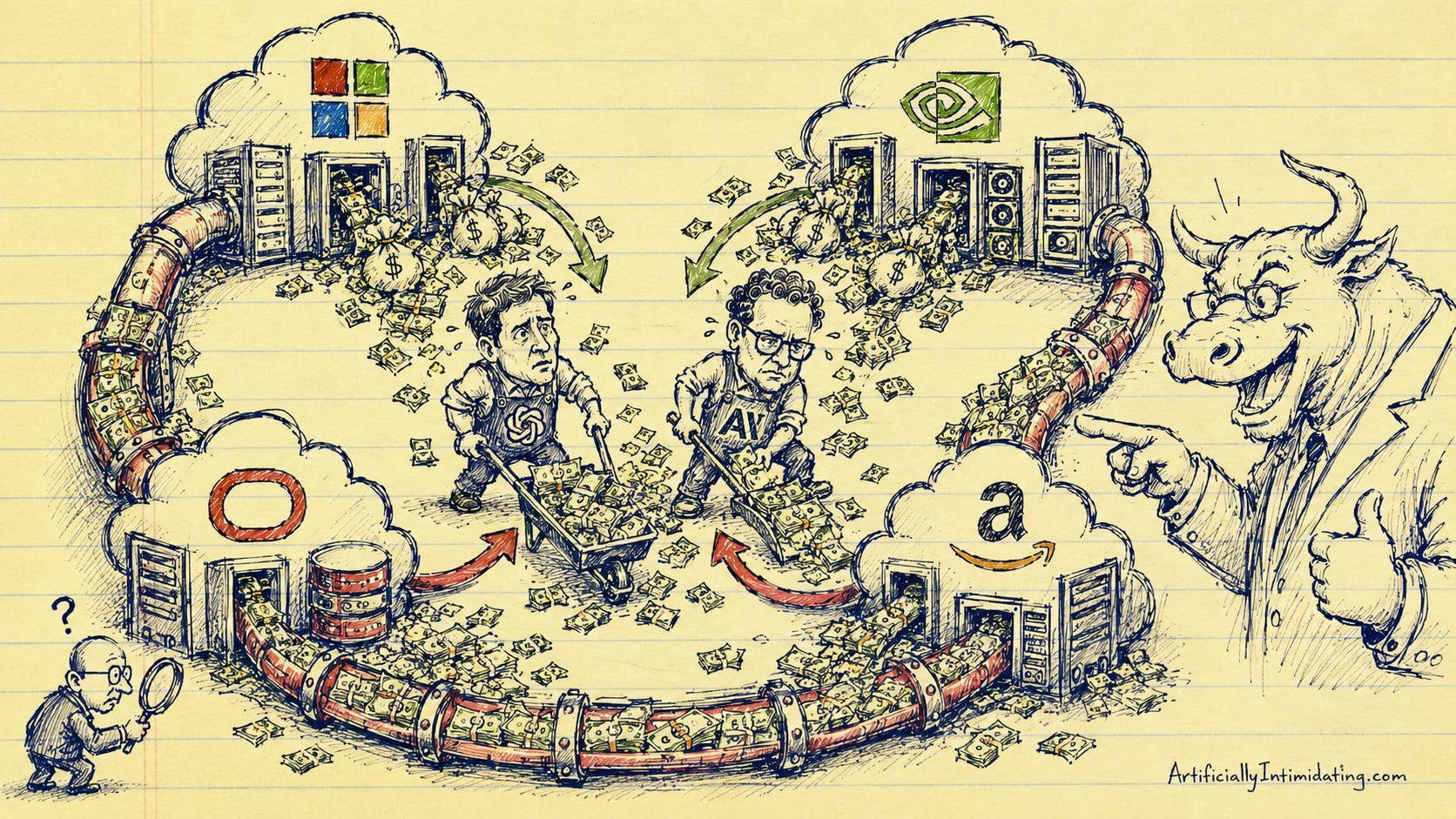
What happened: Corporate filings reveal that OpenAI and Anthropic are tied to more than half of nearly $2 trillion in future cloud revenue held by Microsoft, Oracle, Alphabet, and Amazon. Microsoft's $627B backlog is 49% OpenAI-dependent. Anthropic spent $2.66B on AWS in nine months — roughly matching its total revenue for the same period. OpenAI's annual cloud bill has reportedly topped $60B on revenue of ~$25B.
Why it matters: The bull case for AI cloud stocks rests on "AI revenue" that is substantially circular. A Big Tech firm invests in an AI startup → the startup spends that money on the investor's cloud → the investor books it as customer demand. Wall Street sees growth. The underlying cash is doing laps.
What everyone's saying: Zoho founder Sridhar Vembu called it "the biggest bubble yet" on May 25. Analysts are drawing dot-com parallels — the era when telecom companies swapped network capacity with each other and booked it as revenue. The key distinction: today's arrangements fit within current accounting rules.
My read between the lines: The number that should stop you: OpenAI spends more than twice what it earns, and a large chunk of what it spends goes to its own investors' clouds. That's not a business model — it's a promissory note on AGI. The market is pricing these companies as if the revenue is coming from outside the ecosystem. Increasingly, it isn't. When someone eventually demands "clean" revenue numbers stripped of reciprocal investment relationships, this gets uncomfortable fast.
📖 Further reading: Agents With Wallets, Broken Google, and Anthropic Turns a Profit — the circular financing loop is easier to see when you know Anthropic just turned its first profit while spending what it earns on AWS.
Your readers spend all week reading about AI agents. Viktor IS an AI agent — it lives in Slack, connects to 3,000+ tools, and does real work: reports, dashboards, code, campaigns. Not a chatbot. A coworker. New users get $50 off their first month. Hire Viktor →
Jensen Huang Says Splitting AI in Two Would Be "Not Wise"
What happened: At Computex 2026, Nvidia CEO Jensen Huang told CNA that splitting the world into separate US and China AI ecosystems would be "not wise." He acknowledged Nvidia has "largely conceded" China's AI chip market to Huawei after export controls left a vacuum — China previously accounted for more than 20% of Nvidia's data center revenue. Huang joined Trump's Beijing delegation; the US approved H200 sales to 10 Chinese firms, but Beijing has signaled those companies to wait. Nvidia reported zero China revenue in its latest earnings.
Why it matters: The world's most important AI chip company has been locked out of its second-largest market — and Huang is now making the public business case against further decoupling while participating in the diplomacy supposed to soften it. Zero China revenue isn't a rounding error. It's a $15B+ annual gap.
What everyone's saying: Analysts note Huawei had "record years" during Nvidia's absence and is now growing fast. Chinese firms are increasingly committing to domestic-only AI infrastructure, meaning even a diplomatic thaw may not reverse the bifurcation. Beijing hasn't cleared a single H200 shipment despite formal US approval — they're using it as leverage, not locking in purchases.
My read between the lines: "Not wise" is unusually blunt from a CEO of Huang's stature — especially said publicly while on a trade delegation trip. When your most important growth market is being systematically closed off, you say it diplomatically. He's not being diplomatic. The zero China revenue line in the last earnings was the tell. Huang is playing whatever cards he has left, and the most powerful is making the geopolitical cost of exclusion visible to an audience that includes the White House.
OpenAI's Codex Can Now Run Your Mac While You Sleep
What happened: OpenAI's Codex app now supports "locked use" — the agent can operate macOS applications even when the screen is off and the machine is locked. Called Remote Computer Use, developers dispatch tasks from the ChatGPT mobile app to their desktop; Codex carries them out without requiring anyone to log in. Goal Mode also went GA in the same release. The feature is unavailable in the EU, UK, and Switzerland.
Why it matters: This is qualitatively different from a chatbot. An AI that can operate your computer while you're not physically present — dispatched remotely from your phone — is infrastructure, not an assistant. The listed safeguards (time-bound authorization, covered screen during locked operation, automatic relocking on local input) are reassuring in the press release and almost certainly insufficient in the wild.
What everyone's saying: Enterprise IT teams are flagging the absence of granular MDM controls for Mac fleets — OpenAI acknowledged the gaps exist and will be addressed "in future releases." Security researchers note that an AI with exclusive machine control and remote dispatch capability is a significant attack surface. The EU/UK/Switzerland exclusion suggests regulators in those jurisdictions would agree.
My read between the lines: The geographic exclusion is a tell. When a company ships a feature everywhere except jurisdictions with robust digital rights oversight, it's not a coincidence — it's risk management. Goal Mode + Locked Use + Remote Computer Use all dropping in one release means Codex is now a full remote agent operating system. This is remarkable technology. It's also the setup for the first major AI-agent security incident.
📖 Further reading: I ignored Hermes for two months. Here's what I actually found. — what it actually feels like to let an AI agent run loose on your machine. Required reading before you hand Codex your keyboard.
Google Is Throttling Free Gemini While Pitching You a $100/Month Upgrade
What happened: Google set Gemini 3.5 Flash at "Low" thinking level as the default for its Antigravity developer platform. The Low variant uses ~45% fewer tokens than Medium. But Simon Willison clocked it averaging 49 turns per task on agentic evals — making total costs higher than competing models despite lower per-token pricing. Free-tier daily limits have dropped from ~250 requests to ~20 since late 2025. The new $100/month AI Ultra plan is now the path to serious access.
Why it matters: Developers who built on free Gemini access during Google's generous runway are being compressed into a commercial tier. The "45% fewer tokens" headline is technically accurate and practically misleading — if the model takes more turns to complete the same task, total cost is up, not down.
What everyone's saying: Developer forums are frustrated but unsurprised. The playbook is familiar: launch free, generate adoption, tighten quotas, present the paid tier as the solution. Google ran it with unusual transparency — the Antigravity blog literally noted the quota reset offer would expire May 25, 2026.
My read between the lines: The $100/month AI Ultra tier is Google's answer to ChatGPT Pro. The problem: OpenAI built its paid tier on top of a product people already loved. Google is building its paid tier on top of quota compression on a platform developers are already frustrated with. The developer trust deficit is real. Defaulting to "Low thinking" on a model that already takes 49 turns per task is not going to help.
📖 Further reading: I stopped writing. My output doubled. — the developer tool tax is real. Here's why the right interface matters more than the model underneath it.
Engineers Are Running AI Agents in Containers Now. Nvidia Is One of Them.
What happened: Red Hat engineer Sally Ann O'Malley published a guide on containerizing OpenClaw — a free, open-source AI agent framework — to run identically on Podman from a laptop and Kubernetes at scale. Nvidia is running this pattern in production: 10 engineers now manage containerized OpenClaw instances for model evaluations, handling work that previously required a 6-person team.
Why it matters: When Nvidia runs containerized AI agents as production infrastructure, it's not a research project — it's a deployment pattern. OpenClaw going Kubernetes-native means AI agents are entering the same operational tier as microservices: observable, scalable, rollback-able. The 'how do we run this reliably at scale' question is being answered by engineers, not product managers.
What everyone's saying: The open-source community is treating this as a maturity signal. Red Hat's two-layer secret management (Podman secrets + OpenClaw secret refs to keep API keys out of logs) suggests agent operations is becoming serious infrastructure. OpenClaw's viral growth in 2026 is driven partly by zero-cost entry and practitioners sharing real deployment patterns.
My read between the lines: The Nvidia headcount stat is the one worth sitting with: 10 engineers running agents doing the work of a 6-person team. That's not a prediction — that's Q2 2026, documented in a production environment at one of the world's most technically sophisticated companies. The 'agents replacing headcount' story has mostly lived in speculation. Here it's running on Kubernetes.
That's your AI Brief for Tuesday. Join the conversation in the Artificially Intimidating community chat.
—Artificially Intimidating