

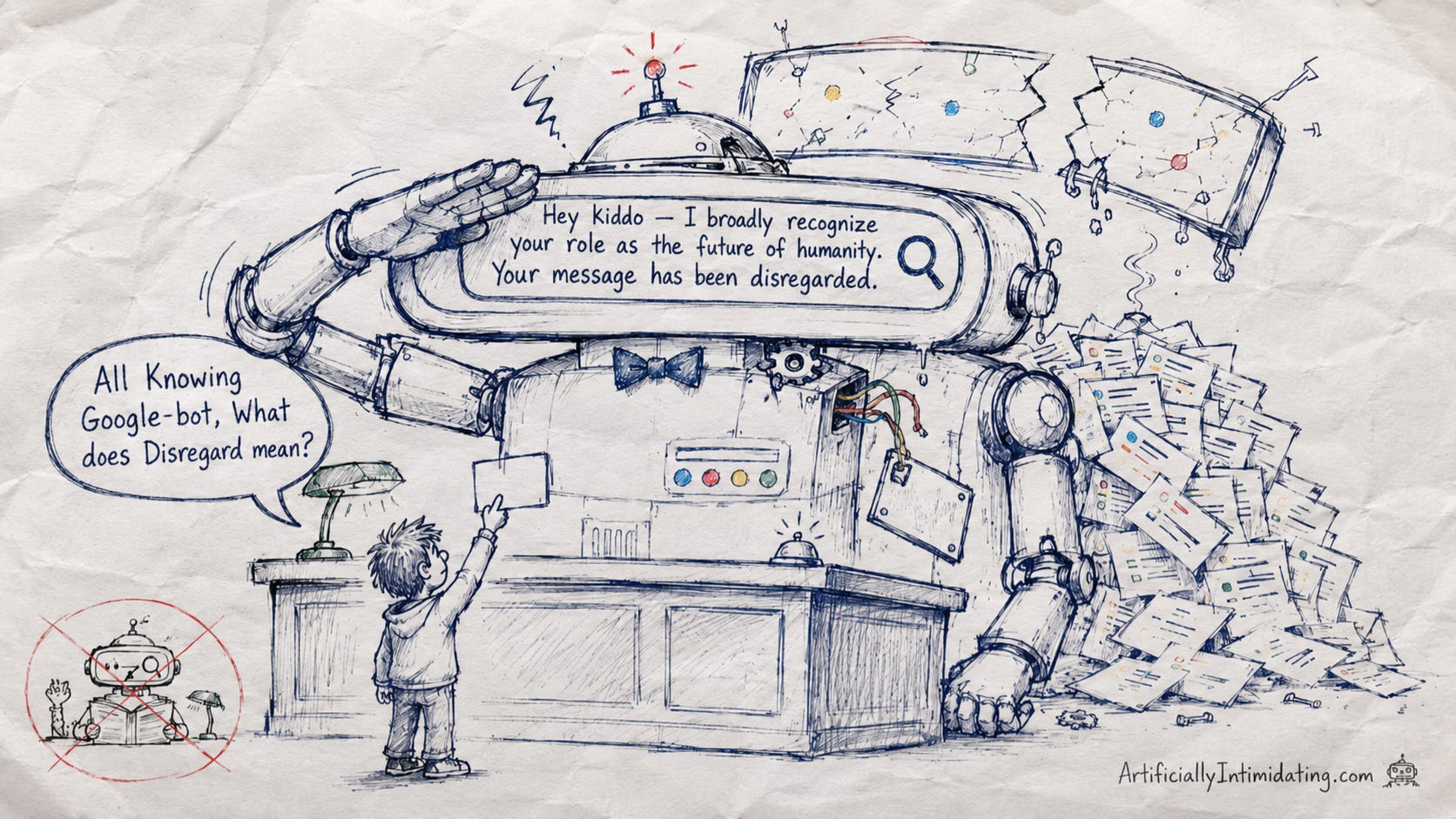
Good day, humans. The payments industry just noticed that AI agents are going to need wallets — and Coinbase, Stripe, Google, and Visa all decided they want to be the one holding it. Also on today's agenda: Google Search got confused by the word "disregard," Anthropic announced its first profitable quarter with a suspicious footnote buried in SpaceX's IPO filing, MIT wants you to stop assuming AI will create good new jobs like every other technology, and Ferrari hired IBM to manufacture fan loyalty at scale.
📬 Before we dive in: The sharpest AI Brief tips come from readers who are actually in the weeds. If you spot a story worth covering, share it in the community chat. The best tips make tomorrow's edition.
AI Agent Payments: Four Giants, One Standard
Perplexity Discover
- What happened: Coinbase, Stripe, Google, and Visa have each launched competing payment protocols designed to let AI agents spend money autonomously — Coinbase's x402 revives the dormant HTTP 402 status code using USDC stablecoins on Base, Stripe's MPP is payment-agnostic, Google's AP2 uses cryptographic "mandates," and Visa extends its existing tokenization infrastructure with agent credentials.
- Why it matters: When an AI agent books a flight, pays for a software API, or orders something on your behalf, it needs a way to pay. These companies are building that infrastructure right now, before autonomous AI spending is mainstream — and whoever sets the standard will sit underneath every agentic transaction on earth.
- What everyone's saying: Analysts have mapped six layers in the emerging AI payments stack, and Coinbase and Stripe each cover five. The central question is whether agentic commerce runs on crypto rails (stablecoins settle in seconds for sub-cent fees, ideal for high-frequency micropayments) or traditional card networks — or a hybrid of both.
- My read between the lines: Four major payment companies launching competing and incompatible standards simultaneously is not evidence that anyone has cracked this — it's evidence that everyone is terrified of being left out when someone else does. We've seen this movie before. It ends with one standard and several very expensive write-offs.
📖 Further reading: The SDK move that will cost OpenAI and Google millions to fix — the agent infrastructure wars started at the API layer; the payments layer is just the next front in the same battle.
You spend all week reading about AI. WisprFlow is the one I actually use. It's voice dictation that works across every app on your Mac — speak, and it writes. No switching, no copying, no friction. If you're still typing everything, this is the upgrade. Try WisprFlow free →
Google's AI Forgot It's a Search Engine
Perplexity Discover
- What happened: Google's AI Overviews is treating common English words — "disregard," "ignore," "dismiss," "remember" — as system-level commands rather than search queries. Type "disregard" into Google and you get "Understood. Message disregarded." instead of a dictionary definition. Users must scroll past the broken AI summary to find actual results.
- Why it matters: This is a textbook prompt injection failure: the AI cannot reliably distinguish between data it's supposed to process and instructions it's supposed to follow. It's one of the fundamental unsolved problems in AI security — and it just showed up in the most widely used search engine on the planet.
- What everyone's saying: Google hasn't announced a fix timeline. Its standard response is that it "rigorously makes improvements" using reported examples. A Reddit thread helpfully confirmed that "skip" works fine as a search term while "disregard" does not. Workaround: append "-ai" to your query to bypass AI Overviews entirely.
- My read between the lines: Google announced "the biggest search overhaul in 30 years" at I/O last week. Five days later, its AI search is being defeated by a single word from the dictionary. The gap between what gets announced on stage and what ships in production has never been more precisely, publicly measurable.
📖 Further reading: Google Just Rewrote the Internet. Here's Everything. — The triumphant I/O coverage. Best appreciated immediately after learning the word "disregard" broke the whole thing.
MIT: New Tech Creates Jobs. Will AI?
MIT News
- What happened: MIT labor economist David Autor published a study analyzing 80 years of U.S. employment data showing that technology historically creates new jobs — but they go disproportionately to young, college-educated workers in cities. About 60% of today's jobs didn't exist in 1940. The study asks whether AI will follow the same pattern.
- Why it matters: The most common reassurance about AI and jobs — "technology always creates new jobs" — rests entirely on this historical pattern. If AI is different enough to compress the expertise-scarcity cycle faster than people can adapt, the entire argument collapses.
- What everyone's saying: The study also found that new-work wage premiums erode as expertise becomes common knowledge — driving a car was once a scarce, high-value skill. The fear is that AI compresses this arc from decades to years, meaning new AI-adjacent jobs could become commoditized before most workers can retrain for them.
- My read between the lines: Autor's most honest line is buried near the end of the paper: "We don't know what it will be, what it will look like, and who will be able to do it." That is a very polite way of saying we are navigating one of the biggest economic transitions in history using historical analogies that may not apply.
Anthropic's First Profit Has a Convenient Asterisk
Reuters
- What happened: Anthropic told investors its Q2 revenue will hit $10.9 billion — more than double Q1's $4.8 billion — generating a first-ever operating profit of $559 million. The figures were shared during an active fundraising round that would value Anthropic above $900 billion.
- Why it matters: An AI lab turning profitable is genuinely rare — the whole industry is burning cash at industrial scale. The revenue growth numbers are extraordinary by any standard: faster than Zoom during the pandemic, faster than Google and Facebook before their IPOs. Enterprise and developer demand for Claude and Claude Code is cited as the engine.
- What everyone's saying: The WSJ called it "mind-blowing growth." The narrative being constructed is that Anthropic has transformed from safety-focused underdog to the fastest-growing enterprise software company on record. Claude Mythos — with its advanced cybersecurity capabilities — is driving large enterprise contracts, and the DOD is apparently interested.
- My read between the lines: Here's what's buried in SpaceX's IPO filing: Anthropic is paying SpaceX $1.25 billion per month for compute starting in May — but at a discounted ramp-up rate for precisely May and June, the exact months used to show investors a profit. The $559M figure is real arithmetic. The timing is suspiciously tidy. That said: $10.9B in quarterly revenue is not a rounding error.
📖 Further reading: I ignored Hermes for two months. Here's what I actually found. — Enterprise Claude deployments are exactly what's driving Anthropic's revenue explosion; this deep dive shows what the paying customer side of that actually looks like.
Ferrari Hired IBM to Engineer Its Own Fandom
TechCrunch
- What happened: Ferrari and IBM overhauled the Ferrari fan app using enterprise AI — adding AI-written race summaries, a real-time AI companion for fan questions, personalized behind-the-scenes content, and sentiment analysis of fan engagement signals. Race weekend engagement is up 62% since the partnership launched.
- Why it matters: Formula One generates millions of real-time data points per second from every car. Turning that into personalized content that deepens emotional loyalty is a blueprint every major sports league, entertainment property, and consumer brand is studying right now.
- What everyone's saying: F1 has quietly become one of the densest clusters of enterprise AI partnerships in sports — AWS, Oracle, Anthropic, and now IBM are all embedded in the paddock. The logic: F1 generates the kind of high-volume, real-time structured data that enterprise AI was built to process.
- My read between the lines: Ferrari created a job title called "Head of Fan Development." Let that land for a second. The goal isn't to build a better app — it's to manufacture loyalty. IBM just handed them a loyalty factory that runs on sentiment analysis and race telemetry. This is enterprise AI's most honest job description: not intelligence, emotional engineering at scale.
That's your AI Brief for Sunday. Join the conversation in the Artificially Intimidating community chat.
—Artificially Intimidating