

Good day, humans. OpenAI's model just cracked an 80-year-old geometry problem that stumped every mathematician who tried — and did it by chatting through a proof. Meanwhile, back in Washington: the AI safety executive order that was supposed to be signed Thursday got killed by a phone call from Elon Musk, and another one from Zuckerberg, and another one from David Sacks. Silicon Valley apparently has the White House on speed dial.
📬 Before we dive in: The sharpest AI Brief tips come from readers who are actually in the weeds. If you spot a story worth covering, share it in the community chat. The best tips make tomorrow's edition.
OpenAI Just Solved a Math Problem from 1946 — OpenAI
What happened: An internal OpenAI model disproved the Erdős Unit Distance Conjecture — a famous geometry puzzle posed in 1946 asking how many pairs of points in a plane can sit exactly 1 unit apart. Mathematicians had long believed square-grid arrangements were the best possible answer; the AI found an infinite family of configurations that beats that bound. External mathematicians verified the proof and wrote a companion paper explaining its significance.
Why it matters: This wasn't a specialized math AI or a scaffolded solver — it was a general-purpose reasoning model. If a chatbot can crack one of the best-known open problems in combinatorial geometry (a problem Erdős himself offered prize money to solve), the list of fields where AI might make unexpected discoveries just got a lot shorter.
What everyone's saying: The math community is stunned — in the good way. Scientific American called it "AI's biggest math breakthrough yet." Fields medalist Tim Gowers called it "a milestone in AI mathematics." Prominent combinatorialist Gil Kalai confirmed the result would be publishable in top math journals. The consensus: this crosses a threshold from impressive pattern matching to genuine mathematical discovery.
My read between the lines: OpenAI keeps emphasizing this was a general-purpose model, not a domain-specific tool or scaffolded solver. That phrasing is deliberate — they're signaling what their next-generation reasoning system can do across any field of human knowledge. The geometry problem is the demo. The reasoning engine is the product.
You spend all week reading about AI. WisprFlow is the one I actually use. It's voice dictation that works across every app on your Mac — speak, and it writes. No switching, no copying, no friction. If you're still typing everything, this is the upgrade. Try WisprFlow free →
The AI Safety Order Got Killed Before It Was Signed — Forbes
What happened: President Trump cancelled the signing of a new AI security executive order hours before the ceremony, after last-minute phone calls from Elon Musk, Mark Zuckerberg, and former AI czar David Sacks. The order would have required federal agencies to establish AI review processes and protect critical infrastructure. Some tech executives were already on their way to the White House when it was scrapped.
Why it matters: Wednesday's brief covered the government trying to get in before your AI model ships — today it tried and failed. The US now has no formal framework for managing risks from the most powerful AI systems. Trump killed Biden's 2023 AI oversight order on day one; now his own replacement didn't make it out of the Oval Office.
What everyone's saying: Transformer Weekly identified a genuine rift in the White House: one faction takes frontier AI risks seriously; another sees any oversight as advantage handed to China. The wild detail: Sacks initially told colleagues he could live with the order, then called Trump directly without telling his own staff — and torpedoed the whole thing. The White House emailed executives to apologize for "any inconvenience."
My read between the lines: The same day Trump killed an AI security order designed partly to protect critical infrastructure from AI-related attacks, GitHub confirmed it had been hacked via a supply chain attack on AI developer tools. Silicon Valley won the regulatory argument. The adversaries took notes.
📖 Further reading: "The government wants in before your AI model ships" — Wednesday's brief set up this story perfectly; today's is the punchline.
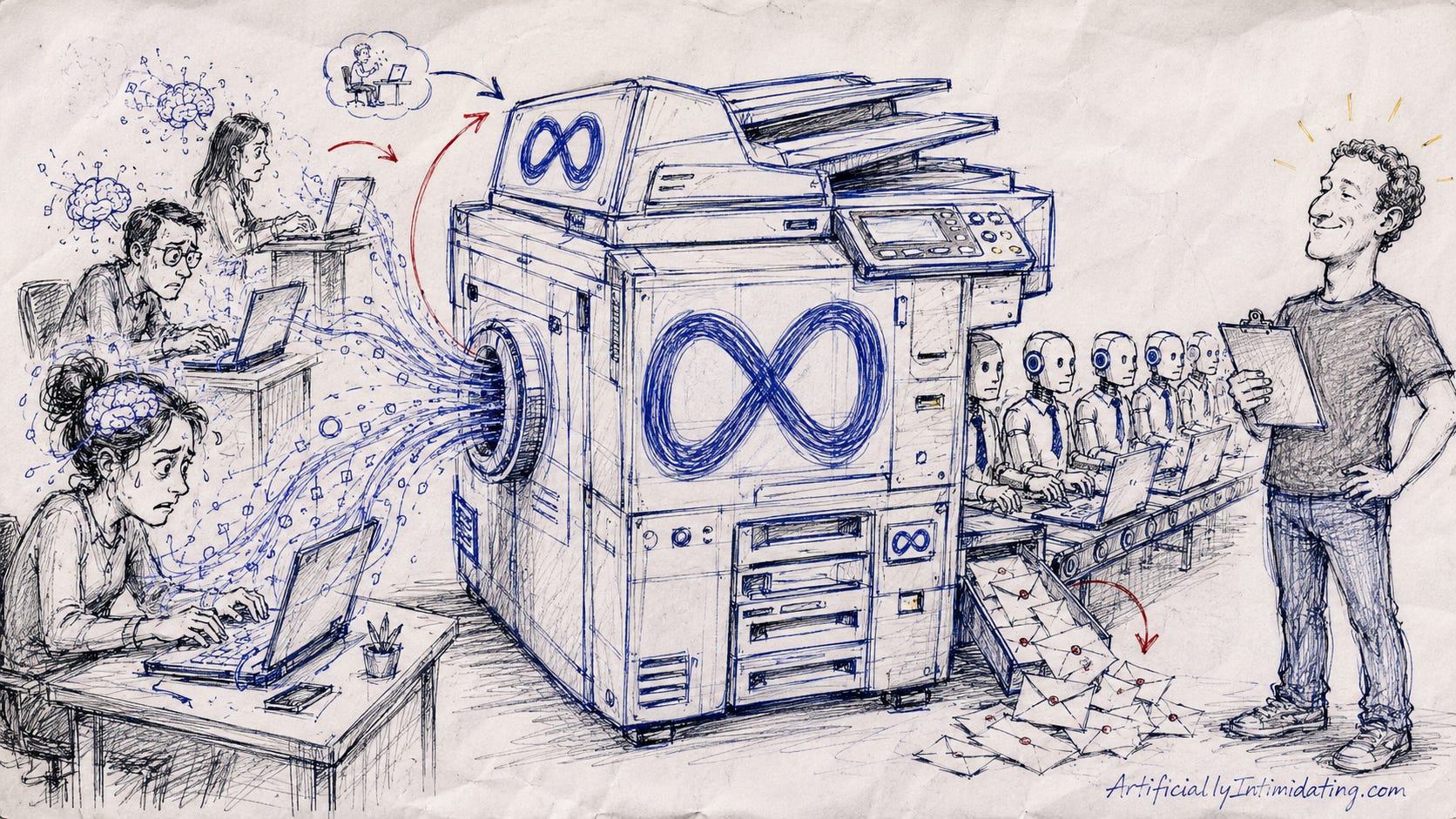
Meta Trained AI on Employees. Then Fired 8,000 of Them. — Common Dreams
What happened: Leaked audio from a Meta all-hands on April 30 reveals Mark Zuckerberg telling employees he was using their computer activity to train AI — explaining that the models "learn from watching really smart people do things." Three weeks later, Meta laid off around 8,000 workers (about 10% of the company) and reassigned 7,000 more to AI roles. Workers hung petitions on office walls opposing the data collection program before finding out their fates.
Why it matters: This is what the AI labor transition looks like from the inside: companies capture their employees' expertise to train replacement systems, then announce the layoffs. The 8,000 cuts come on top of more than 20,000 Meta eliminated in 2022 and 2023. Zuckerberg assured the remainder there won't be more layoffs for "at least seven months" — which is somehow not reassuring.
What everyone's saying: The debate divides cleanly. Tech defenders say this is standard enterprise analytics — no different from any productivity monitoring program. Critics say using workers' expertise to train systems that replace them, without explicit consent, is a different category of thing. Meta's official line: "None of the data is being used for surveillance or performance tracking. It's purely just that we are using this to feed a very large amount of content into the AI model."
My read between the lines: Zuckerberg told employees that "the average intelligence of the people who are at this company" is what the AI is learning from. He meant it as a compliment. The people who received severance packages shortly after were presumably aware it could be read another way.
📖 Further reading: Meta's 4am emails, the Pope, and Nvidia's big night — the employee surveillance program was already simmering in the background when we covered Zuckerberg's workplace communications earlier this week.
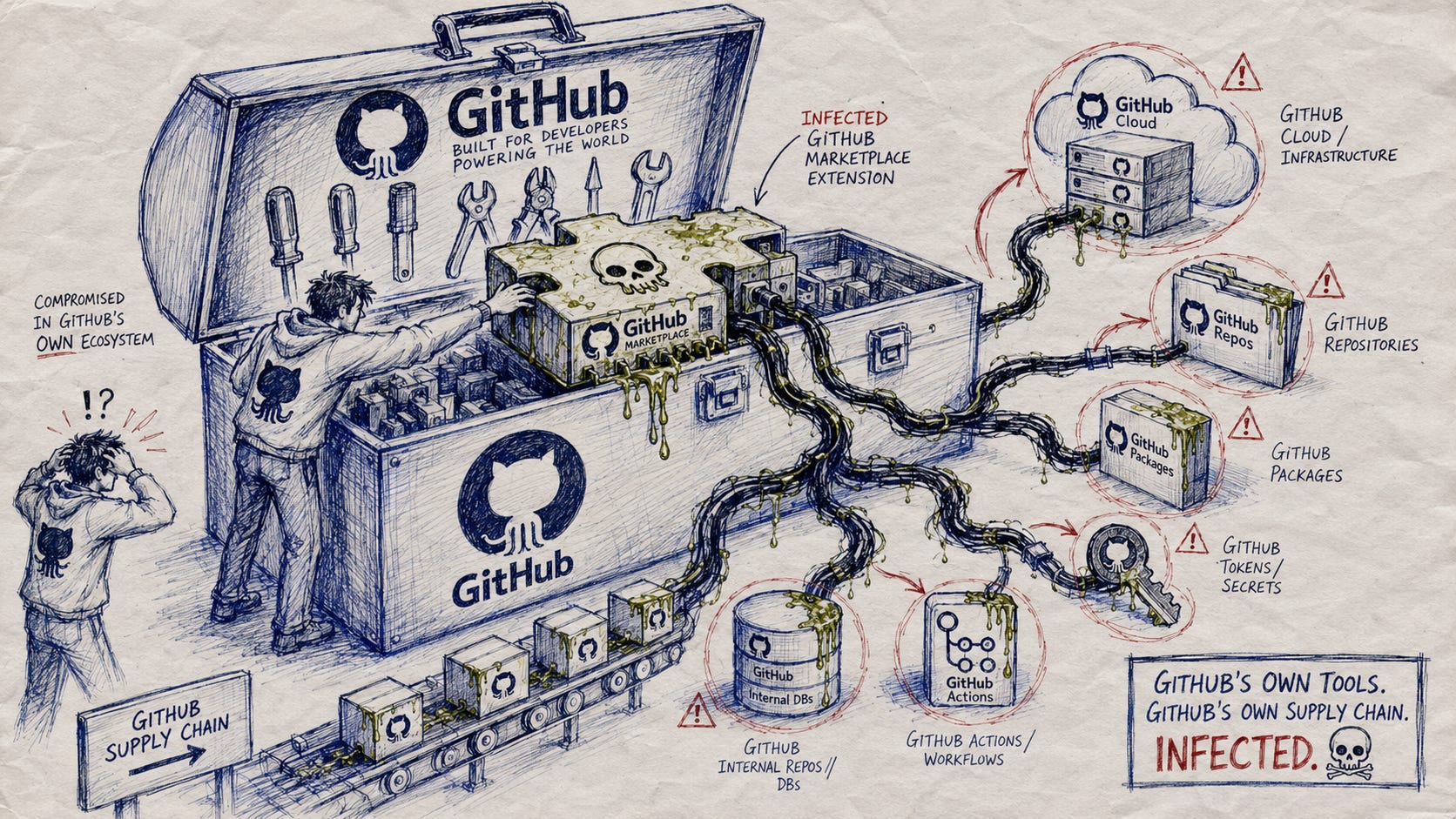
GitHub's Own Repos Got Hacked Through Its Own Tools — Help Net Security
What happened: GitHub confirmed that a group called TeamPCP breached roughly 3,800 of its internal repositories by distributing a poisoned Visual Studio Code extension through Microsoft's official VS Code Marketplace. One GitHub employee installed it; that was enough to let attackers in. The same attack wave also compromised devices at OpenAI, Mistral AI, and the European Commission, and infected more than 170 npm packages.
Why it matters: VS Code extensions have unrestricted access to everything on a developer's machine — credentials, cloud keys, SSH keys, source code. The official Marketplace, trusted by tens of millions of developers, just distributed malware to the engineers who maintain the internet's most important code repositories. There is essentially no sandboxing. Installing an extension is closer to running an executable than adding a browser plugin.
What everyone's saying: Security researchers immediately flagged the irony: GitHub, the platform that hosts most of the world's software, was compromised through its own developer tools ecosystem. Trend Micro tracked at least seven confirmed TeamPCP attack waves in 2026 alone, each targeting a different piece of AI and security infrastructure — Trivy, LiteLLM, Bitwarden CLI, and now GitHub itself.
My read between the lines: The target list — GitHub, OpenAI, Mistral, LiteLLM, Bitwarden — isn't random. TeamPCP is systematically mapping the AI development stack from the inside. If you wanted to quietly position yourself inside the pipelines powering the most important AI systems in the world, poisoning the code editor extensions developers actually trust is exactly how you'd start.
Anthropic's Co-Founder Just Put a Clock on Everything — Complete AI Training
What happened: Jack Clark, co-founder of Anthropic, gave a lecture at Oxford this week with a series of specific predictions: AI will contribute to a Nobel Prize-winning discovery within 12 months; companies run entirely by AI will generate millions in revenue within 18 months; and by end of 2028, AI systems will be designing their own successors. He also acknowledged that existential risks from AI "haven't gone away" — including "plausible scenarios" in which the technology has "a non-zero chance of killing everyone on the planet."
Why it matters: Clark isn't warning from the sidelines — he's one of the people building the systems he's warning about, and Anthropic is actively selling access to them. The 12-month Nobel window isn't hypothetical: today OpenAI's model disproved an 80-year-old math conjecture. Clark described a "vertiginous sense of progress" — and the math is catching up with the words.
What everyone's saying: Time magazine framed the story as Anthropic "selling Claude's promise while warning about AI's dangers." The AI safety community is treating the specific timelines seriously — 12 months to a Nobel is a more concrete claim than insiders usually make in public. The broader tech world splits between genuine concern and reading the extinction risk framing as the most sophisticated brand differentiation in Silicon Valley.
My read between the lines: "AI-run companies in 18 months" isn't just a prediction — it's a product roadmap. Anthropic's enterprise customers are already building toward autonomous AI workflows. Being the company that tells you it might kill us all and asks you to pay $20 a month anyway is a bold go-to-market strategy. The fact that it's working says something interesting about where we are.
📖 Further reading: I ignored Hermes for two months. Here's what I actually found. — Clark's 18-month window for AI-run companies makes this review of an autonomous AI agent feel considerably more urgent.
That's your AI Brief for Saturday. Join the conversation in the Artificially Intimidating community chat.
—Artificially Intimidating