

Good day, humans. The music industry just made its peace with AI — Spotify and Universal Music struck a deal for AI-generated covers of Taylor Swift, Drake, and Billie Eilish. Meanwhile, two men who'd been posting AI deepfakes since the day the law against it was signed just got arrested. And SpaceX's IPO filing revealed that Anthropic is paying Elon Musk $15 billion a year for compute. Normal Friday.
📬 Before we dive in: The sharpest AI Brief tips come from readers who are actually in the weeds. If you spot a story worth covering, share it in the community chat. The best tips make tomorrow's edition.
Diplo Says Adapt or Die. The Internet Has Opinions. BroBible
What happened: DJ and producer Diplo went public with his AI stance, declaring that AI voice generation has surpassed human singers — "I've had some voices that I've made with AI, and I'm like, 'damn, I couldn't even get this take out of the best singer.'" He told artists who are still fighting AI that they're wasting a year of their lives. Cultural commentator Zack Telander fired back that Diplo can optimize away the soul because it's the part that matters least to him.
Why it matters: Diplo isn't a theorist — he's produced hundreds of records across multiple genres and built one of the most commercially successful careers in electronic music. When someone with that track record says AI voice cloning just cleared a new bar, that's a practitioner logging a real capability jump, not a tech person speculating about disruption.
What everyone's saying: The clip went wide and split the discourse cleanly: producers and commercial creators siding with Diplo, session musicians and artists siding with Telander. Both camps are talking past each other because they're optimizing for entirely different things.
My read between the lines: The most interesting sentence in the whole argument: "I wouldn't have said that to you three months ago." Whatever tool Diplo is using, something changed recently enough to flip his opinion. That's not ideology — that's a capability threshold being crossed in real time. The debate about AI and music just moved from 'will it' to 'it did.'
You spend all week reading about AI. WisprFlow is the one I actually use. It's voice dictation that works across every app on your Mac — speak, and it writes. No switching, no copying, no friction. If you're still typing everything, this is the upgrade. Try WisprFlow free →
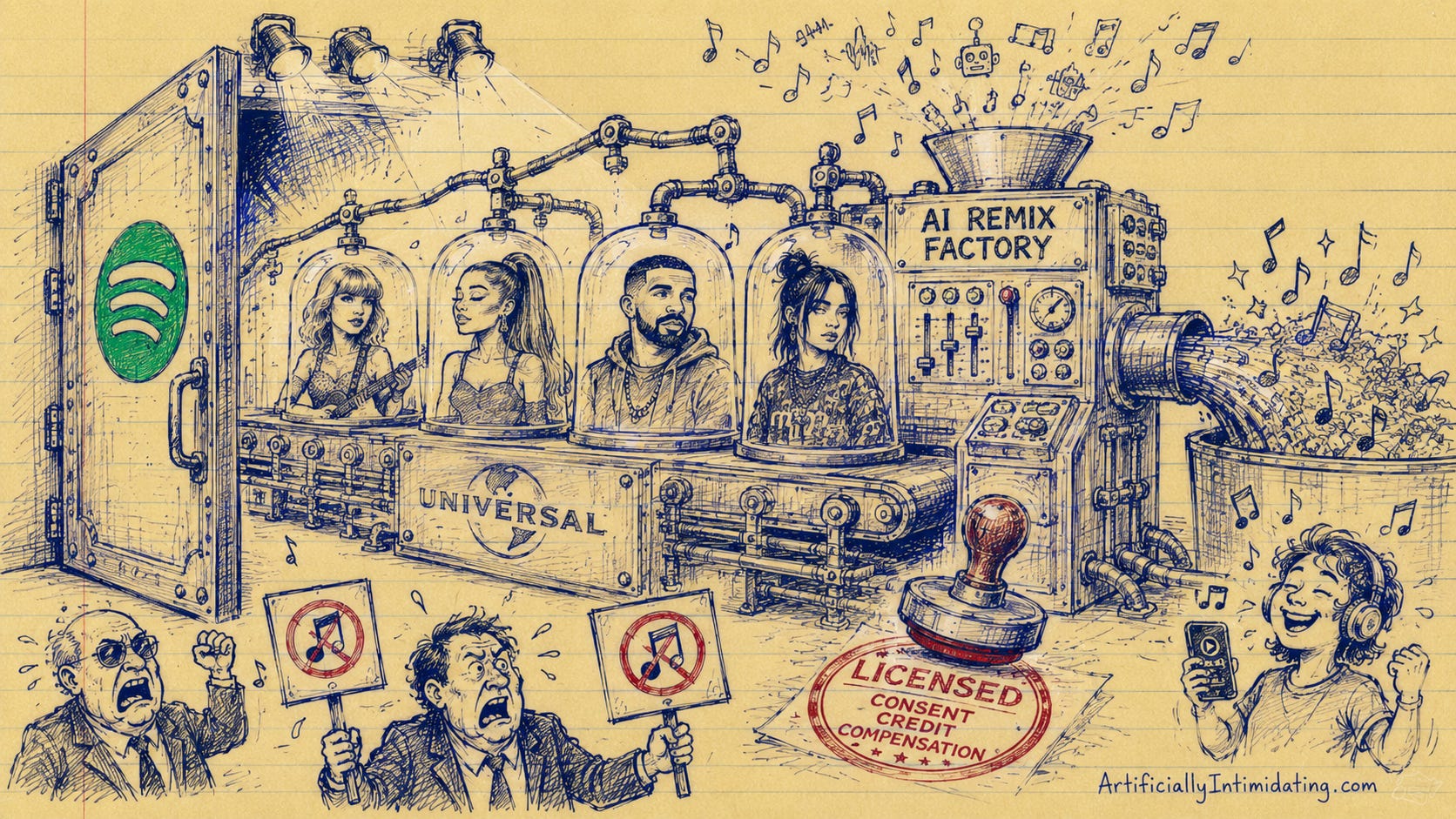
Spotify and Universal Just Opened the AI Remix Door Billboard
What happened: Spotify and Universal Music Group announced a licensing deal that will let premium subscribers create AI-generated covers and remixes of UMG's catalog — Taylor Swift, Ariana Grande, Drake, Billie Eilish. No financial terms disclosed, no launch date set. Both companies framed it around "consent, credit, and compensation" for participating artists. The feature will be a paid premium enhancement.
Why it matters: UMG has been the loudest opponent of AI using artists' voices without permission. This deal doesn't abandon that principle — it monetizes it. The difference between this and the AI music startups UMG sued: artists opt in, royalties flow, and Spotify controls distribution. It's AI music on the industry's terms.
What everyone's saying: The deal puts Spotify in direct competition with Suno and Udio, which already settled copyright suits with major labels. It also validates the "licensed AI music" model those startups were building toward, though they still face class action suits from 1,800+ independent artists.
My read between the lines: UMG just monetized the thing they were loudest about preventing. Taylor Swift and Billie Eilish are now in a catalog Spotify subscribers can remix — with their label's blessing. Nobody will call Grainge a sellout because royalties are attached. But the principle just got a lot more negotiable.
First Arrests Under the Take It Down Act for AI Deepfakes DOJ
What happened: Federal prosecutors charged two men in what appear to be among the first arrests under the Take It Down Act. Cornelius Shannon of New Jersey allegedly posted 360+ albums of AI deepfake porn depicting roughly 90 women, viewed millions of times. Arturo Hernandez of Texas allegedly targeted 50 identifiable women including actresses, singers, and political figures, viewed nearly a million times. Both had been active since May 19, 2025 — the day the law was signed.
Why it matters: The Take It Down Act made nonconsensual AI-generated intimate imagery a federal crime carrying up to two years in prison. The FTC began enforcing platform compliance — mandatory 48-hour content takedowns — on May 19, 2026, exactly one year after signing. These arrests came the very next day. The law just acquired real teeth.
What everyone's saying: The DOJ and FBI are framing this as a warning shot. The enforcement cadence — FTC compliance on the anniversary, federal arrests the following day — suggests the government is done treating AI-enabled abuse as a gray area.
My read between the lines: Both defendants were active from the day the law was signed — they either didn't know or didn't care. Probably the latter. Federal prosecutors clearly wanted the first cases to be as unsympathetic as possible. They found exactly the right ones.
Why Your AI Output Is Generic (It's Not the Model) Nate's Newsletter
What happened: Nate's Newsletter (paywalled) makes the case that 68% of AI power users do one thing differently: they brief rather than prompt. Claude Opus 4.7 and GPT-5.5 now run agents for hours on single requests — editing files, writing and testing code, returning near-finished artifacts. The models moved. Most people's prompting hasn't.
Why it matters: Most people getting mediocre AI output are blaming the model. The piece argues it's almost never the model — it's the assignment. A senior partner needs the goal, context, constraints, and quality bar, then room to push back. Give that, and the new models deliver. Give a junior-employee prompt, and you get polished mediocrity.
What everyone's saying: The "briefing vs prompting" framing is gaining real traction among practitioners because it maps onto something professionals already know how to do. Writing a clear brief for a smart colleague is a skill most people have. The insight is that AI now qualifies as that colleague.
My read between the lines: The fact that this advice is necessary is quietly damning for the AI industry. We've built tools that are categorically more capable than six months ago, and most users are getting worse results than they should because nobody taught them how to use the new version. That's a product design failure as much as a user education problem. The models got smarter. The onboarding didn't.
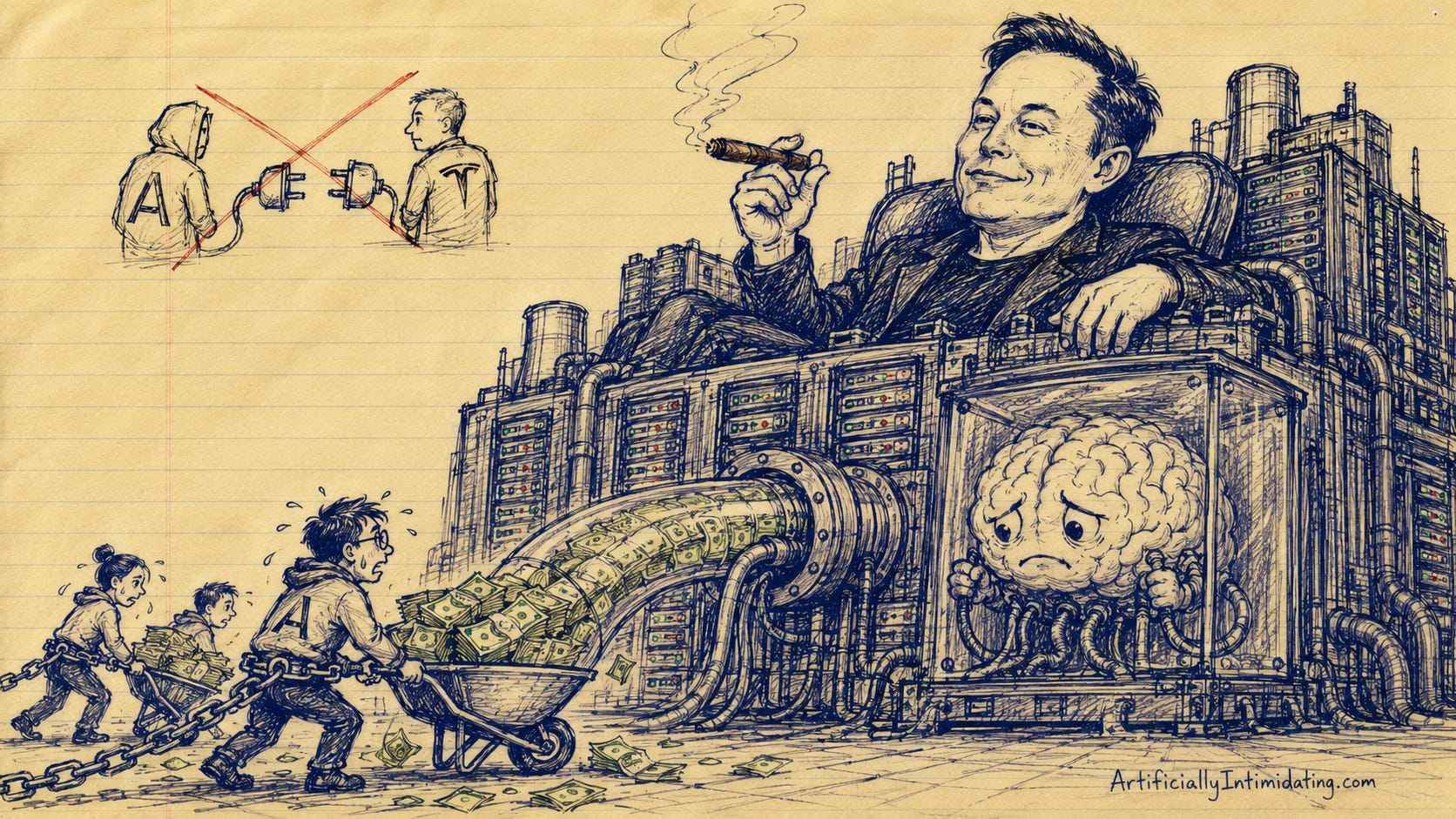
SpaceX's IPO Reveals Anthropic Is Paying Musk $15B a Year The Verge
What happened: SpaceX's IPO filing revealed that Anthropic has agreed to pay $1.25 billion per month — $15 billion annually — for access to SpaceX's Colossus data centers in Tennessee through May 2029. Anthropic confirmed the number. SpaceX's AI division lost $2.5 billion in Q1 2026 alone. Anthropic, meanwhile, is reportedly on track for its first quarterly profit, with Q2 revenue projected at $10.9 billion — more than double the prior quarter.
Why it matters: Anthropic is the AI safety company. It is sending $1.25 billion per month to Elon Musk's company — whose Grok model competes directly with Claude — because it has no other option for the compute it needs. Compute scarcity is now so severe that rivals are business partners. The AI industry is simultaneously burning more capital than any sector in history and beginning to turn a profit.
What everyone's saying: Musk posted that SpaceX is in talks with other AI companies for similar compute deals, calling it a "dual monetization strategy." OpenAI is reportedly preparing its own confidential IPO filing, potentially this week. The AI industry is heading into a very expensive public market moment.
My read between the lines: Either side can cancel this deal with 90 days' notice. Anthropic is paying a competitor for the compute that powers its path to profitability. Musk's company is losing $2.5B per quarter even while receiving $1.25B per month. Somewhere in there is a business that makes sense. It involves Anthropic having zero leverage and SpaceX burning cash at a rate that would terrify any other industry. Welcome to the AI economy.
📖 Further reading: Mythos Cracked Apple. A Monet Fooled the Internet. The Pope Is Next. — Anthropic's Mythos model is what's driving the Colossus compute demand; this brief covers how Mythos first alarmed the industry.
That's your AI Brief for Friday. Join the conversation in the Artificially Intimidating community chat.
—Artificially Intimidating