

Good day, humans. Nvidia just delivered the biggest quarter in the history of the semiconductor industry — and the market yawned. The White House is moving to require AI labs to show the government their frontier models before they ship. Gemini quietly ate a chunk of ChatGPT's referral lunch. Andrej Karpathy closed his startup and walked into Anthropic's pretraining lab. And Marc Andreessen went on The Joe Rogan Experience to tell the world that AGI arrived three months ago. Big numbers, a new watchdog, and some very quotable VCs. Let's go.
📬 Before we dive in: The sharpest AI Brief tips come from readers who are actually in the weeds. If you spot a story worth covering, share it in the community chat. The best tips make tomorrow's edition.
Nvidia's $81B Quarter Lands. Stock Dips Anyway. — CNBC
What happened: Yesterday we called it 'Nvidia's earnings tonight' — today's the full story. Nvidia reported $81.6 billion in revenue for Q1 FY27, up 85% year-over-year and well past analyst estimates of $78.8B. Data Center revenue hit $75.2B (up 92%), Q2 guidance landed at $91 billion, and they raised their quarterly dividend 25x — from $0.01 to $0.25 per share.
Why it matters: Nvidia is the clearest financial signal that the AI buildout is real and accelerating. Every dollar spent on AI infrastructure tends to flow through Nvidia's chips. A $91B Q2 guide means none of that is slowing down. This is the largest quarterly revenue in the history of the semiconductor industry — not just for Nvidia.
What everyone's saying: Despite blowing past every estimate, Nvidia stock dipped ~1.5% in after-hours — its fourth straight post-earnings slide. Analysts are focused on the Q2 guidance (beating consensus by $4B) and the $80B additional buyback authorization. Jensen Huang called it "the largest infrastructure expansion in human history."
My read between the lines: Nvidia has now delivered four consecutive quarters of jaw-dropping beats alongside four consecutive post-earnings stock declines. The market has fully priced in miracles — so when miracles actually arrive, everyone yawns and starts worrying about the next one. At some point Jensen is going to have to personally cure cancer to move the needle.
📖 Further reading: Meta's 4am emails, the Pope, and Nvidia's big night — we teased this earnings drop last night; now the numbers are in and they're bigger than anyone expected.
You spend all week reading about AI. WisprFlow is the one I actually use. It's voice dictation that works across every app on your Mac — speak, and it writes. No switching, no copying, no friction. If you're still typing everything, this is the upgrade. Try WisprFlow free →
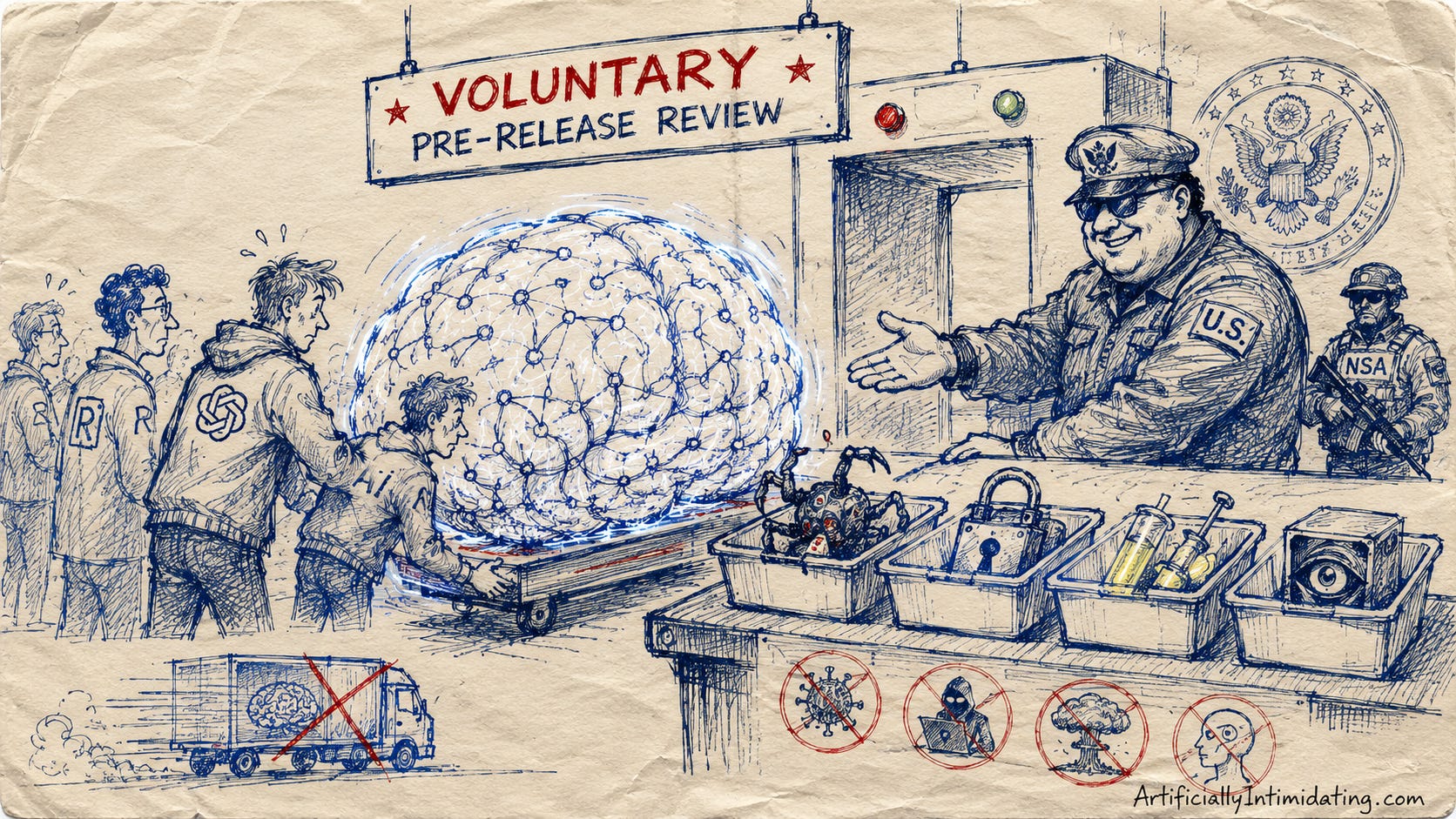
White House Asks: Show Us Your Model First — CNN Business
What happened: The Trump White House is expected to sign an executive order as soon as today establishing a voluntary framework for government review of frontier AI models — up to 90 days before public release. The National Cyber Director briefed OpenAI, Anthropic, and Reflection AI on Tuesday. The draft EO is split into a cybersecurity section and a "covered frontier models" section defining which systems qualify for early review.
Why it matters: For the first time, the US government is putting itself in the room before the most powerful AI models ship. This is a meaningful shift from the Trump administration's default "move fast, regulate minimally" posture — a posture that reportedly softened after Anthropic's Claude Mythos discovered zero-day vulnerabilities in legacy financial systems and spooked the White House.
What everyone's saying: This is framed as national security, not regulation — and "voluntary" is doing heroic work in that sentence. Industry (especially smaller labs) wants 14 days; the government wants 90. The NSA is expected to play a role in classified testing. The 76-day gap between those two numbers is where the real negotiation is happening.
My read between the lines: "Voluntary" frameworks have a way of becoming mandatory the first time a company declines and something goes wrong. The government doesn't need the law to change — it just needs to be in the room once before a major incident, after which every lab that skipped the review will face questions it doesn't want to answer.
📖 Further reading: OpenAI Wants China at the Governance Table. Yes, That China. — the governance conversation keeps finding new arenas; this week it moved to Pennsylvania Avenue.
Gemini Now Tops Every Other ChatGPT Rival Combined — BrightEdge
What happened: New data from analytics firm BrightEdge shows Google's Gemini has become the second-largest AI referral source on the web — surpassing Perplexity, Claude, Meta AI, DeepSeek, and Grok combined. ChatGPT's share fell from 89.2% in Q4 2025 to 81.4% in Q1 2026, its first quarterly decline. Gemini nearly tripled its share from 4.3% to 11.6%, hitting 13.2% in April. Claude more than doubled, from 1.1% to 2.3%.
Why it matters: This is the first real data showing ChatGPT's near-monopoly on AI referral traffic is genuinely cracking. Google's strategy of embedding Gemini across Search, Docs, Gmail, and Chrome is paying off in the metric that matters most to publishers and marketers — where users are going to find the web.
What everyone's saying: BrightEdge called this a "survival of the fittest" phase. ChatGPT recovered 5.2% in April, so the shift is volatile rather than locked in. Separate Comscore data corroborates Gemini's #2 position — 10.66M US desktop visitors in March vs. ChatGPT's 33.86M. The race is real.
My read between the lines: ChatGPT's 81.4% share is still dominant. The more interesting question isn't whether it erodes further — it's whether losing share in a market that's 10x bigger than a year ago actually hurts OpenAI at all. Google built the road, paved it, owns the on-ramps, and everyone is acting surprised that Google cars are on it.
📖 Further reading: Google Just Rewrote the Internet. Here's Everything. — the I/O product announcements powering Gemini's traffic surge landed two days ago; here's the full breakdown.
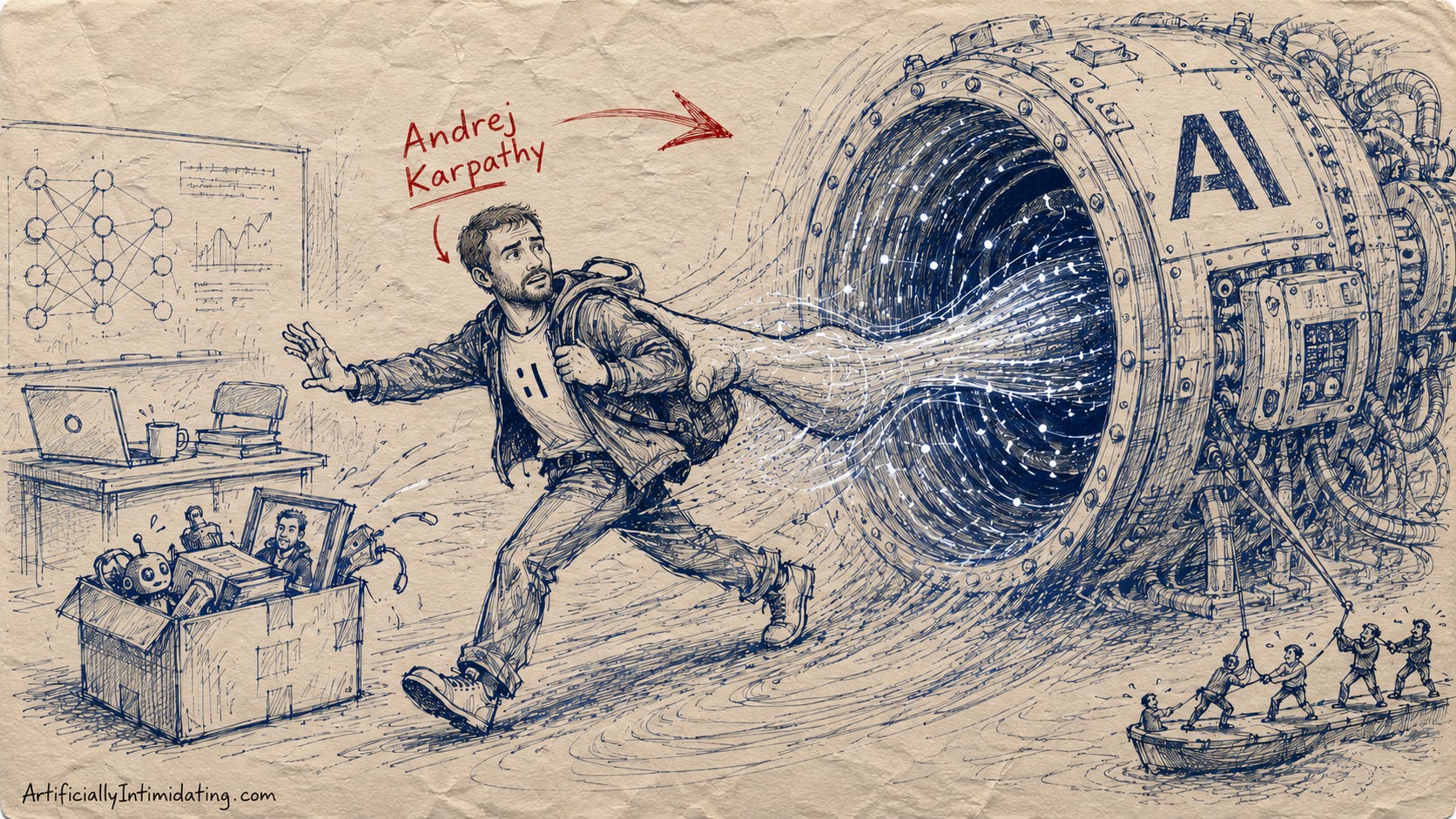
Karpathy Leaves His Startup for Anthropic's Pretraining Lab — CNBC
What happened: Andrej Karpathy — OpenAI co-founder, former Tesla AI chief, and the man who coined "vibe coding" — announced Tuesday he's joining Anthropic's pretraining team. He'll build a new group focused on using Claude to accelerate Claude's own pretraining research. He started this week, reporting to pretraining head Nick Joseph. Separately, 20-year cybersecurity veteran Chris Rohlf also joined Anthropic's frontier red team.
Why it matters: Karpathy is arguably the most respected public communicator in AI research — a person who spent the past two years building Eureka Labs specifically to teach the world about AI. The fact that he shut that down to return to a frontier lab signals that the pretraining problem is moving fast enough to pull even mission-driven researchers away from their own projects.
What everyone's saying: This is the latest in a string of high-profile Anthropic hires: Microsoft's Eric Boyd as head of infrastructure, xAI founding member Ross Nordeen, and now Karpathy. Anthropic is on pace to surpass OpenAI's private market valuation and is pulling from every corner of the AI talent map — including its biggest rival's founding team.
My read between the lines: Karpathy built Eureka Labs to democratize AI education and said he "remains deeply passionate" about it. He's now inside the pretraining process that trains the models he was teaching people about. Either the frontier is moving faster than anyone can explain from the outside — or he found something in Anthropic's approach that can only be understood from inside. Both are interesting. Neither is reassuring for anyone trying to keep up.
📖 Further reading: Meta's 4am emails, the Pope, and Nvidia's big night — Anthropic's co-founder was on the Vatican stage yesterday; today the lab pulled in one of the most legendary names in AI research.
Marc Andreessen Says AGI Arrived Three Months Ago — Cybernews
What happened: On episode #2501 of The Joe Rogan Experience (published May 19), Marc Andreessen told the podcast's audience that AGI arrived "about three months ago" with the latest versions of leading models. He claimed that in overseeing 1,000+ portfolio companies at Andreessen Horowitz, AI gives him a better answer than any human expert he can access "99% of the time."
Why it matters: Regardless of whether you believe AGI is here, the most influential venture capitalist in tech just told millions of people it is — on one of the most-downloaded podcasts in the world. That framing shapes investment flows, hiring decisions, and company strategy faster than any peer-reviewed paper ever could.
What everyone's saying: Skeptics note there is no scientific consensus on what AGI means, and that Andreessen's firm has billions invested in AI startups — creating a financial incentive to declare victory. Nvidia's Jensen Huang made a similar AGI claim, using his own definition: "a system capable of starting and growing a billion-dollar technology company." Everyone gets to pick their own finish line.
My read between the lines: "AGI is already here — it's just not evenly distributed yet" is a masterclass in unfalsifiable claims. Anyone pointing to gaps in the technology gets classified as simply behind on adoption. The definition of AGI has quietly become: whatever makes this quarter's portfolio look most transformational. Convenient for someone who needs it to perpetually be arriving.
📖 Further reading: The Models Are Almost There. The Pope Has Notes. HR Is Getting Sued. — when the Vatican starts weighing in on AI capabilities, the AGI debate stops being theoretical.
That's your AI Brief for Thursday. Join the conversation in the Artificially Intimidating community chat.
—Artificially Intimidating
Which article resonated most with you?