

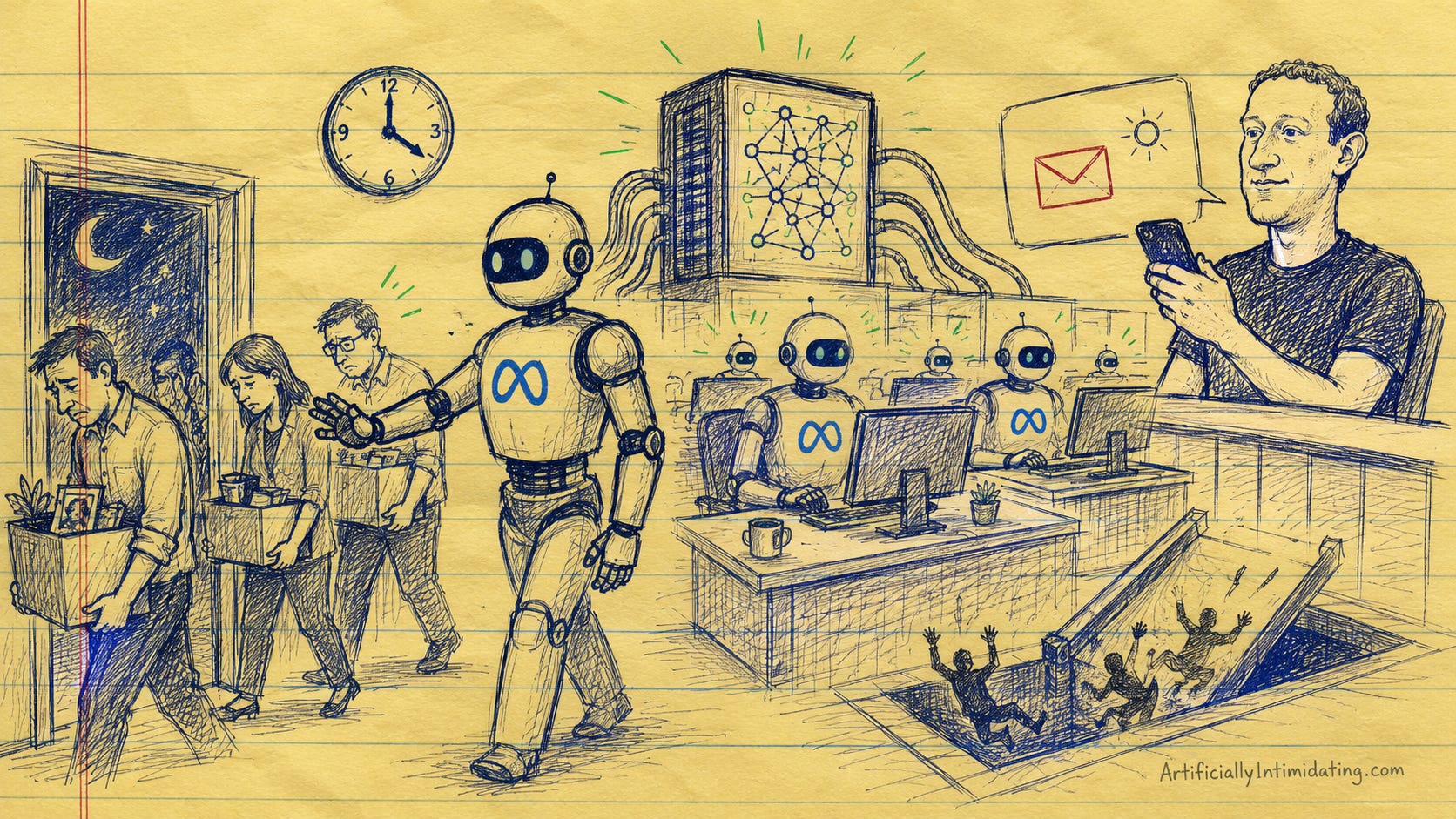
Good day, humans. The courtroom drama Silicon Valley staged for three weeks ended in two hours Monday — a California jury tossed Musk's OpenAI lawsuit before most people finished their coffee, clearing the runway for an IPO the company has been quietly preparing all year. Meanwhile, Meta started sending 4am layoff emails to 8,000 employees this morning, and Pope Leo XIV announced he will share a Vatican stage with Anthropic co-founder Chris Olah to present the first papal encyclical on artificial intelligence. If you caught last night's Google I/O special edition, you know Google rewrote the internet yesterday … And apparently the rest of the industry didn't get the memo to pause while the keynote was running.
📬 Before we dive in: The sharpest AI Brief tips come from readers who are actually in the weeds. If you spot a story worth covering, share it in the community chat. The best tips make tomorrow’s edition.
Musk’s OpenAI Crusade Dies on a Calendar — The Rundown AI
What happened: A California jury unanimously dismissed Elon Musk’s lawsuit against Sam Altman, OpenAI, and Microsoft in under two hours Monday, ending a three-week trial without ever ruling on whether OpenAI betrayed its nonprofit mission. The jury found Musk had known about OpenAI’s for-profit shift as early as 2021 — years before he sued in 2024 — and had blown past California’s three-year statute of limitations. He plans to appeal, calling it a “calendar technicality.”
Why it matters: The verdict clears the single biggest legal cloud over OpenAI’s planned IPO. Musk had sought court-imposed restrictions on the company’s for-profit mission; with those gone, OpenAI — now valued at $852 billion — can proceed toward public markets without a court potentially unwinding its corporate structure.
What everyone’s saying: Three weeks of leaked documents and billionaire testimony ended on a technicality rather than a ruling on the merits. Most coverage frames this as a procedural win for OpenAI, with Altman legally vindicated on a calendar rather than a principle. Musk’s lawyers are framing the appeal as the “real” case.
My read between the lines: The trial did more damage to xAI than to OpenAI. Grok downloads are down 60% since January, less than 1% of users pay for it, and 50+ employees departed for Meta and Thinking Machines Lab after SpaceX absorbed xAI at a $250 billion valuation — less than a third of OpenAI’s $852B. Musk went to court to slow a competitor; instead he published a detailed prospectus of his AI company’s weaknesses for the whole industry to read.
📖 Further reading: The SDK move that will cost OpenAI and Google millions to fix — The jury cleared OpenAI’s legal runway; yesterday we covered the SDK shift that reshapes the competitive ground it’s now racing on.
You spend all week reading about AI. WisprFlow is the one I actually use. It’s voice dictation that works across every app on your Mac — speak, and it writes. No switching, no copying, no friction. If you’re still typing everything, this is the upgrade. Try WisprFlow free →
Meta Started Sending Layoff Emails at 4am Today — New York Times
What happened: Meta began notifying 8,000 employees — 10% of its 78,000-person workforce — of layoffs Wednesday morning, starting with 4am emails in Singapore and rolling through Europe and the US. Another 7,000 employees are being involuntarily moved into four new AI divisions. Meta now expects to spend $125–145 billion in capital expenditures this year, mostly on AI infrastructure.
Why it matters: This is the biggest single-day tech layoff event of 2026, and unlike previous rounds, many jobs aren’t just being cut — they’re being explicitly replaced by AI agents. Meta’s own internal memos describe the goal as having AI handle “tasks now done by humans.” For the first time at scale, a major company is publicly naming AI substitution rather than dressing it up as restructuring.
What everyone’s saying: Officially it’s a strategic pivot to AI-first structure. Unofficially, employees describe “anger and anxiety” across the company, hundreds planned “commiserate or celebrate” drinks in New York, and HR told workers to stay home before sending 4am termination emails. It’s the deepest round of cuts since Zuckerberg’s 2022 “year of efficiency.”
My read between the lines: Meta is trailing OpenAI, Google, and Anthropic in the generative AI race — and it’s burning $130 billion this year trying to catch up while cutting the 10% of the workforce that was supposed to execute that strategy. The bet is that the AI agents being built by the 7,000 reassigned workers will replace the productivity of the 8,000 who got 4am emails. That’s not a restructuring. That’s a wager.
📖 Further reading: The Models Are Almost There. The Pope Has Notes. HR Is Getting Sued. — “HR Is Getting Sued” was Monday’s tease; today Meta made the HR story concrete at 4am.
The Pope and the AI Researcher Are Sharing a Stage — Sojourners
What happened: Earlier this week we called it “The Pope Is Next” — today’s the full story. Pope Leo XIV will personally present his first encyclical, “Magnifica Humanitas” (Magnificent Humanity), at a Vatican press conference on May 25, breaking with centuries of tradition. Joining him on stage will be Chris Olah, co-founder of Anthropic. The document is expected to address AI in warfare, human dignity, and workers’ rights. VP JD Vance already called it “a very, very important document.”
Why it matters: Encyclicals carry real-world policy weight to 1.4 billion Catholics and directly influence government positions in regions where the Church’s voice shapes law. Presenting alongside a tech co-founder — rather than a cardinal — signals intent to engage Silicon Valley as a collaborator, not just a moral critic. That’s a significant shift in how institutions outside tech are approaching AI governance.
What everyone’s saying: Catholic media is focused on the unprecedented presentation format. Tech media is focused on Anthropic’s involvement. Everyone agrees that choosing Chris Olah — who studies how neural networks develop internal representations, not just whether they perform well — is notably more substantive than a standard PR partnership. “Magnifica Humanitas” is already being called the most consequential moral document on AI ever published.
My read between the lines: The Church picked the one AI researcher known for asking whether AI systems understand anything at all, not just whether they can predict the next token. Olah’s mechanistic interpretability work asks whether there’s something like genuine concepts inside these models. That’s either the perfect collaborator for a document about human dignity — or a sign that even the Vatican can’t answer the question it’s trying to regulate.
📖 Further reading: Mythos Cracked Apple. A Monet Fooled the Internet. The Pope Is Next. — The brief that first dropped the tease — in hindsight, the most important four words in last Friday’s edition.
Cursor’s New Model: Near-Frontier at $1 a Task, SpaceX Wants It for $60B — The Next Web
What happened: Cursor released Composer 2.5, an agentic coding model built on Moonshot AI’s open-source Kimi K2.5, trained with 25x more synthetic tasks than its predecessor. It benchmarks near Claude Opus 4.7 and GPT-5.5 on coding tasks, but costs under $1 per task versus up to $11 for those models. Separately, SpaceX disclosed a signed agreement to acquire Cursor for $60 billion once its $75 billion IPO closes June 12 — filing for what would be the largest stock-market debut in history, eclipsing Saudi Aramco.
Why it matters: Composer 2.5 demonstrates that open-source foundations plus focused reinforcement learning can reach near-frontier coding performance at a fraction of frontier prices. At under $1 per task, serious agentic coding workflows become economically viable for most engineering teams — not just hyperscale companies. Price compression in AI coding isn’t a trend anymore. It’s the market structure.
What everyone’s saying: Coverage is dominated by the $60B acquisition headline rather than the model release, which is almost backwards — the model is the more consequential development for working developers. A 60x revenue multiple on a $1B ARR startup tells you exactly where “AI developer tooling” sits in the current arms race.
My read between the lines: Cursor went from $500M ARR in May 2025 to $1B ARR by October — doubling in five months. SpaceX is paying $60 billion to lock in the coding-AI distribution layer before it fully commoditizes. The irony: Composer 2.5 is precisely the thing accelerating that commoditization. SpaceX may be acquiring a business that its own acquisition is in the process of obsoleting.
Nvidia Reports Tonight: The AI Economy’s Real Report Card — Kiplinger
What happened: Nvidia reports its fiscal Q1 2027 results tonight after market close. Wall Street expects $79.2 billion in revenue — up 80% year-over-year — and $1.78 in adjusted EPS, up 120%. The four largest hyperscalers (Alphabet, Amazon, Microsoft, Meta) have collectively committed roughly $725 billion in capital expenditure for 2026, up 77% from last year, with most earmarked for AI infrastructure that runs on Nvidia chips.
Why it matters: Nvidia’s quarterly reports have become the single best real-time gauge of whether the AI infrastructure buildout is accelerating or plateauing. At $5.4 trillion market cap, a strong beat tonight could briefly make Nvidia the world’s first $6 trillion company. More importantly, Jensen Huang’s guidance will tell us whether Trump’s chip export restrictions to China are actually biting — or whether hyperscaler spending is large enough to absorb them.
What everyone’s saying: Wall Street expects another beat and a strong guide, but analysts openly wonder whether we’ll “finally see a more positive stock reaction after a series of blasé moves following solid prints.” The deeper question for the AI industry is whether $725 billion in hyperscaler capex is the ceiling or the floor for 2026.
My read between the lines: Every story in today’s brief — Meta cutting 8,000 jobs to fund AI infrastructure, Cursor acquired for $60B, the Pope collaborating with an AI lab — is downstream of whether Nvidia can keep supplying the chips that run everything. Tonight’s earnings call isn’t really about Nvidia. It’s a referendum on whether the entire AI investment thesis holds for the next two years.
📖 Further reading: Jensen Huang on Air Force One isn’t the real chip story — Tonight’s Nvidia call is the next chapter in the chip story Nicholas was tracking last week.
That’s your AI Brief for Wednesday. Join the conversation in the Artificially Intimidating community chat.
—Artificially Intimidating