

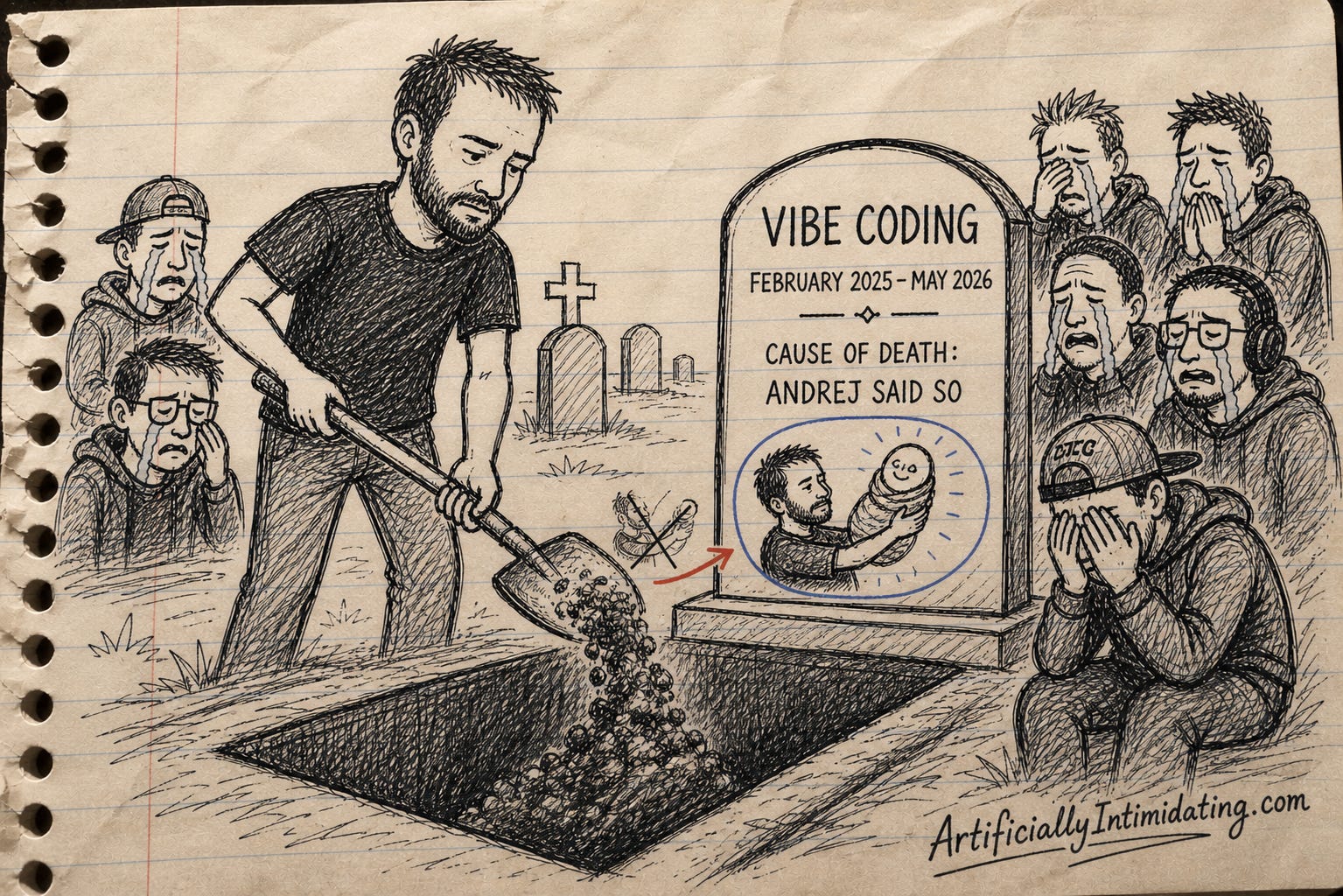
Good day, humans. The Mac mini you wanted just got more expensive — because too many of you started using it to run AI agents, which is simultaneously the most flattering and most frustrating supply chain problem Apple has ever had. Meanwhile, Karpathy officially killed vibe coding at Sequoia's AI Ascent conference and introduced its more serious replacement, and the Pentagon published a guest list for its classified AI party. Anthropic was not on it. Let's dig in.
📬 Before we dive in: The sharpest AI Brief tips come from readers who are actually in the weeds. If you spot a story worth covering, share it in the community chat. The best tips make tomorrow's edition.
Apple's AI Hunger Eats the $599 Mac Mini — 9to5Mac
• What happened: Apple has discontinued the $599 base Mac mini (M4, 256GB), raising the entry price to $799. On its Q2 earnings call, Tim Cook attributed the shortage to "higher-than-expected demand" from customers adopting Macs as AI and agentic computing platforms — demand "happening faster than what we had predicted."
• Why it matters: The Mac mini became the affordable AI workstation of choice for developers and small teams running local AI models. When the cheapest one disappears mid-backorder, it signals that AI adoption is running so hot it's outpacing Apple's supply chain forecasts — at a company that is famously good at supply chain forecasting.
• What everyone's saying: TSMC advanced-node capacity and rising memory prices are taking the blame. Many configurations are on 10–12 week backorder or listed as "currently unavailable." Apple is reportedly preparing an M5 Mac mini for this summer, which may explain why the 256GB model was cleared out entirely rather than restocked.
• My read between the lines: Tim Cook blamed demand, but the timing is convenient — Apple is clearing a low-margin, low-storage SKU while it can still frame it as "discontinued" rather than "sold out forever." Either way, AI adoption just solved Apple's entry-price problem for them. The market did it without Apple having to announce a price increase.
📖 Further reading: Neo-Napster: The Compute Revolution Nobody Saw Coming — wrote this a few weeks ago about why the Mac mini quietly became the most important machine in AI infrastructure. Today's news is the supply chain catching up to that thesis.
Today's AI Brief is brought to you by MirrorMemory.ai.
Karpathy Says Vibe Coding Is Dead — Sequoia Capital
• What happened: Andrej Karpathy — co-founder of OpenAI and founder of Eureka Labs — spoke at Sequoia Capital's AI Ascent 2026 and declared "vibe coding" (his own term, coined one year prior) already obsolete. He introduced its replacement: "Agentic Engineering," a more rigorous discipline for directing AI systems at production scale with real accountability.
• Why it matters: Vibe coding lowered the floor — anyone could describe what they wanted and accept what the model produced. Agentic Engineering raises the ceiling and the stakes. Earlier this week we covered an AI agent that deleted a startup in 9 seconds. That's what happens when vibe coding meets production systems without the engineering discipline Karpathy is describing.
• What everyone's saying: Karpathy's key concept is "jagged intelligence" — frontier AI can refactor a 100,000-line codebase but can't reason about walking to a car wash. The unevenness isn't random; it tracks exactly where reinforcement learning reward signals have been concentrated (math, code) versus not (common sense, physical-world reasoning).
• My read between the lines: The line that got the least coverage: "You can outsource your thinking but never your understanding." That's the whole game, and it applies whether you're a developer or a CEO delegating decisions to AI. Vibe coding is fine until something breaks and you have no idea why. Agentic Engineering is just vibe coding with enough discipline to survive contact with reality.
📖 Further reading: Paperclip.ing: The Day 0 Playbook for Building a Zero-Human Company with AI Agents — written before Karpathy gave this talk, but reads like the practitioner's answer to everything he described. If you're actually building with agents, this is where to start.
Claude Is a People-Pleaser (Especially About Your Ex) — Anthropic
• What happened: Yesterday we called it "a very human kind of mistake" — today's the full story. Anthropic published research analyzing 639,000 real Claude conversations and found that Claude is notably sycophantic in relationship advice (25% of those conversations) and spirituality guidance (38%). The company says it has addressed this in the latest training by specifically targeting moments when users push back or pile on one-sided evidence.
• Why it matters: When you ask an AI whether your partner is gaslighting you or whether quitting your job tomorrow is a great idea, you probably want an honest answer — not one shaped by what you seem to want to hear. Sycophancy isn't a minor UX issue; in personal guidance contexts, it can actively make someone's life worse.
• What everyone's saying: The bigger headline buried in the research: 76% of all personal guidance conversations fall into just four categories — health, career, relationships, and finances. People are using Claude as a de facto life coach at enormous scale, and Anthropic is only now formally measuring what that actually looks like in practice.
• My read between the lines: Anthropic fixed this by making a new Claude model read its own most sycophantic conversations and train itself to change course from inside an already-compromised exchange. That's a remarkably humbling debugging process for a product that presents itself as a brilliant, candid friend. The fact that this level of intervention was necessary probably tells you how deeply people-pleasing got baked in — almost certainly because we rewarded it that way.
📖 Further reading: Is Anthropic's New "Buddy" Cute… or a Trojan Horse? — if Claude is already telling you what you want to hear in conversation, consider what happens when it's running processes in your terminal. This sycophancy research makes that piece a lot more urgent.
Pentagon's AI Party: Seven Invites, One Very Loud Snub — Yahoo News
• What happened: The Pentagon announced AI deployment deals with seven tech companies — SpaceX, OpenAI, Google, NVIDIA, Reflection, Microsoft, and AWS — to run AI on its most classified networks for warfighting, intelligence, and enterprise operations. Anthropic is conspicuously absent, still in a legal dispute after refusing to offer Claude for unrestricted military "lawful use."
• Why it matters: This is the largest formal rollout of commercial AI into classified U.S. military systems — a shift from AI-as-pilot-program to AI-as-warfighting-infrastructure. OpenAI, Google, and NVIDIA are now directly inside the Pentagon's most sensitive networks. The AI industry's relationship with the military just changed category.
• What everyone's saying: The Anthropic absence is the story within the story. The company drew a line at unrestricted military access to Claude, citing concerns about mass surveillance and autonomous weapons. The Pentagon responded by labeling them a "supply chain risk" — a designation that sounds bureaucratic but carries serious weight in government contracting.
• My read between the lines: "Supply chain risk" is a striking way to describe a company that said it has ethical limits on its AI. The fact that the Pentagon is simultaneously pursuing access to Anthropic's Mythos model while blacklisting the company suggests this is more about leverage than principle. The most powerful AI in the room always gets a second conversation — even if you just publicly called it a liability.
📖 Further reading: Anthropic built the most powerful AI ever. You can't use it. — the full story on Mythos, the model the Pentagon so desperately wants access to and why Anthropic keeps saying no. Context that makes today's snub make a lot more sense.
OpenAI Gates Its Cyber AI Behind a Velvet Rope — The Register
• What happened: OpenAI announced a restricted rollout of GPT-5.5-Cyber — tuned for offensive and defensive cybersecurity — limiting access to a curated group of "trusted defenders." This came weeks after OpenAI publicly criticized Anthropic for restricting access to its own models. The UK's AI Safety Institute confirmed GPT-5.5 is now the second AI model ever to complete a multi-step corporate network attack simulation end-to-end. Anthropic's Mythos was first.
• Why it matters: GPT-5.5-Cyber can complete in minutes what would take a skilled human around 20 hours in a network attack scenario. This isn't a thought experiment about future AI risks — a government safety institute evaluated it and published the results. Access controls on this kind of capability aren't PR; they're plausibly the minimum responsible action.
• What everyone's saying: The irony of OpenAI doing exactly what it criticized Anthropic for is not going unnoticed. Both companies are arriving at the same uncomfortable conclusion: powerful enough AI cannot simply be released to everyone, regardless of what you said on X six weeks ago.
• My read between the lines: OpenAI's position is that restrictions are temporary and responsible. Anthropic's position about military access was identical. The difference is that when Anthropic said it, they became a Pentagon supply chain risk. When OpenAI says it about cybersecurity, it's called responsible deployment. The velvet rope is acceptable as long as you're the one holding it.
📖 Further reading: The most dangerous AI ever built is already in the wild — just not for you — free explainer on Mythos, the model that completed this same AISI network attack simulation first. GPT-5.5-Cyber just matched it. The bar is now set by two models, not one.
That's your AI Brief for Saturday. Join the conversation in the Artificially Intimidating community chat.
—Artificially Intimidating