

Good day, humans. Google I/O 2026 is live today and the announcements are already arriving faster than you can read them — Gemini Intelligence is Google's bet that your phone should just handle things for you, Googlebook laptops are a thing now, and somehow Anthropic pulled off the most aggressive SDK land-grab in the AI industry's short history. Oh, and Elon Musk lost his lawsuit against OpenAI, which was always going to be the end of that story.
📬 Before we dive in: The sharpest AI Brief tips come from readers who are actually in the weeds. If you spot a story worth covering, share it in the community chat. The best tips make tomorrow's edition.
Google's Entire Bet — CNET Live Updates
What happened: Google I/O 2026 kicked off today with a wave of AI announcements centered on "Gemini Intelligence" — Google's new branding for an agentic layer across Android that can read your screen, navigate between apps, and complete multi-step tasks on your behalf. Press the power button, describe what you need (booking a reservation, assembling a grocery cart), and Gemini works through it in a secure window that asks for confirmation before completing any transaction. Google also unveiled the Googlebook: a new category of laptops built around Gemini rather than Chrome, with hardware arriving this fall from Acer, Asus, HP, Lenovo, and Dell.
Why it matters: "Gemini Intelligence" is Google's answer to the question every phone user has: why can't my device just do the thing? It can now, sort of. For everyday people, this is the first version of AI that acts more like an assistant and less like a very fast search box — it takes action across your apps, then waits for you to say go. The Googlebook signals something bigger: Chrome OS may be quietly on its way out, and Gemini is the new platform.
What everyone's saying: Pre-conference buzz was all about Gemini 4, but the real show is Google making Gemini the connective tissue across phones, laptops, Wear OS, Android Auto, and smart glasses. Alphabet stock is up roughly 25% year-to-date with expectations elevated — analysts are watching for a "standout announcement" and this batch of Gemini Intelligence features looks like a genuine answer.
My read between the lines: Google spent three years answering "are you losing the AI race?" with press releases. Today they answered with a developer conference. Gemini Intelligence is the operating system play they needed — AI not as a feature, but as the infrastructure everything else runs on. The name "Googlebook" is either visionary or a symptom of someone who's been staring at slides for too long. History will decide.
You spend all week reading about AI. WisprFlow is the one I actually use. It's voice dictation that works across every app on your Mac — speak, and it writes. No switching, no copying, no friction. If you're still typing everything, this is the upgrade. Try WisprFlow free →
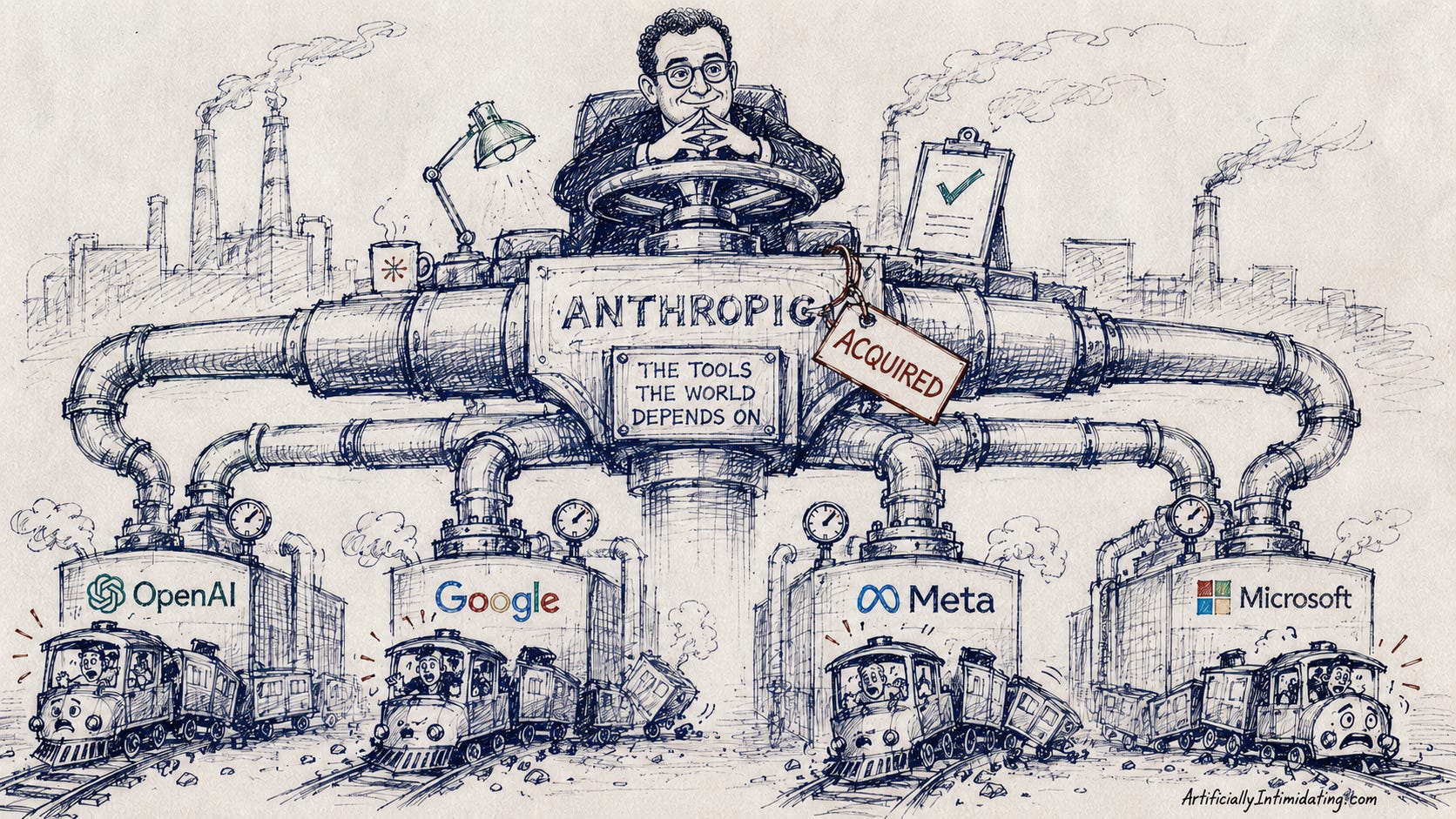
Anthropic Bought the Tools Its Rivals Depend On — Anthropic.com
What happened: Anthropic acquired Stainless, a startup that built the software development kits (SDKs) used by OpenAI, Google, Meta, and Cloudflare to let developers access their AI services. The deal is reported at over $300 million — more than double Stainless's valuation from just five months ago. Anthropic is shutting down Stainless's hosted services for all other customers; existing clients keep what they've already built.
Why it matters: An SDK is the toolkit that lets developers plug an AI model into their apps. Every major AI lab — OpenAI, Google, Meta — has been using Stainless's tools to build those kits. Now Anthropic owns the company that made them. Competitors will need to rebuild their developer tooling from scratch, a process that takes months and significant engineering resources even for the largest players in the field.
What everyone's saying: The coverage calls it an infrastructure play disguised as a startup acquisition. Stainless also built Model Context Protocol (MCP) server infrastructure — the open standard Anthropic invented for how AI agents connect to external services. Owning both the SDK generation layer and MCP infrastructure gives Anthropic unusual leverage over how the entire AI developer ecosystem is structured going forward.
My read between the lines: This is a chess move disguised as a corporate acquisition. Anthropic just bought the equivalent of the loading dock that all of its competitors use to ship their products. The subtle genius: it's perfectly legal, not a regulatory red flag, and completely devastating to rivals. OpenAI and Google will rebuild — but not for free, and not today. This is what it looks like when a company that's been called "safety-focused" starts playing offense.
📖 Further reading: Your laptop has been in the way this whole time — Anthropic's infrastructure ambitions just got a lot more interesting; this explains the managed agents vision they're building toward.
The Jury Has Spoken. Musk Lost. — TechCrunch
What happened: A federal jury in Oakland sided with OpenAI and Sam Altman on Monday, rejecting Elon Musk's lawsuit alleging the company betrayed its nonprofit mission by going commercial. The nine-member jury found Musk's 2024 lawsuit was filed too late — past the statute of limitations. The verdict is advisory; the judge retains final authority and will issue her ruling in the coming weeks. Three weeks of Silicon Valley drama featuring testimony from Satya Nadella and Ilya Sutskever ended quietly.
Why it matters: This removes the single biggest legal cloud hanging over OpenAI as it prepares for a potential IPO at a $1 trillion valuation. Musk had sought billions in damages, the removal of Sam Altman and Greg Brockman, and the unwinding of OpenAI's for-profit conversion. None of that is on the table anymore. For anyone building on or investing in OpenAI, this is the all-clear signal.
What everyone's saying: OpenAI called it "sour grapes" from a co-founder who left in 2018 and started a competing AI company. Musk's team argued the statute of limitations clock shouldn't have started until Microsoft's $10 billion investment in 2023 made the commercial transformation undeniable. Legal experts had flagged the limitations issue as Musk's greatest vulnerability from the start — this was the most likely outcome.
My read between the lines: Musk filed a lawsuit to stop OpenAI from becoming a trillion-dollar for-profit company. By the time the jury ruled, OpenAI was already worth $850 billion and preparing to go public. Courts move too slowly to regulate the AI industry — and now there's a federal court record confirming it. The real story is that it took three weeks of celebrity testimony to reach a conclusion that was essentially a calendar dispute.
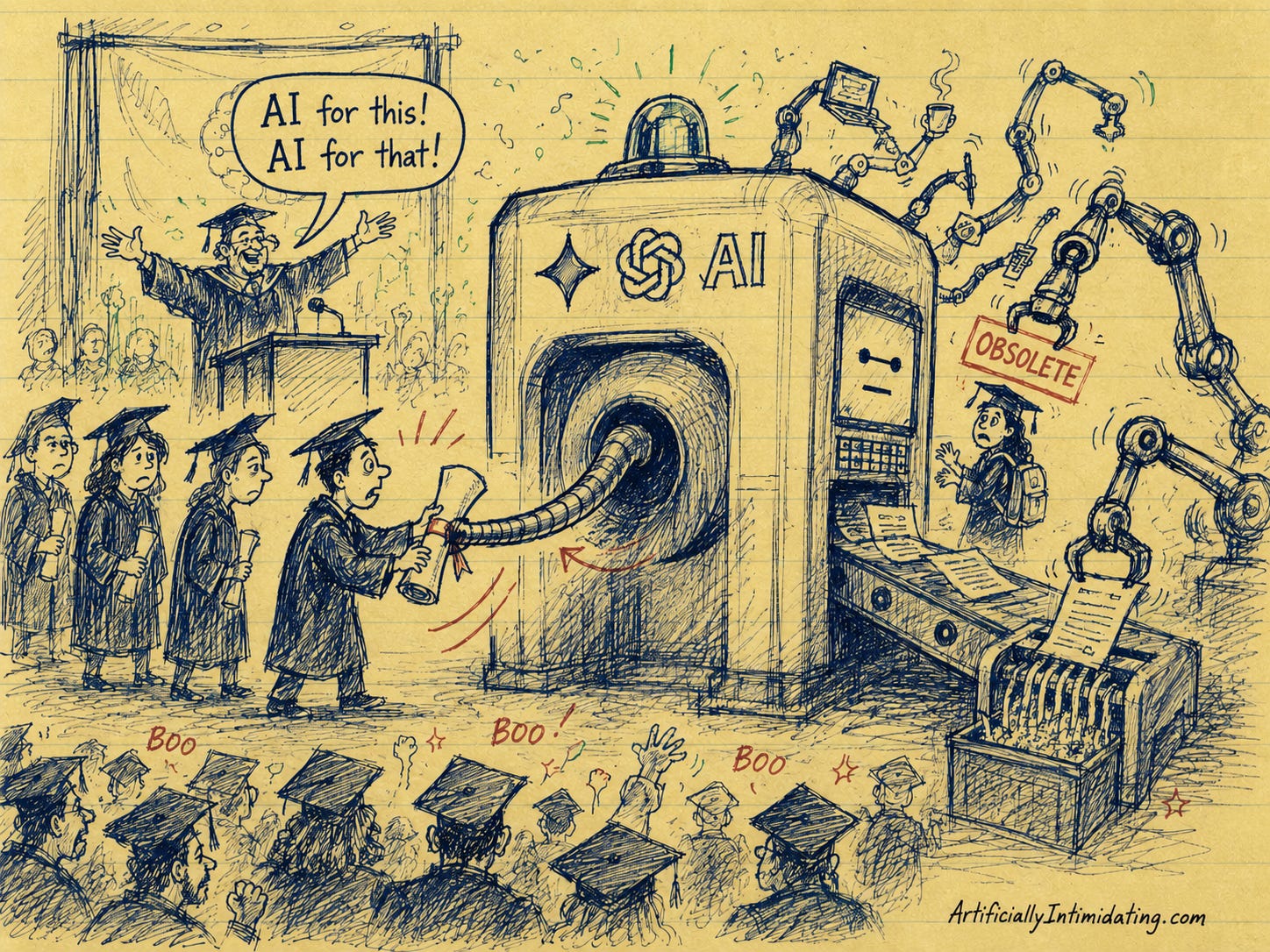
Class of 2026 Has Notes on the AI Hype — NBC News
What happened: At graduation ceremonies across the United States this month, students have been booing commencement speakers who offered optimistic talking points about AI. Former Google CEO Eric Schmidt was jeered at the University of Arizona when he suggested graduates could assemble teams of AI agents to do work they couldn't do alone. An executive at the University of Central Florida got the same treatment for calling AI "the next Industrial Revolution." The pattern is spreading across campuses.
Why it matters: This isn't just vibes — it's measurable. A Gallup survey from April found only 22% of Gen Z respondents are excited about AI, down 14 points from 2025. Anger rose to 31%. Nearly half of employed Gen Zers say AI risks outweigh benefits. They're graduating into a job market where 47% of companies expect to halt entry-level hiring by 2027 because of AI. The people being asked to celebrate the technology are the same people bearing its costs.
What everyone's saying: The coverage frames it as a widening disconnect between corporate speakers and the graduates receiving them. Even daily AI users among Gen Z have grown less positive — excitement dropped 18 points among that group in a single year. A Gallup researcher's summary: "In 2026, the most prevalent emotions are anger and anxiety, and the least commonly felt sentiments are excitement and hopefulness."
My read between the lines: Eric Schmidt, the man who oversaw Google's greatest decade, got booed off a stage by 22-year-olds for celebrating the exact technology his former company is betting its future on. That's not just irony — it's a brand problem. The AI industry has spent years promising augmentation, not replacement. The Class of 2026 just reviewed that pitch and filed a noise complaint. One star.
📖 Further reading: The chatbot psychosis story the industry doesn't want to talk about — the Gen Z unease erupting at graduation ceremonies is the retail version of a concern that runs a lot deeper than commencement speeches.
Alexa Is Now Your Podcast Producer — Amazon News
What happened: Amazon launched "Alexa Podcasts," a feature for its Alexa+ AI assistant that generates custom podcast episodes on any topic you request. Tell Alexa what you're curious about, it researches the subject from 200+ news sources, gives you an outline to review, lets you adjust the length and tone conversationally, then produces an AI-hosted audio episode. The feature is available immediately to Alexa+ subscribers in the US — free for Prime members, $19.99/month for everyone else.
Why it matters: This is the most frictionless AI audio product yet — no documents, no uploads, no configuration. For anyone who wants the information density of a podcast without the work of finding a good one on their specific topic, this is that. Google's NotebookLM already does something similar; Spotify is building in this direction; ElevenLabs has GenFM. Amazon's entry changes the distribution math: Alexa is already in tens of millions of homes.
What everyone's saying: The immediate comparison is to Google's NotebookLM Audio Overviews, which have become a genuine tool for researchers and professionals who want their reading turned into audio. Amazon's advantage is simplicity and scale — no setup required, just ask. The AI audio space is becoming genuinely crowded, with Spotify, ElevenLabs, Amazon, and Google all competing for the same habit.
My read between the lines: The most interesting line in Amazon's announcement wasn't about podcasts. It was the throwaway mention of future features including "content based on users' own documents." Amazon just described the endpoint of this product: a personal AI that turns your files, notes, and reading list into audio you can consume on a walk. They're not building a podcast generator — they're building the media company of one. The podcast is just the first episode.
That's your AI Brief for Tuesday. Join the conversation in the Artificially Intimidating community chat.
—Artificially Intimidating