

Good day, humans. Google I/O starts tomorrow — Gemini 4, XR glasses, the works — but the industry didn't take the day off. Apple showed its hand on a standalone Siri app with privacy baked in from the start. OpenAI quietly became the first AI company to cut a nation-state deal (it's with Malta). xAI is fighting California in the 9th Circuit over what it trained on. And Colorado just repealed the first serious AI law in the country. Full Monday.
📬 Before we dive in: The sharpest AI Brief tips come from readers who are actually in the weeds. If you spot a story worth covering, share it in the community chat. The best tips make tomorrow's edition.
Apple's Standalone Siri Gets Auto-Deleting Chats — Bloomberg / Mark Gurman
What happened: Apple is building a standalone Siri app (codenamed "Campo") to compete directly with ChatGPT and Gemini. Under the hood it's powered by Google's Gemini models, routed through Apple's Private Cloud Compute. The signature feature: auto-deleting chats with options to keep conversations 30 days, one year, or forever — the same framework already used in iMessage. Preview at WWDC June 8; ships with iOS 27 this fall.
Why it matters: Siri has been a running joke for years. Apple is finally making a serious play, and it's leading with privacy as the differentiator rather than raw capability — a smart bet as regulators crack down on how AI companies handle user data. A chat bubble interface, file uploads, and switchable models (ChatGPT or Gemini, your choice) make this more than a cosmetic refresh.
What everyone's saying: Apple is late, and it's shipping the app with a beta label even at launch — a rare public admission they're still building in production. The consensus is cautious optimism: the design looks right, the privacy angle is genuine, but Apple has made Siri promises before and burned that goodwill badly.
My read between the lines: Apple isn't trying to win the model race. It's trying to own the trust layer. The fact that Siri routes queries through Private Cloud Compute before they touch Google's Gemini — and gives you receipts on how long the conversation lasts — is a product statement: every other AI assistant is watching you. This one lets you forget. That might be worth more than smarter answers.
📖 Further reading: Your laptop has been in the way this whole time — Apple's Siri app is really about owning the agentic layer on your device; this post explains why that battle matters more than the chatbot interface.
You spend all week reading about AI. WisprFlow is the one I actually use. It's voice dictation that works across every app on your Mac — speak, and it writes. No switching, no copying, no friction. If you're still typing everything, this is the upgrade. Try WisprFlow free →
Google I/O 2026 Kicks Off Tomorrow — Gemini 4 Expected — Perplexity
What happened: Google's annual developer conference begins tomorrow (May 19) at the Shoreline Amphitheatre. Keynote at 10 a.m. PT, livestreamed on YouTube. On the expected slate: Gemini 4, Android 17, Project Aura XR glasses (built with Xreal and Qualcomm), and "Aluminium OS" — Google's merged Android-ChromeOS platform. Alphabet stock is up ~25% year to date heading in.
Why it matters: Google's Gemini has been losing power users to Claude and ChatGPT — a fact that power users have been broadcasting loudly on Google's own developer forums in the days leading up to I/O. A Gemini 4 with improved reasoning and real coding chops could reset that narrative. And with Android on billions of devices, Google's distribution advantage is enormous if it can get the models right.
What everyone's saying: Expectations are "elevated" — analyst code for setting you up to disappoint. Google had a banner Q1 ($109.9B revenue, +21.8% YoY) and the stock reflects it. The pressure going into I/O is high, and the company needs a standout AI moment, not just a feature checklist with screenshots.
My read between the lines: The real story isn't whether Gemini 4 benchmarks well. It's whether Google can convince developers the platform is worth betting on after years of instability. The viral "power users fleeing to Claude" thread on Google's own developer forum, published days before the keynote, is either a fire alarm or the best publicity Google didn't plan. Either way, the bar is set uncomfortably high.
📖 Further reading: The Models Are Almost There. The Pope Has Notes. HR Is Getting Sued. — Yesterday we covered how open-weight models are closing the gap on frontier AI; today's Gemini 4 announcement will tell us whether the frontier has moved again.
OpenAI Is Now Doing Nation-State Deals — Economic Times
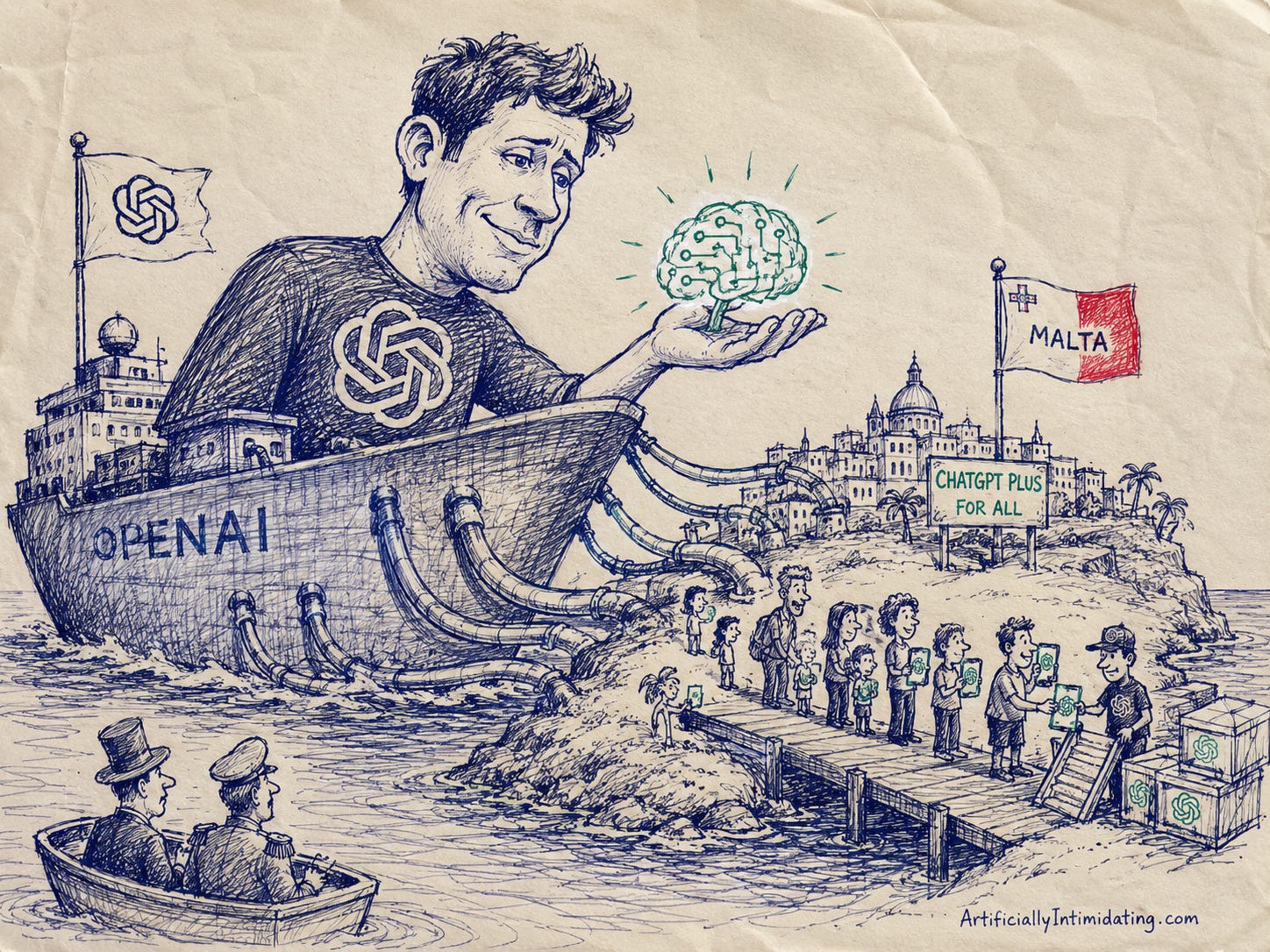
What happened: OpenAI signed a deal with the Maltese government to give every resident of Malta free ChatGPT Plus for one year — provided they complete a free AI literacy course. Malta becomes the first country to run this kind of programme. It's open to Maltese citizens living abroad too. About a third of Malta's 500,000-person population was already using ChatGPT before the deal.
Why it matters: This is OpenAI's "for Countries" strategy under Stargate going live. The playbook: partner with national governments on data centers, custom ChatGPT deployments, and national AI startup funds. Malta is a proof-of-concept — small, fast-moving, already AI-curious. If it works and produces measurable literacy outcomes, this model scales to every government that wants to be seen as leading on AI.
What everyone's saying: The framing is win-win: Malta upskills its population, OpenAI gets government-backed user acquisition and legitimacy. The financial terms were not disclosed — which means OpenAI is almost certainly subsidizing this. Economy Minister Silvio Schembri called it transformational. OpenAI is calling it a partnership.
My read between the lines: OpenAI is facing subscriber pressure as cheaper competitors flood the market. Locking in nation-state contracts — with the policy goodwill, adoption metrics, and regulatory cover they provide — is how you build a moat while the consumer AI market commoditizes. Malta has 500,000 people. The strategy it's testing has 8 billion potential beneficiaries.
📖 Further reading: OpenAI Wants China at the Governance Table. Yes, That China. — OpenAI's geopolitical ambitions have been growing fast; the Malta deal is the latest chapter in the company's bid to reposition itself as global AI infrastructure, not just a chatbot.

Elon's xAI Is Fighting to Hide What It Trained On — Perplexity
What happened: xAI has escalated its fight against California's AB 2013 — the state's AI training data transparency law — appealing to the 9th Circuit after a federal judge refused to block it. AB 2013 took effect January 1 and requires AI developers to publicly disclose high-level summaries of their training datasets: whether they contain copyrighted material, personal data, or synthetic content. OpenAI and Anthropic have already complied. xAI has not.
Why it matters: California is trying to make AI training data at least slightly transparent. xAI's argument — unconstitutional compelled speech, trade secrets exposure — could set precedent. A win at the 9th Circuit doesn't just protect Grok's training secrets; it becomes the legal framework that slows every state-level AI disclosure rule from coast to coast.
What everyone's saying: The optics are rough for xAI. OpenAI and Anthropic — companies with equally valuable proprietary training processes — looked at the same law and filed their disclosures. xAI filed a lawsuit. Legal observers note the 9th Circuit's framework for compelled corporate disclosure is quite broad, making this appeal an uphill fight. The district judge already rejected xAI's trade secret defense as too vague to hold up.
My read between the lines: xAI also filed a separate suit against Colorado's AI Act — which Colorado then repealed anyway (see story 5). There's a pattern here: challenge every state-level AI transparency rule, drag it into years of litigation, and let the political environment shift. With 1,500 AI bills in 45 states in 2026 alone, that's expensive. But it's apparently cheaper than disclosing what Grok was actually trained on.
America's First State AI Law Was Just Repealed by Its Own State — Troutman Privacy
What happened: Colorado's governor signed SB 26-189 into law, officially repealing and replacing the Colorado AI Act — the first comprehensive state AI law in the United States. The original 2024 law required AI developers to assess and mitigate algorithmic discrimination risks and maintain risk management programs. The replacement strips most of that out: it's now a disclosure-only framework with narrower obligations and limited consumer rights.
Why it matters: Colorado's AI Act was the first major test of whether U.S. states could regulate AI ahead of Congress. Its rollback is a signal: the business coalition against aggressive state-level AI regulation is winning. The EU-style approach — duty of care, risk assessments, impact reports — has little political staying power when companies threaten to deploy their AI elsewhere.
What everyone's saying: AI industry groups call the new law "a more balanced framework." Consumer advocates call it a gutting. Both are right. The replacement still requires disclosures and still allows lawsuits in narrow cases — but the structural teeth of the original (the duty of care, the risk management mandate) are gone.
My read between the lines: Colorado didn't repeal this law because it was bad policy. It repealed it because companies threatened to stop deploying AI in the state, and Governor Polis — a tech-friendly Democrat — decided adoption beats protection. Every state legislature will face this same choice. Most will probably make the same call. The practical lesson for anyone watching federal AI legislation: whoever moves first absorbs the political heat, and the heat is enough to melt most laws.
📖 Further reading: OpenAI Wants China at the Governance Table. Yes, That China. — The regulatory race between AI companies and governments isn't just a U.S. story; this week's geopolitics episode is the backdrop for understanding why Colorado just blinked.
That's your AI Brief for Monday, May 18. Join the conversation in the Artificially Intimidating community chat.
—Artificially Intimidating