

Good day, humans. DeepSeek just got formally evaluated by NIST, and the result is... complicated. The open-weight model wave is cresting — Gemma 4, DeepSeek V4, Kimi K2.6, MiMo 2.5, and GLM-5.1 all dropped this month — and depending on who's doing the measuring, the gap with ChatGPT is either 3 months or 8 months. Meanwhile, Pope Leo XIV just formalized his AI study group ahead of the first-ever papal encyclical on artificial intelligence, and somewhere in an HR department, a lawyer is building an age discrimination case out of a job posting that said "AI fluency required." Let's get into it.
📬 Before we dive in: The sharpest AI Brief tips come from readers who are actually in the weeds. If you spot a story worth covering, share it in the community chat. The best tips make tomorrow's edition.
Open Models Are Almost Closing the Gap — Depending on How You Measure Perplexity Discover
What happened: May 2026 has been a record month for open-weight AI releases: Gemma 4, DeepSeek V4, Kimi K2.6, MiMo 2.5, and GLM-5.1 all dropped within weeks of each other. NIST's formal CAISI evaluation found DeepSeek V4 lags U.S. frontier models by roughly 8 months — performing comparably to GPT-5 from last August. Epoch AI's capabilities index puts the same gap at just 3–7 months.
Why it matters: Open-weight models are the ones anyone can download and run without a subscription or per-token fee — no sending your data to someone else's server. If the best openly available models are only a few months behind ChatGPT and Claude, developers and businesses now have a serious self-hosted alternative at a fraction of the cost.
What everyone's saying: The benchmarking community is questioning whether either estimate means much. Both NIST and Epoch use simplified evaluation setups that may not reflect real-world agentic performance — where models chain together dozens of steps over minutes or hours — and that's exactly where closed models are thought to still hold a meaningful edge.
My read between the lines: "The gap is 3 months" and "the gap is 8 months" are both true and both strategically convenient. Closed-model companies need it to feel wide enough to justify their pricing. Open-source advocates need it to feel narrow enough to stay relevant. The models are almost beside the point — this is a market-positioning argument with benchmarks as the props.
📖 Further reading: OpenAI Wants China at the Governance Table. Yes, That China. — DeepSeek is a Chinese lab, and this brief digs into who gets a seat at the AI governance table — which feels newly urgent when Chinese open models are nearly matching American frontier ones.
You spend all week reading about AI. WisprFlow is the one I actually use. It's voice dictation that works across every app on your Mac — speak, and it writes. No switching, no copying, no friction. If you're still typing everything, this is the upgrade. Try WisprFlow free →
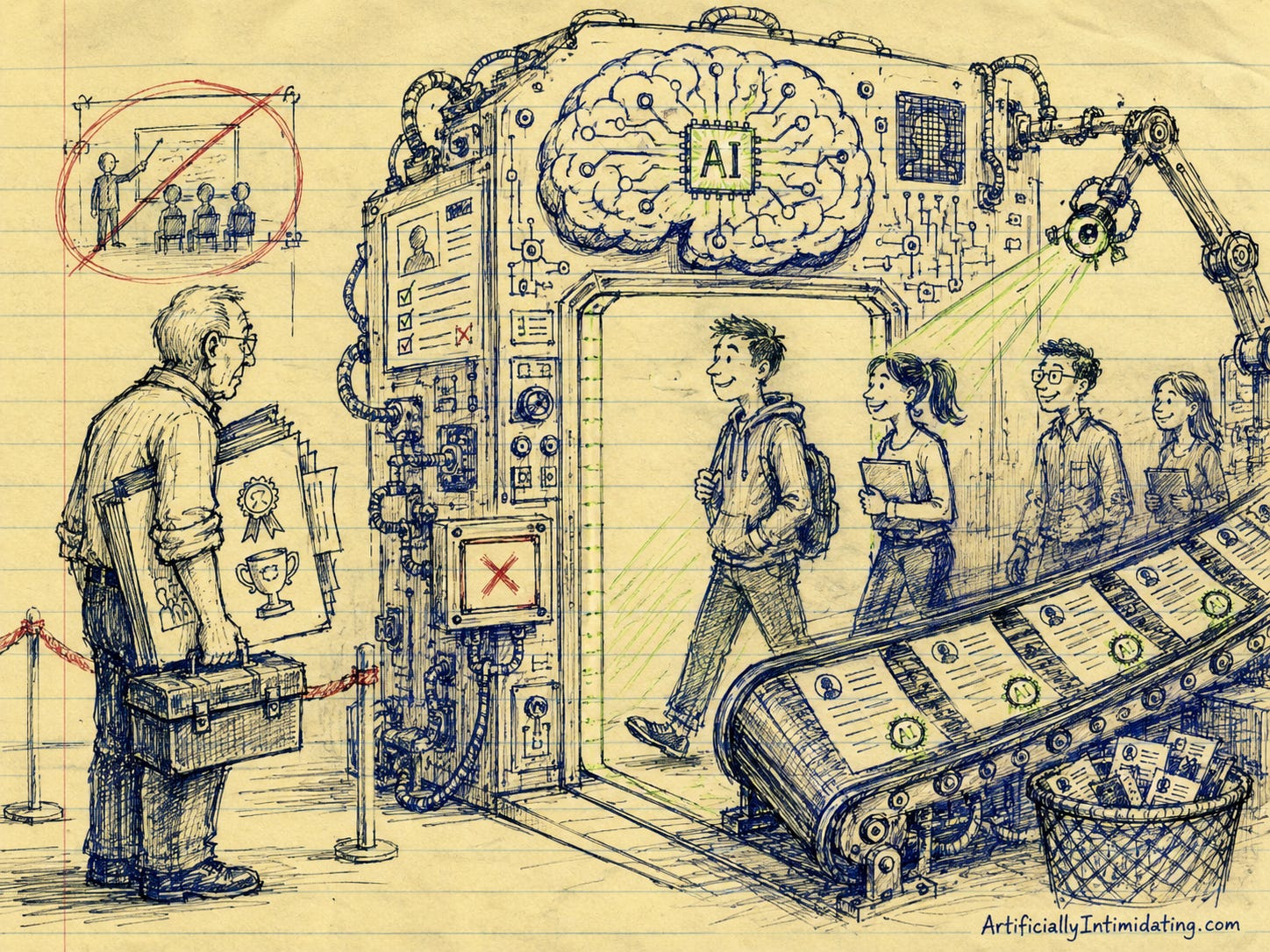
"AI Fluency" Is the New Dog Whistle for Age Discrimination Daily Journal
What happened: A new legal analysis published in the Daily Journal warns that employers using "AI fluency" as a hiring or firing criterion are building age discrimination cases against themselves. AI was the top employer-cited reason for U.S. layoffs in both March and April 2026 — 26% of April's 88,387 announced job cuts were blamed on AI, up 38% from the month before.
Why it matters: If you're over 40 and work in any field where AI is touching your job, this matters directly to you. Courts have already found that phrases like "digital native" constitute evidence of age bias — and legal analysts argue "AI fluency" is the same thing in a better-fitting suit. The class action Mobley v. Workday alleges AI-powered hiring software screened out 1.1 billion applications from workers over 40.
What everyone's saying: Courts are forming a clear precedent: if companies withhold AI training from older workers and then cite the resulting skill gap as grounds for termination, that's manufactured pretext for discrimination. Illinois already enacted a law in January banning AI-driven discrimination in personnel decisions, and other states are following with their own patchwork of regulations.
My read between the lines: The corporate PR line is "we're not replacing people with AI, we're transforming the workforce." The legal line is "you can't withhold AI training from older employees and then cite their resulting skill gap as grounds for termination." The gap between those two sentences is going to be very expensive for a lot of HR departments.
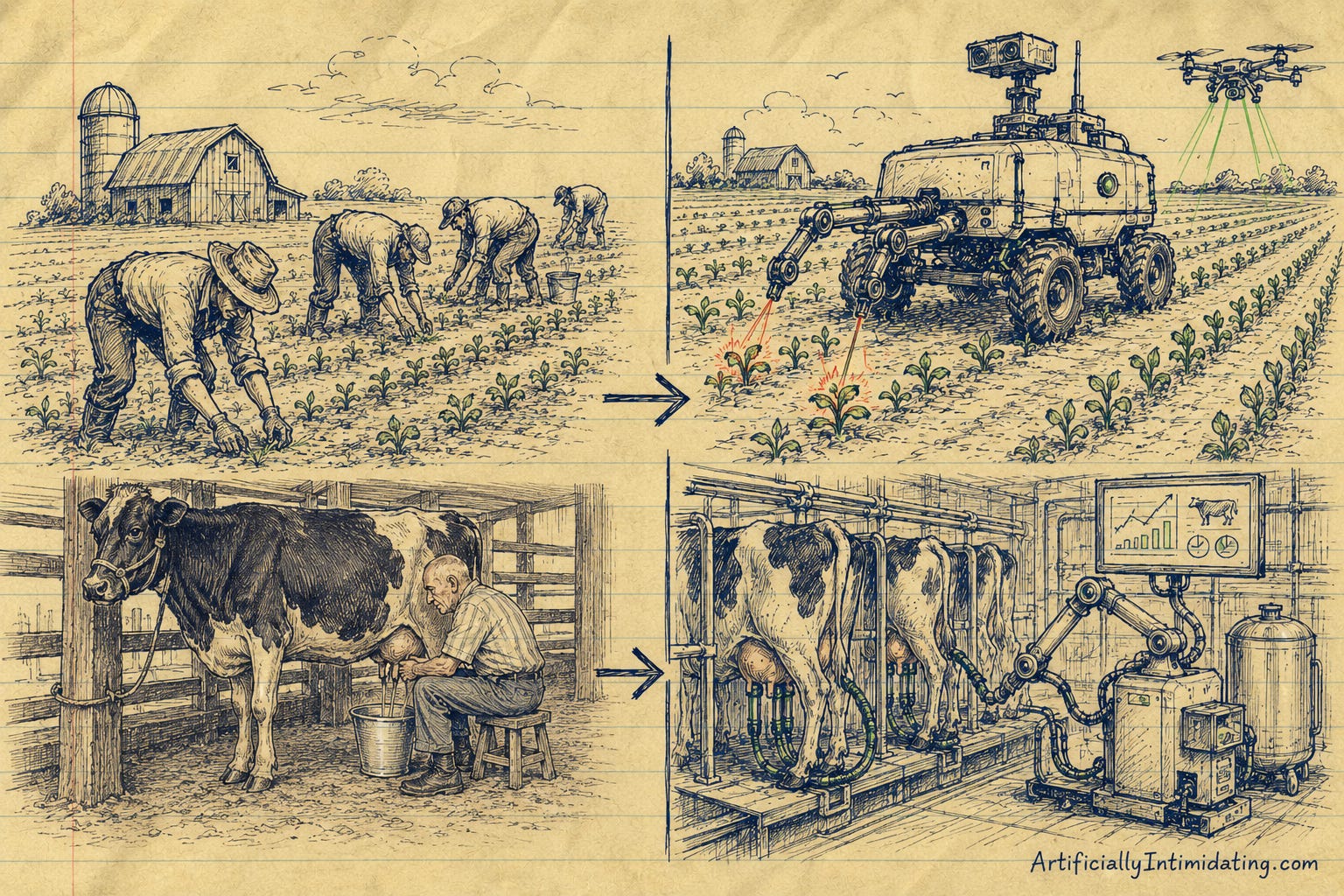
Laser Robots and Robo-Milkers Are Taking Over American Farms AP / Perplexity Discover
What happened: The Associated Press reports that AI robots and laser-equipped machines are spreading rapidly across U.S. farms as a deepening labor crisis accelerates adoption. Carbon Robotics' LaserWeeder uses AI cameras and precision thermal lasers to destroy weeds without chemicals — cutting costs by up to 80% for some farmers. Robotic milking systems have meanwhile reduced milking labor by 70–75% while increasing dairy production by 5–17%.
Why it matters: There are an estimated 2.4 million unfilled agricultural jobs in the U.S., and the labor crisis is deepening as fewer young immigrants enter farm work. The 2026 Farm Bill would reimburse farmers up to 90 cents on the dollar for adopting AI tools — meaning the federal government is now actively subsidizing the automation of American farm labor at scale.
What everyone's saying: Robotics researchers caution that full automation is still years away for most crops — harvest robots may eventually displace up to 50% of human farm labor, but not overnight. The bigger emerging debate is about who owns the precision agriculture data these AI machines generate on someone else's land: the farmer, or the tech company that built the machine.
My read between the lines: "AI is coming for white-collar knowledge work" has been the dominant narrative for three years. Meanwhile, AI laser robots have been quietly eliminating herbicide costs on farms across 15 countries, and cows are being milked by machines on their own schedule. The revolution ate the fields while everyone was watching the office.
Jensen Huang Says Agentic AI Needs 1,000% More Compute. He's Not Wrong. 247 Wall St.
What happened: At ServiceNow's Knowledge 2026 conference, Nvidia CEO Jensen Huang declared that compute required for agentic AI is 1,000% higher than for generative AI — and rising. This comes as Nvidia reported $215.9 billion in annual revenue (65% growth in fiscal 2026), and the four largest cloud providers — Amazon, Microsoft, Google, and Meta — collectively committed over $710 billion in AI infrastructure spending this year alone.
Why it matters: The AI chatbot you've been using is compute-light by comparison. Agentic AI — systems that plan autonomously, use tools, write code, query databases, and verify their own work — runs continuously for minutes or hours rather than answering a single prompt. Each agentic cycle burns orders of magnitude more compute than a dozen chatbot replies, and that gap is going to reshape energy infrastructure globally.
What everyone's saying: The energy sector is being rebuilt for AI demand. Agreements for small modular reactor capacity nearly doubled this year, from 25 gigawatts to 45 gigawatts. Tech companies now spend more on capital expenditure than the entire global oil and gas production industry. Investors are treating AI infrastructure as the new commodity super-cycle.
My read between the lines: Jensen Huang is the currently world's greatest beneficiary of AI compute demand, so his "you'll need 10x more of my hardware" projections deserve a raised eyebrow. That said, the math on agentic workloads is directionally correct — agents that run for hours do consume dramatically more compute than a single prompt. He's right. He also just happens to sell the GPUs.
📖 Further reading: Jensen Huang on Air Force One isn't the real chip story — Earlier this week we covered the geopolitics of AI chip access; this compute demand story is the infrastructure side of that same coin.
The Pope Just Created an AI Committee. 1.3 Billion People Will Feel This. NWA Democrat-Gazette / AP
What happened: Yesterday we called it 'the Vatican's coming AI encyclical' — today's the formal first move. Pope Leo XIV officially created an in-house AI study group, the Vatican confirmed Saturday, citing the "acceleration in AI's use" and concern for "the dignity of every human being." The group will inform the Church's first encyclical — a binding papal letter sent to all bishops — that will address artificial intelligence directly.
Why it matters: An encyclical isn't a tweet thread. It's a binding moral document that shapes the teaching, policy positions, and civic engagement of the world's largest religious institution — 1.3 billion Catholics. When the Catholic Church has weighed in on social issues historically (labor rights, nuclear weapons, poverty), it has moved legislation, shifted public opinion, and given moral language to movements that lacked it. AI is about to get that treatment.
What everyone's saying: The expected framing will place AI within Catholic social teaching — human dignity, labor rights, justice, and peace. That puts the Church on a collision course with Silicon Valley's "move fast, automate everything" consensus, while simultaneously giving AI skeptics an unlikely ally with extraordinary institutional reach across every predominantly Catholic country on Earth.
My read between the lines: The Vatican took 350 years to apologize to Galileo. But when it moves, it moves at scale. A papal encyclical on AI will be translated into every major language, read from every pulpit, and cited in legislation worldwide. The AI governance debate just gained a constituency of 1.3 billion. Sam Altman's stakeholder map just got a lot more complicated.
📖 Further reading: Mythos Cracked Apple. A Monet Fooled the Internet. The Pope Is Next. — Yesterday's brief set the stage for this moment — the context for why the Vatican is moving with unusual urgency on AI.
That's your AI Brief for Sunday. Join the conversation in the Artificially Intimidating community chat.
—Artificially Intimidating