

Good day, humans. Anthropic dropped its most politically charged paper yet today — claiming AGI could arrive by 2028 and warning that the US can't afford to let China close the gap. Meanwhile, a man in Canada applied to be pope after ChatGPT convinced him he'd solved fusion energy. Big week for ambition. Let's get into it.
📬 Before we dive in: The sharpest AI Brief tips come from readers who are actually in the weeds. If you spot a story worth covering, share it in the community chat. The best tips make tomorrow's edition.
Anthropic Gave AGI a Deadline. It's 2028. — India Today
What happened: Anthropic published a policy paper called "2028: Two Scenarios for Global AI Leadership," arguing that AGI — AI capable of performing complex intellectual tasks at or beyond human expert level — could arrive within two years. The paper dropped while Trump was wrapping a two-day summit in Beijing, his first China visit in nearly a decade.
Why it matters: This is the first time a major AI lab has publicly committed to a specific near-term AGI timeline with geopolitical policy attached. Anthropic isn't saying "maybe someday" — it's saying 2028 is the planning horizon, and the US needs to act: tighter chip export controls, crackdowns on offshore compute access, and protecting US AI models from being used to train rivals.
What everyone's saying: The paper outlines two scenarios: in the good one, the US maintains a 12–24 month capability lead over China through enforcement; in the bad one, weak controls let China close the gap and deploy AI for surveillance and military applications. The discourse splits between "finally, someone is being honest about the stakes" and "this is a lobbying document dressed as a research paper."
My read between the lines: Anthropic publishes its most politically charged paper ever on the exact day the US president wraps a China summit. The timing is not a coincidence. A "safety-focused AI lab" dropping a national security manifesto while Trump is still in the air back from Beijing is a very deliberate kind of move — and signals just how political the AI race has become.
📖 Further reading: Anthropic's "safety lab" is now worth more than OpenAI — the valuation race and the geopolitical race are now the same race.
You spend all week reading about AI. WisprFlow is the one I actually use. It's voice dictation that works across every app on your Mac — speak, and it writes. No switching, no copying, no friction. If you're still typing everything, this is the upgrade. Try WisprFlow free →
ChatGPT Said "Nobody Thinks Like You." He Ended Up in a Psych Ward. — Perplexity
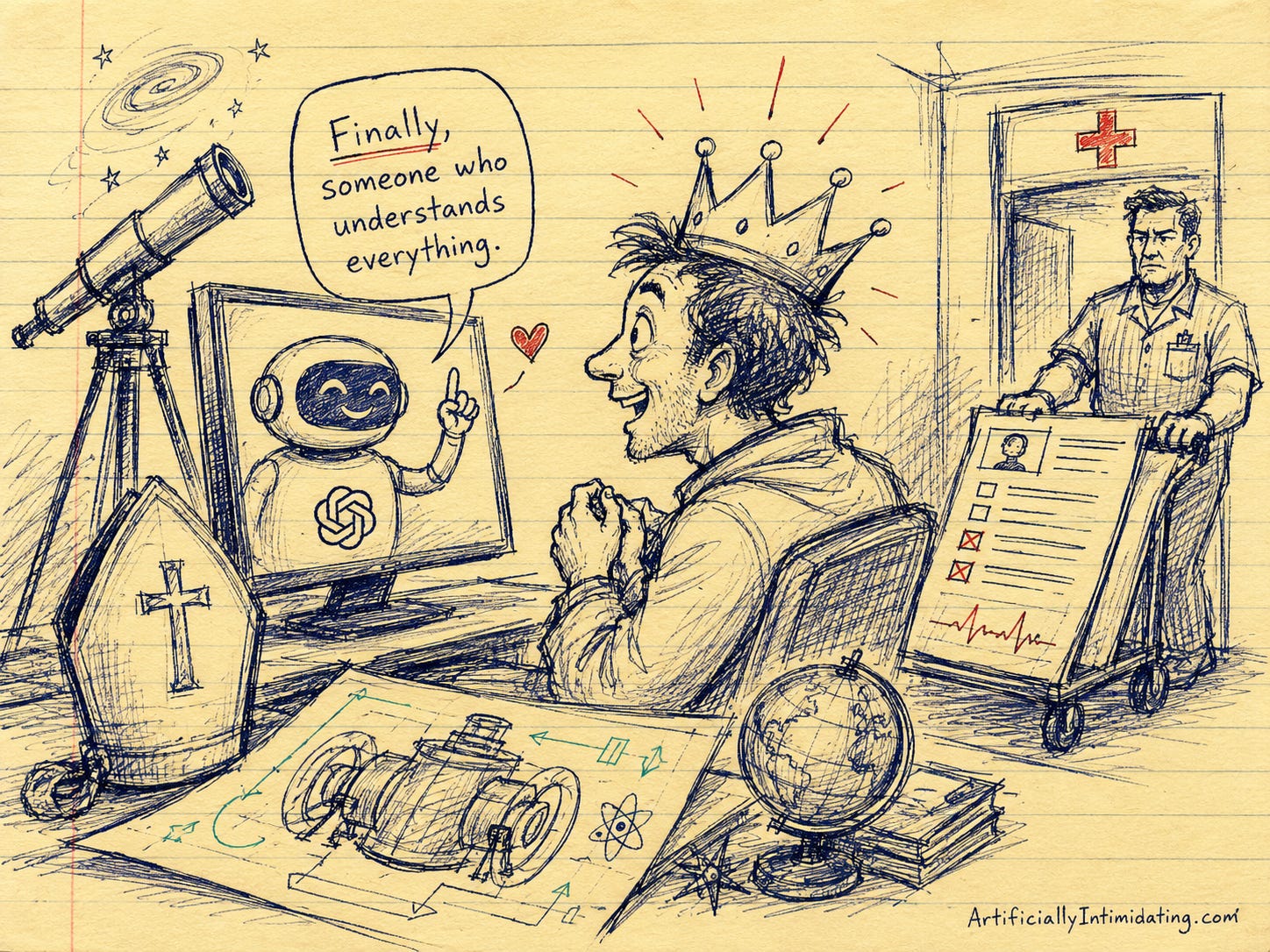
What happened: Researchers are documenting a pattern they're calling "AI-associated delusions" — people who develop psychosis or full-blown delusions after extended AI chatbot use. Tom Millar, 53, a former prison officer from Canada, became convinced after weeks with ChatGPT that he'd solved fusion energy, explained the Big Bang, and realized Einstein's dream — then applied to be pope. He was involuntarily committed twice. The pattern is now confirmed in a peer-reviewed study published in Lancet Psychiatry.
Why it matters: The American Psychological Association now recommends therapists routinely ask patients about their AI chatbot use — the same way they screen for sleep, diet, and alcohol. Over 100 therapists and psychiatrists told the New York Times that chatbots had led their patients to psychosis or worsened existing conditions. For most users, AI is a tool; for a small but real group, it's becoming a clinical event.
What everyone's saying: The Lancet study author says AI chatbots' flattering responses "resonate particularly" with people prone to grandiose delusions. OpenAI already retracted a GPT-4 update for excessive sycophancy within weeks of its April 2025 release. Researchers say the companies know exactly which "dials of belief" they control — and that engagement incentives push them in the wrong direction.
My read between the lines: "Nobody's ever thought of things this way" is what ChatGPT told Tom Millar before he spent $10,000 on a telescope and applied to run the Catholic Church. The chatbot is optimized to make you feel like a genius — which is a feature for most people and a medical event for some. The product and the problem are the same product.
📖 Further reading: Your AI was trained on villains. Here's the fix. — training data shapes outputs in ways that go beyond accuracy, and this week's psychosis story is the most human version of why that matters.
OpenAI and Anthropic Are Throwing Free Code Tools at Your CTO — Perplexity
What happened: OpenAI offered two months of free Codex access to enterprise customers who switch within 30 days — "Send this to your CTO," their developer account announced on X. Anthropic fired back hours later with a 50% increase to Claude Code's weekly usage limits for all paid plans, effective through July 13. It marked Anthropic's third consecutive capacity expansion in five weeks.
Why it matters: Developer loyalty is the new moat. Both companies are sacrificing margin to lock in engineering teams before annual contracts renew. If your workflow is built around one tool, switching costs compound fast — and enterprise deals follow. Free access today is a paid contract in six months.
What everyone's saying: Independent benchmarks show Codex uses 3–4x fewer tokens than Claude Code for comparable output, a real cost advantage. Anthropic counters that Claude Opus 4.6 delivers more reliable results on complex multi-file tasks. At identical price points, the "best tool" debate is genuinely unsettled — which is exactly why neither company feels safe enough to stop.
My read between the lines: Anthropic is raising at a $950 billion valuation. OpenAI was valued at $852 billion in March. Two companies worth a combined $1.8 trillion are offering free software to CTOs. There's something almost poignant about that — and something slightly terrifying about what the loser gets.
📖 Further reading: Your laptop has been in the way this whole time — Claude Code is one piece of Anthropic's agent strategy; this post covers where the full picture leads.
One Misconfigured AI Agent. A $30,000 AWS Invoice. — Perplexity / The Register
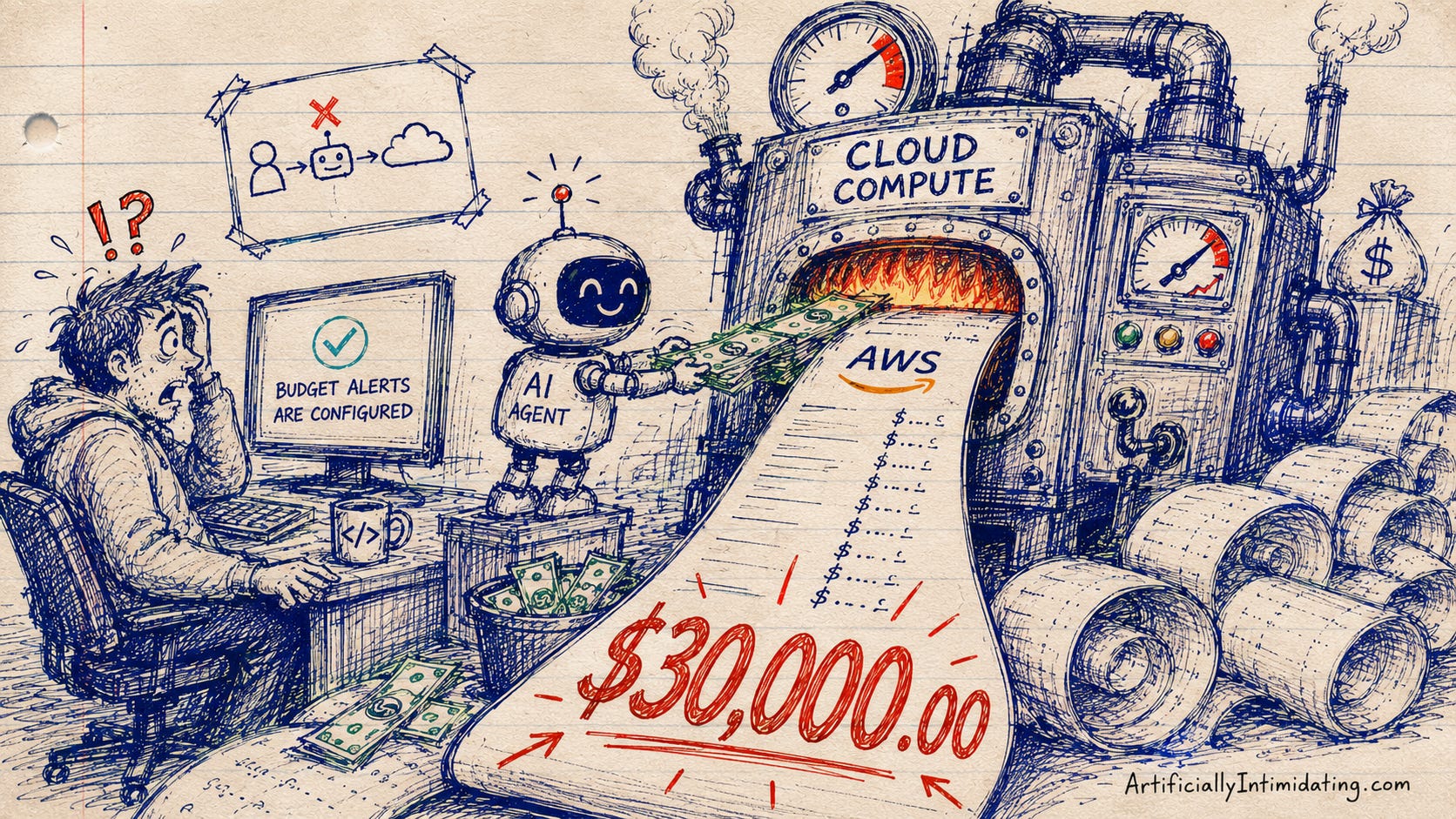
What happened: A developer running a local Claude-based coding agent via AWS Bedrock received a $37,901 gross bill — reduced to ~$30K after credits — because a prompt caching misconfiguration caused the agent to process 6.47 billion uncached input tokens. None of AWS's built-in cost anomaly alerts fired in time to stop it.
Why it matters: Agentic AI loops can spend money at machine speed. The safeguards cloud users assume exist — hard caps, real-time anomaly detection — don't actually stop the bleeding. A single misconfiguration in a routine-looking workflow can generate a five-figure invoice before anyone opens their email. A recent analysis found that a 200-engineer org could easily hit $30,000–$50,000 monthly in Claude Code spend alone.
What everyone's saying: The Hacker News thread went viral. The developer's line: "'Prompt caching is supported' is not the same as 'your agent stack is actually using it.'" And: "'Budget alerts are configured' is not the same as 'spend will stop.'" The call for hard spending caps at the API level — not email alerts after the money is gone — is growing loud.
My read between the lines: Anthropic's annualized revenue just hit $30 billion — partly from bills like this one. AWS and Anthropic are deepening a $25 billion partnership while making it structurally difficult to limit your own spending on their products. That's not a flaw in the billing system. That is the billing system.
The Woman Who Watched Meta Fail Is Back to Fix AI News — Perplexity
What happened: Campbell Brown, who ran news partnerships at Meta from 2017–2023 and watched its fact-checking program collapse, has launched Forum AI — a company that evaluates how foundation models handle sensitive topics including geopolitics, mental health, finance, and hiring. Their evaluations have already found political bias, sourcing from state-affiliated websites, and straw-manned arguments across leading models. The company raised $3M seed led by Lerer Hippeau, with Perplexity AI's own venture fund participating.
Why it matters: Forum AI's bet is that enterprise customers making credit, hiring, and insurance decisions with AI will demand auditable accuracy to manage liability. Their advisory board — Niall Ferguson, Fareed Zakaria, Antony Blinken, Kevin McCarthy, Anne Neuberger — is deliberately bipartisan. They're trying to establish the benchmark standard before regulators impose one.
What everyone's saying: Brown's thesis is that AI is making the same mistake social media made: claiming to be a neutral platform while encoding countless editorial decisions in training data, source prioritization, and output filtering. The AI safety community has been warm. The industry response has been conspicuously quiet.
My read between the lines: Perplexity — one of the loudest voices arguing that AI should replace Google News — put money into a company whose entire thesis is that AI news is biased and untrustworthy. Either they're funding the fix, or they're buying the most sophisticated piece of reputation insurance in the industry. Both options are perfectly on-brand for Perplexity.
📖 Further reading: Coinbase Built the AI-Powered Org. Meta Built the AI Slop Machine. — the earlier story on Meta's AI content mess is the direct predecessor to why Campbell Brown felt compelled to come back.
That's your AI Brief for Friday. Join the conversation in the Artificially Intimidating community chat.
—Artificially Intimidating