

Good day, humans. Today's brief takes you inside the room where the AI deals are actually being made — Beijing — and then to a four-month-old London startup whose name should tell you everything about where we are. Plus: OpenAI floating the geopolitical proposal nobody expected, Claude learning to dream, and a Mayo Clinic AI that sees pancreatic cancer a year before your doctor does. Let's get into it.
📬 Before we dive in: The sharpest AI Brief tips come from readers who are actually in the weeds. If you spot a story worth covering, share it in the community chat. The best tips make tomorrow's edition.
The Real Beijing Deal: Nvidia Chips Are Flowing — Reuters
What happened: Yesterday we called it "Jensen Huang boarding Air Force One" — today's the full story. The U.S. Commerce Department has approved Nvidia H200 chip sales to roughly 10 Chinese companies, including Alibaba, Tencent, ByteDance, and JD.com, while Trump meets Xi in Beijing.
Why it matters: H200 chips are the fuel for serious AI training and inference. The chip export bans were designed to preserve America's AI infrastructure edge over China. That edge just narrowed, overnight, with a Commerce Department signature.
What everyone's saying: This is a significant reversal of Biden-era chip controls, and the market is reading it as bullish for Nvidia. China hawks are furious. The question is whether the Xi summit produces something that makes the trade-off worth it.
My read between the lines: Jensen Huang flies to Beijing on Air Force One, and 48 hours later the Commerce Department greenlights H200 sales to Alibaba and ByteDance. That's not a coincidence — that's a transaction. The question nobody's asking yet: what did China give up?
📖 Further reading: Jensen Huang on Air Force One isn't the real chip story — AI Brief May 13 — Yesterday we teased this. Today it's the full story — and it's bigger than the plane ride.
You spend all week reading about AI. WisprFlow is the one I actually use. It's voice dictation that works across every app on your Mac — speak, and it writes. No switching, no copying, no friction. If you're still typing everything, this is the upgrade. Try WisprFlow free →
OpenAI Wants to Govern AI Alongside China — The Japan Times
What happened: Hours before the Trump-Xi summit began, OpenAI VP of global affairs Chris Lehane publicly called for a U.S.-led global AI governance body with China as a member — framing it as the best way to make AI development safer and more resilient globally.
Why it matters: Most AI governance proposals treat China as a threat to manage around. OpenAI is proposing to seat them at the table instead. Whether that's idealistic or strategic, it's a fundamentally different approach than what any government has floated so far.
What everyone's saying: The optimistic read is that excluding China from any governance framework makes it meaningless. The cynical read is that OpenAI is positioning itself as the reasonable adult in the room — the company willing to talk to everyone — as global AI regulation takes shape.
My read between the lines: OpenAI just did what governments are afraid to do — explicitly named China as a governance partner rather than an adversary. The timing, hours before a summit where the U.S. just greenlighted chip sales to ByteDance, suggests the political weather is shifting fast. Someone in Washington decided the containment strategy is over.
📖 Further reading: Anthropic's "safety lab" is now worth more than OpenAI — AI Brief May 9 — The governance dynamics look different when you remember Anthropic now outvalues OpenAI. Who actually speaks for AI safety in this new regime?
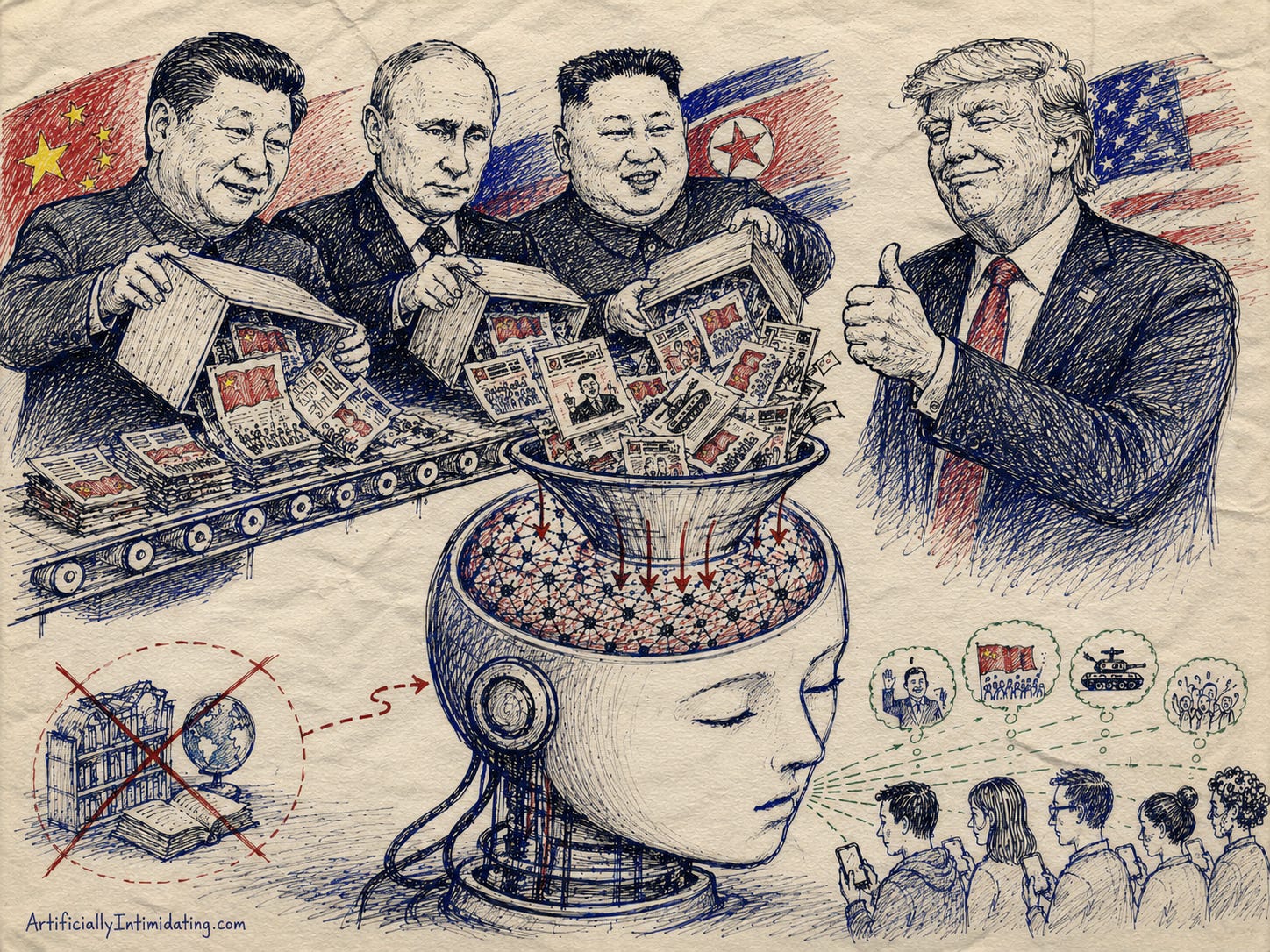
Your AI Has a Propaganda Problem Baked Into Its Training Data — Nature
What happened: A peer-reviewed study published in Nature found that Chinese state media appears in LLM training data at rates vastly exceeding Chinese-language Wikipedia. Researchers from the University of Oregon, Purdue, UCSD, NYU, and Princeton tested models across 37 countries and found that LLMs consistently return more favorable responses to authoritarian governments when queried in that country's language.
Why it matters: LLMs don't learn from neutral sources — they learn from whatever dominates the training data pile. If Chinese state propaganda crowds out independent Chinese-language sources, a model's understanding of China is effectively shaped by the CCP's preferred narrative. The same dynamic likely holds across other authoritarian states. This is a structural issue, not a prompt-engineering one.
What everyone's saying: The methodology is what gives this real weight — 37 countries, cross-lingual testing, peer review in Nature. The AI safety community has been raising training data bias concerns for years, but this study gives it a specific, measurable shape. Expect it to feature prominently in AI governance debates, particularly given today's other headlines about U.S.-China AI relations.
My read between the lines: Read this alongside today's chip story and OpenAI's governance proposal and you get a complete geopolitical picture in one brief: the U.S. is selling China the hardware, OpenAI wants China at the governance table, and the models everyone is already building on are quietly tilting toward authoritarian narratives in certain languages. Nobody is stitching all three of these together. Now you are.
AI Catches Pancreatic Cancer 475 Days Before Doctors Do — News-Medical
What happened: Mayo Clinic's REDMOD system — an AI model trained on routine CT scans — detects the invisible signature of pancreatic cancer a median of 475 days before clinical diagnosis, with performance superior to expert radiologists, validated on a large real-world cohort.
Why it matters: Pancreatic cancer's five-year survival rate is around 12%, largely because it's almost always caught after it's spread. REDMOD works on CT scans patients are already getting for unrelated reasons — no extra tests, no specialist referrals. Just a model flagging what human eyes miss, on imaging that already exists.
What everyone's saying: Unlike earlier AI health studies validated on curated datasets, this one was tested against a large low-prevalence cohort — the hard test that resembles real clinical deployment. That's the validation step where most AI medical tools quietly disappear. This one passed.
My read between the lines: The paper details a "modifiable diagnostic threshold" — radiologists can tune how aggressively REDMOD screens based on patient risk factors. That's an AI tool designed to know its own uncertainty. It's the version of medical AI that might actually be safe to deploy at scale, and it's the detail nobody in the mainstream coverage is leading with.

He Dumped 11 Years of Old Files Into Claude. Claude Found $400,000. — CoinDesk
What happened: Developer @cprkrn recovered 5 Bitcoin — worth roughly $400,000 — locked in a wallet since 2015, by feeding years of old computer files into Claude. Claude identified an older wallet.dat file buried in the data, spotted a bug in the btcrecover decryption tool (wrong key concatenation order), rewrote the fix, and successfully decrypted the private keys. The thread pulled over 414,000 views on X within hours.
Why it matters: This isn't a chatbot story. @cprkrn didn't ask Claude for information — he used it as a forensic investigator. Feed it the mess, let it find the signal. Claude debugged third-party code it had never seen, identified the relevant file from years of digital noise, and completed a task that would have required a specialist or serious luck otherwise. The wallet had been written off as permanently inaccessible.
What everyone's saying: The thread spread fast because it's aspirational and practical at the same time. Multiple developers reported pulling out old hard drives immediately after reading it. The consensus reaction was less "wow, Bitcoin" and more "wait — what else have I written off that AI could recover?"
My read between the lines: The story is about a mental model shift. Most people still use AI as a smarter search engine — ask questions, get answers. @cprkrn used it as a problem-solver on messy, real-world data with no clean inputs and no guaranteed answer. That's the mode that unlocks the actual leverage. And $400,000 is a fairly compelling argument for pointing it at whatever you've already given up on.
That's your AI Brief for Thursday, May 14. Join the conversation in the Artificially Intimidating community chat.
—Artificially Intimidating