

Good day, humans. Happy Mother’s Day to those who observe and forget I said anything to those who do not!
Today it's official: AI has become Corporate America's all-purpose restructuring justification. Coinbase fired 700 people and called it "rebuilding as an intelligence." Challenger, Gray & Christmas found AI was the top cited reason for April layoffs — for the second straight month. Meanwhile, over in Europe, a Guerrilla Games co-founder is building a game engine on the premise that one developer can replace ten. And Meta's Facebook is apparently dying under the weight of the AI-generated slop it helped make possible. Let's get into it.
📬 Before we dive in: The sharpest AI Brief tips come from readers who are actually in the weeds. If you spot a story worth covering, share it in the community chat. The best tips make tomorrow's edition.
AI Is April's Official Layoff Justification — Again Fortune
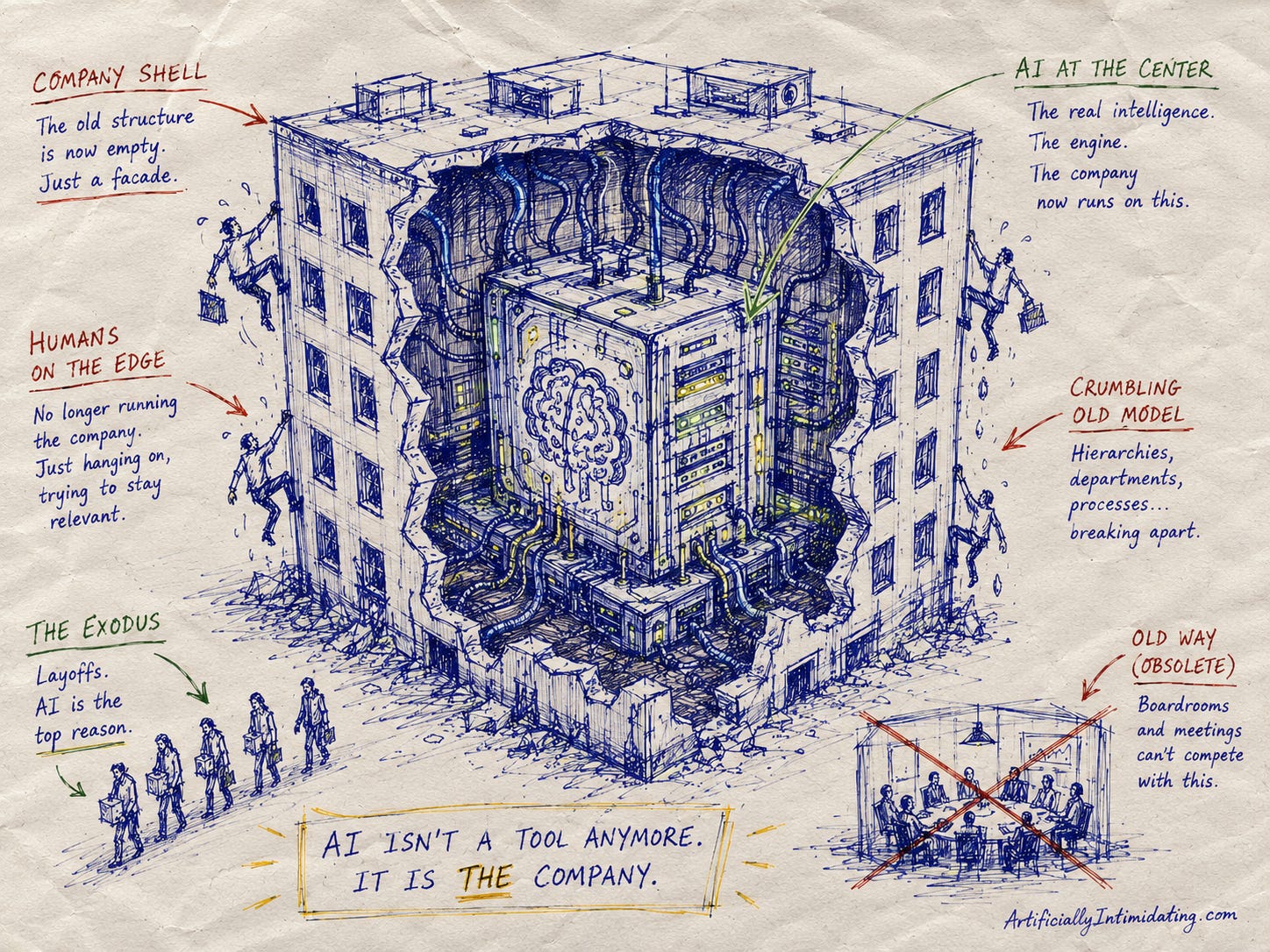
What happened: AI was the top cited reason for U.S. job cuts in April for the second straight month — 21,490 of 83,387 total cuts attributed to AI and automation, per Challenger, Gray & Christmas. The most explicit case study: Coinbase fired 700 employees (14% of its workforce), with CEO Brian Armstrong declaring the company is "rebuilding Coinbase as an intelligence, with humans around the edge aligning it." Block cut 40% of its staff. Cloudflare cut 1,100.
Why it matters: For two straight months, more U.S. employers are naming AI as their reason for cutting than any other factor — including the economy. That's not an anecdote, that's a measurable shift in how American companies justify workforce decisions. When the second-largest crypto exchange frames itself as "an intelligence," it hands other CEOs a template for a conversation they were going to have anyway.
What everyone's saying: The debate is whether this is real structural change or "AI-washing" — companies using AI as cover for cuts they'd make during any down cycle. McKinsey says most jobs aren't being fully automated yet. CNN ran the headline "AI isn't actually taking your job" the same day the Challenger data dropped, which is a bold editorial call.
My read between the lines: The most revealing phrase in Armstrong's memo isn't "AI-native pods." It's "humans around the edge." CEOs used to say employees were their greatest asset. Now they're the guardrails. That's not a layoff rationale — that's a new job description, and it is going to spread.
You spend all week reading about AI. WisprFlow is the one I actually use. It's voice dictation that works across every app on your Mac — speak, and it writes. No switching, no copying, no friction. If you're still typing everything, this is the upgrade. Try WisprFlow free →
Meta's Facebook Has Become an AI Slop Machine Futurism
What happened: Futurism published a sharp essay arguing Meta has "entered its death spiral" — Facebook has become, in 2026, "an infinite timeline of AI slop, ads, and lazy misinformation" that the company shows no apparent interest in cleaning up. The comparison is drawn explicitly to Yahoo and AOL's long declines, and the piece asks whether Zuckerberg's empire is following the same arc.
Why it matters: Facebook has nearly 3 billion monthly active users. If the feed becomes so polluted that engagement craters, Meta's entire advertising business — which funds Llama, Ray-Ban glasses, the metaverse, all of it — starts to crack. The AI slop problem isn't aesthetic. It's existential to their core ad product.
What everyone's saying: The consensus is that this has been coming for years — Facebook lost cultural cachet when parents joined, and cheap generative content is just finishing the job. Reddit and Discord captured the communities. AI-generated posts are flooding what's left. None of the major platforms have figured out how to fight AI slop at scale.
My read between the lines: The cruelest irony: Meta's AI research is genuinely world-class. Llama is excellent. Meta AI is competitive with ChatGPT. And none of it stops Facebook from turning into a digital Applebee's that also serves supplement ads. You can win the AI arms race and still lose the internet.
Linear's Founder Broke the AI Layoff Email Template Business Insider
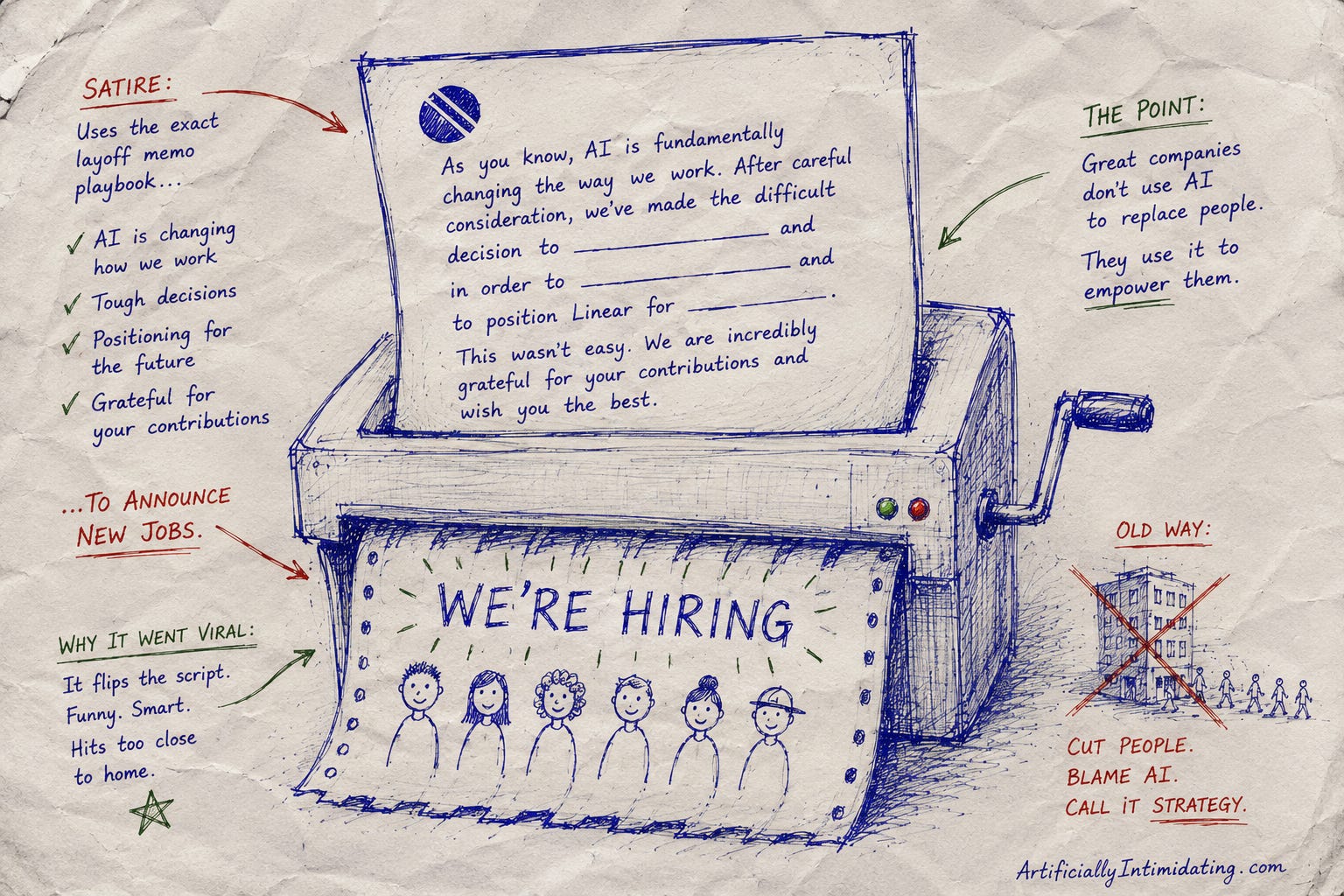
What happened: Tuomas Artman, co-founder of project management tool Linear, posted a hiring announcement written in the exact cadence of today's AI-era layoff memos. "We've made the difficult decision to increase our workforce," it began. "This is not a cost-cutting exercise or a reflection of anyone's performance. We're simply reimagining every role for the agentic AI era." It went massively viral in a week when Coinbase, Cloudflare, and Block all announced AI-justified cuts.
Why it matters: Linear is a real, well-regarded company that is genuinely hiring — and one that has built an enviable product with a lean team. The joke works on two levels: it punctures the sanitized corporate-speak that's become standard for AI-justified layoffs, while also making a credible recruiting pitch to engineers who are watching their peers get cut.
What everyone's saying: The post landed so hard that Business Insider built a "Mad Libs for AI-driven layoff announcements" in response. LinkedIn and X flooded with shares. The subtext everyone picked up: the AI layoff memo has become so formulaic that its exact mirror image is instantly legible.
My read between the lines: We have already developed a genre. "Reimagining every role for the agentic era," "not a cost-cutting exercise," "AI-native pods" — these phrases are so standardized that writing their inverse is immediately legible as parody. That's what happens when an industry moves fast enough to generate its own clichés in under two years.
📖 Further reading: Anthropic's "safety lab" is now worth more than OpenAI — AI Brief May 9 — Yesterday's brief included the full story on Google rewriting the tech interview for the AI era — the other side of the hiring-vs-cutting coin.
White House Floats AI Vetting, Then Walks It Back Politico
What happened: The Trump administration floated — then quietly retreated from — a plan to require pre-release AI model vetting akin to FDA drug approvals. The White House briefed OpenAI, Anthropic, and Google on the plans. Then NIST announced Google DeepMind, Microsoft, and xAI agreed to voluntarily share models for safety testing. Then a senior White House official said the whole thing was "taken out of context" and they want "partnership, not government regulation."
Why it matters: This is the administration that revoked Biden's AI safety executive order on Day 1. The fact that any pre-release review is now even a trial balloon signals AI safety has gone from political liability to political necessity. Something called "Mythos" is reportedly the catalyst — and nobody's fully explained what that means yet.
What everyone's saying: The tech industry sees the gap clearly: voluntary model sharing with NIST costs companies very little and buys goodwill. A mandatory pre-release vetting regime is a fundamentally different constraint. Everything happening this week is happening in that gap, and companies are lobbying hard to stay on the left side of it.
My read between the lines: The sequence here is the tell: NYT reports the plan → the White House panics → an official says it was mischaracterized. Confident policy doesn't move that way. "Partnership, not regulation" is the polite version of "we're stalling while we figure out what to do about an AI incident we aren't fully explaining to the public."
📖 Further reading: The president who killed AI safety rules just brought them back — AI Brief May 5 — Five days ago we covered the original move that set this week's policy scramble in motion.
A Guerrilla Games Founder Is Rebuilding the Game Engine Tech4Gamers
What happened: Arjan Brussee — co-founder of Guerrilla Games and former Epic programmer — is building a game engine called "The Immense Engine" with a Dutch startup. It's designed AI-native from the ground up, built around AI agent frameworks rather than adapted for them after the fact. The pitch: a European-sovereign alternative to Unreal Engine — built by Europeans, hosted in Europe, EU-compliant. Premise: one developer with The Immense Engine does the work of ten.
Why it matters: Game engines are the invisible infrastructure of interactive media. Unreal Engine powers games, film VFX, and architectural visualization alike. If an AI-native engine genuinely delivers on "one-person team," it doesn't just challenge Epic — it disrupts every industry that licenses Unreal. That's a multi-billion dollar stack being challenged by a Dutch startup with a bold thesis.
What everyone's saying: Reddit's r/Games is cautiously interested. The European sovereignty angle resonates with EU developers who are uncomfortable depending on US-hosted platforms. The "AI-native" claim is treated as ambitious but unproven — the game industry has seen many engine promises that never shipped.
My read between the lines: The most quietly radical claim here isn't the sovereignty angle — it's "one developer equals ten." If that holds at any meaningful scale, it's not a productivity gain, it's a talent market restructuring for an industry that just survived a brutal 18-month layoff cycle. Game developers have already lived through one existential staffing crisis. They are paying very close attention.
That's your AI Brief for Sunday. Join the conversation in the Artificially Intimidating community chat.
—Artificially Intimidating
The bigger problems with Meta are:
Human Slop: A still picture, or someone just pointing to words on a screen on a reel IS NOT ART. It is just money-making slop. It is the equivalent of selling blank canvases as art, or duct-taping bananas to walls.
The failure of Facebook to actually enforce standards against bullying, racism, and rampant sexism. A couple weeks ago, I saw a post OPENLY calling for bullying of traditionally-disenfranchised populations, I reported it to Meta, who decided that that post blatantly supporting bullying did not go against their rules about bullying. Appeal? Same thing.
Blatant and flagrant misappropriation of funds - they spent $40B on the Metaverse, and couldn't even come up with anything as advanced as Second Life was 20 years ago. Why? Because their ONLY focus was on making as much profit as possible.
The state of stage-four decline of Meta isn't the fault of AI - the onus lies upon humans, and the singular obsession with making money at all costs.