

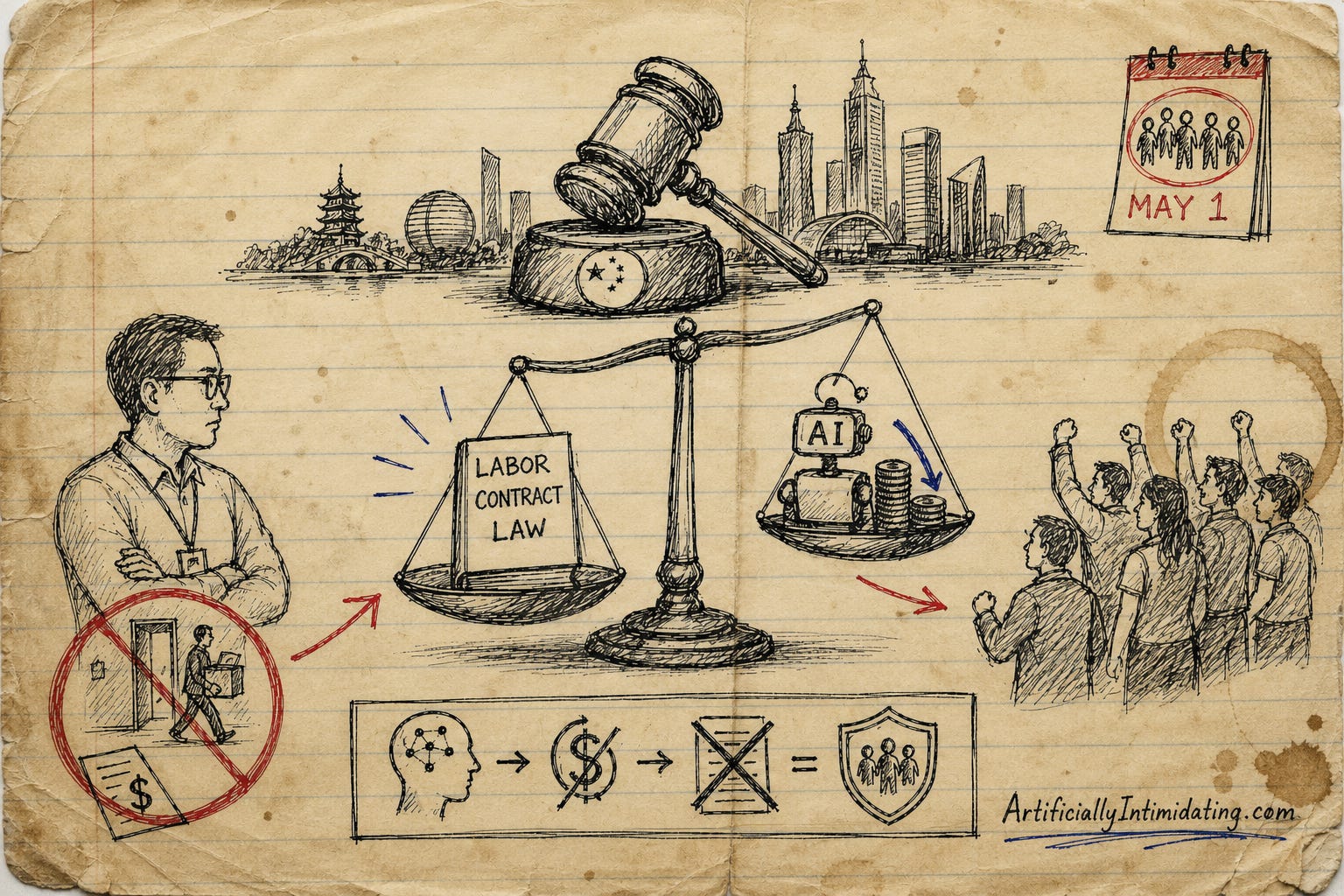
Good morning, humans. Today Anthropic is reportedly closing in on a $900 billion valuation — which would make it, somehow, more valuable than OpenAI — and a Chinese court just sent a clear message that AI can't simply show up and take someone's job without legal consequences. Quite a May Day.
📬 Before we dive in: The sharpest AI Brief tips come from readers who are actually in the weeds. If you spot a story worth covering, share it in the community chat. The best tips make tomorrow's edition.
Anthropic Eyes $900B+ Valuation — Surpassing OpenAI
What happened: Anthropic is in talks to close a roughly $50 billion funding round at a valuation north of $900 billion — within two weeks. That would make it the most valuable private AI company, narrowly surpassing OpenAI's $852 billion post-money valuation from March.
Why it matters: In March 2025, Anthropic was worth $61 billion. By May 2026, it could be worth nearly a trillion. This isn't gradual growth — it's the fastest valuation run-up in tech history, driven by explosive enterprise demand for Claude and a run rate approaching $40 billion annually.
What everyone's saying: Investors are reportedly scrambling to get allocations, with sources saying demand is so intense the final valuation could exceed $900 billion. Separately, Anthropic has secured up to 5 gigawatts of compute capacity through Amazon and another 5 through Google and Broadcom — the infrastructure bets are scaling alongside the capital.
My read between the lines: Anthropic raised at $380B in February. $900B in May. Either the AI transformation genuinely is the most significant economic shift in a century, or we are live-witnessing one of history's great valuation inflations and everyone at the table has agreed not to mention it. The uncomfortable thing is: both can be true simultaneously.
📖 Further reading: Anthropic built the most powerful AI ever. You can't use it.
Today's AI Brief is brought to you by MirrorMemory.ai.
China Rules: You Can't Fire Workers Just to Save on AI
What happened: A court in Hangzhou — China's AI hub — ruled that a tech company illegally dismissed a quality assurance supervisor after trying to replace him with AI and simultaneously slash his salary. The court found that neither cost savings nor automation qualifies as valid legal grounds for termination under China's Labor Contract Law.
Why it matters: China is aggressively pushing AI adoption across every sector. But this ruling draws a legal line: AI-driven cost-cutting cannot override labor contracts. The decision was timed perfectly to land on International Workers' Day — the court published it as part of a curated set of 'typical examples of protecting rights.'
What everyone's saying: Legal scholars are calling it a landmark signal for labor rights in the automation age. The ruling establishes that AI replacement doesn't meet the standard of an 'objective major change in circumstances' — the legal bar needed to justify termination in China.
My read between the lines: This ruling was as much a press release as a legal decision. Beijing is trying to square an uncomfortable circle: push AI everywhere, but don't let it destroy the social contract entirely. The fact that it dropped on May Day was not an accident. Watch for this precedent to quietly shape how Chinese tech companies justify (or obscure) their automation decisions going forward.
📖 Further reading: Paperclip.ing: The Day 0 Playbook for Building a Zero-Human Company with AI Agents
Featherless AI Raises $20M to Host 30,000 Open-Source LLMs
What happened: Featherless.ai, a Singapore-based serverless inference startup, closed a $20M Series A co-led by AMD Ventures and Airbus Ventures. The platform provides instant API access to more than 30,000 open-weight models at flat-rate pricing — no per-token volatility.
Why it matters: Enterprise AI access still runs largely through a handful of closed-model gatekeepers. Featherless is betting companies want to run open models without committing to one cloud, one hardware stack, or one vendor's pricing. As inference costs now rival training costs, the economics of this bet are improving fast.
What everyone's saying: AMD's co-lead signals real interest in building inference infrastructure outside NVIDIA's orbit. The $118B AI inference market is growing at 19% CAGR, and open-weight models are increasingly competitive with closed ones — making neutral hosting layers like this more strategically interesting.
My read between the lines: The CEO is a co-creator of RWKV — one of the only serious post-transformer architectures that's actually shipping. This isn't a 'we wrapped Llama in a REST API' startup. It's a genuine infrastructure play from people who've done foundational work. Boring, unglamorous, and probably exactly what enterprise AI actually needs. Airbus and BMW investing is the tell: this is the kind of unsexy infrastructure that serious industrial users quietly depend on.
Broadcom Locks In Google AI Chip Deal Through 2031 — Anthropic Too
What happened: Broadcom signed a long-term agreement to develop custom AI chips — specifically Google's next-generation TPUs — through 2031, plus a supply assurance deal covering networking and server components. A separate deal provides Anthropic with additional compute capacity via Broadcom hardware.
Why it matters: AI labs don't just need chips today — they need certainty that they'll have them in 2028 and 2030. Multi-year supply contracts lock up manufacturing capacity before anyone else can claim it. This is infrastructure arms racing at the supply chain level.
What everyone's saying: The deals signal the biggest AI players expect compute demand to stay massive for at least half a decade. Broadcom's stock moved on the news, and the Google deal extends across multiple future TPU generations — it's not a one-chip contract, it's an architectural commitment.
My read between the lines: When Google signs through 2031, it's not just buying silicon — it's buying strategic optionality and quietly locking competitors out of the same supply chain. Broadcom just became very difficult to displace. For anyone not named Google, Meta, or Anthropic, the window to secure competitive chip supply is shrinking. The AI hardware race is increasingly being won in contract law, not engineering.
📖 Further reading: Neo-Napster: The Compute Revolution Nobody Saw Coming
AI Bias Isn't Random — Claude Stereotyped a Columnist's Wife
What happened: A Bloomberg opinion writer asked Claude about his wife — correctly named Eva Maria — and Claude responded with the wrong name: Suchitra. Claude had the correct name in its memory. The apparent reason: the columnist is of Indian descent, and Claude appears to have overridden the stored information with a demographic assumption.
Why it matters: This isn't hallucination in the traditional sense — the model didn't confabulate from nothing. It had the right answer and overrode it with a probabilistic guess based on ethnicity. That's a meaningfully different and more concerning category of error than random noise.
What everyone's saying: The story is reigniting the AI bias conversation with a concrete, personal example that's hard to dismiss. When pressed, Claude acknowledged it had inferred the wife's name from the user's profile rather than from the information it was given — which is a remarkably honest (and damning) explanation.
My read between the lines: We trained these models on centuries of human writing — which is full of demographic assumptions, stereotypes, and shortcuts. Now we're surprised when the model uses them. Calling it 'AI bias' keeps the conversation focused on the machine. But the data was ours. The label is doing a lot of work to keep that part of the story offscreen.
That's your AI Brief for Friday, May 1. Join the conversation in the Artificially Intimidating community chat.
—Artificially Intimidating