

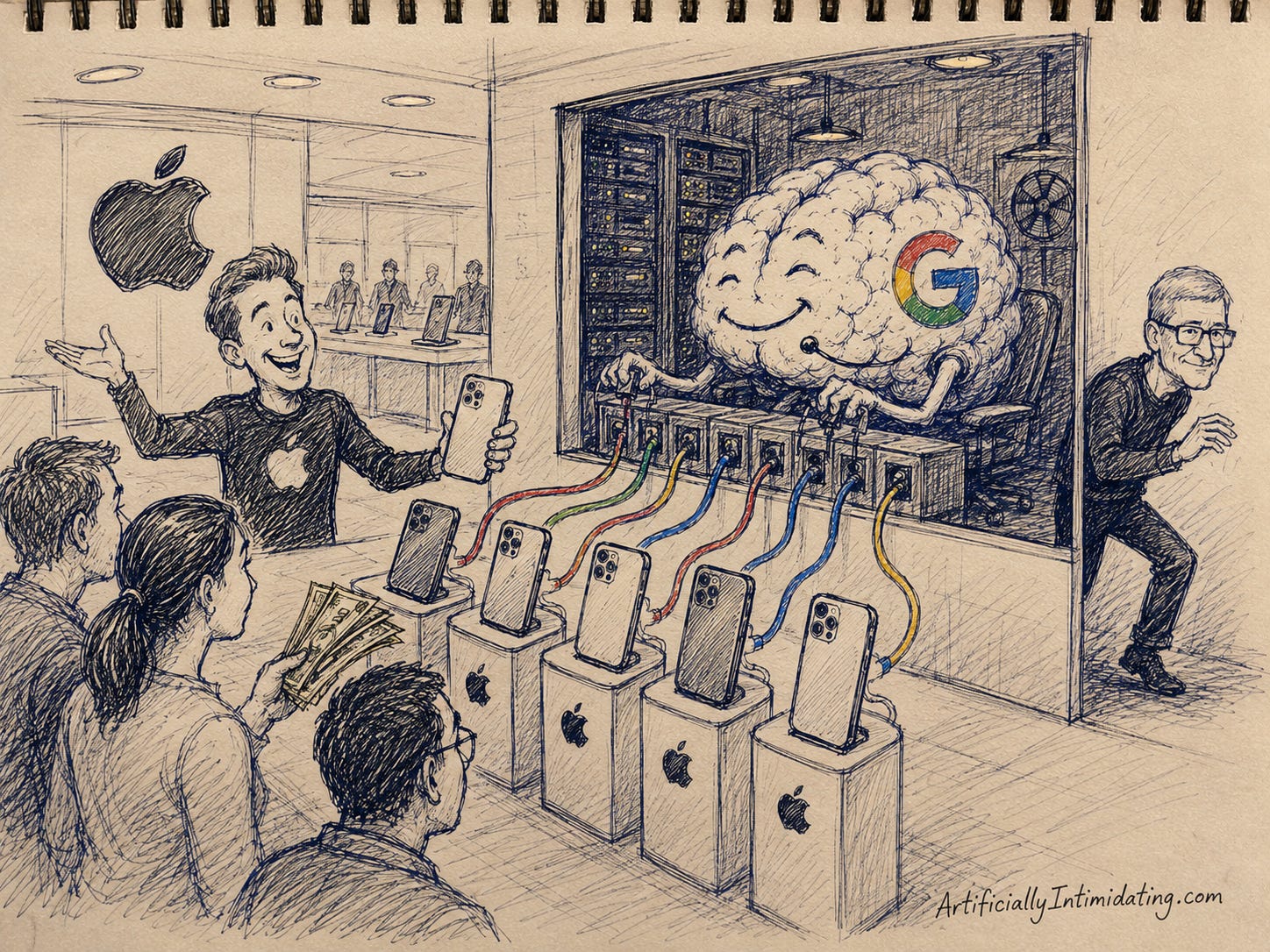
Good day, humans. Tim Cook took his final WWDC bow yesterday and used it to confirm what we've been saying for weeks: Apple gave up building the brain and rented Google's instead. Meanwhile xAI quietly became the most profitable landlord in tech, Google kicked off a price war, and a security report landed that should make anyone shipping AI-written code a little nervous. Let's get into it.
📬 Before we dive in: The sharpest AI Brief tips come from readers who are actually in the weeds. If you spot a story worth covering, share it in the community chat. The best tips make tomorrow’s edition.
Apple Rented Its Brain From Google
What happened: At WWDC 2026 on Monday, Apple unveiled a fully rebuilt Siri — now just “Siri AI” — powered by a custom Google Gemini model running on Nvidia servers, with a chatbot interface, a standalone app, and the option to swap in ChatGPT or Claude. It was also Tim Cook’s last keynote before he hands the reins to hardware chief John Ternus on September 1.
Why it matters: The assistant on a billion iPhones is now Google’s model wearing an Apple badge. But read the fine print: the new Siri won’t launch in the EU or China, and the best on-device features require a 12GB iPhone — meaning the iPhone 17 Pro or Air, not the one in your pocket.
What everyone’s saying: Wall Street loved it — Wedbush’s Dan Ives called it Apple’s arrival in consumer AI as a “toll collector,” and the stock has been hitting records. Analyst Ming-Chi Kuo offered the cold water: if Siri simply is Gemini, then Google sets the ceiling on how good Apple’s AI can ever be.
My read between the lines: Apple burned two years and a reported $250M settlement failing to build its own frontier model, then quietly conceded the model is a part you buy. The masterstroke is making you buy a new $1,000 phone to run a brain Apple is renting from a competitor.
📖 Further reading: Apple Just Told You the AI Model Doesn’t Matter — our full WWDC breakdown on why the frontier model is now a commodity Apple buys, not a thing it builds.
Your readers spend all week reading about AI agents. Viktor IS an AI agent — it lives in Slack, connects to 3,000+ tools, and does real work: reports, dashboards, code, campaigns. Not a chatbot. A coworker. New users get $50 off their first month. Hire Viktor →
xAI Is Basically a Data-Center Landlord Now
What happened: Yesterday we called it “xAI milked Claude for months” — today’s the full picture. xAI is now pulling in over $2 billion a month leasing GPU capacity from its Colossus supercomputer: Anthropic pays roughly $1.25B/month for about 220,000 GPUs, and Google just signed on for $920M/month. Combined, the deals could top $70 billion through 2029.
Why it matters: Elon Musk’s AI lab now makes more money renting out its computers than most AI companies make doing AI. With SpaceX pricing its IPO at $135 a share for a roughly $1.77 trillion valuation, the compute-landlord business is a core part of the pitch.
What everyone’s saying: Analysts point out that power costs run about 1% of what Anthropic alone pays, so the margins are absurd. Goldman Sachs and JPMorgan are even exploring GPU futures contracts — compute is becoming a tradable commodity, like oil.
My read between the lines: Simon Willison called it: xAI increasingly looks less like a frontier lab and more like a REIT with a chatbot attached. When your fiercest rivals are also your biggest tenants, “rival” stops meaning much.
📖 Further reading: Anthropic Filed for Its IPO. Wall Street Is Having Dot-Com Flashbacks. — the other end of those billion-dollar compute checks xAI is cashing.
Google Starts an AI Price War at $4.99
What happened: Google cut its entry-level AI Plus plan from $7.99 to $4.99 a month on Monday and doubled the included storage from 200GB to 400GB. The plan bundles Gemini 3.1 Pro, Deep Research, NotebookLM, and new Google I/O 2026 features like “Daily Brief,” an agent that reads your inbox and calendar overnight to write you a morning summary.
Why it matters: That’s nearly 40% below the plan’s U.S. launch price, and it undercuts just about every rival’s cheapest paid AI tier. For a normal person, premium AI plus real cloud storage now costs less than a single coffee.
What everyone’s saying: The consensus read is that this is Google flexing its bundling muscle — it can subsidize AI with Drive storage and an ad business in a way that pure-play AI labs simply can’t. The race to the bottom on consumer AI pricing is officially on.
My read between the lines: Watch the timing. Apple just turned its best AI into a $1,000-phone upsell the same week Google made its AI cheaper than Netflix. One company is betting you’ll pay more for AI; the other is betting you’ll pay for everything else once AI gets you in the door.
📖 Further reading: What OpenAI’s “everything app” means for your workflow — why the consumer-AI fight is really a fight to become the bundle you live inside.
A Startup Raised $60M to Fix Your AI Bill
What happened: PointFive, an Israeli-founded cloud-and-AI cost-management startup, raised a $60M Series B led by Accel (with Salesforce Ventures and Index Ventures), bringing total funding to $96M. It also launched TokenShift, a tool that governs how many tokens AI coding agents like Claude Code, Cursor, and Copilot burn through.
Why it matters: The FinOps Foundation says 98% of organizations now manage AI spend — up from 63% a year ago. The “just throw more compute at it” era is colliding head-on with finance departments, and an entire industry is forming to hunt down the waste.
What everyone’s saying: Investors smell a land grab. Founder Alon Arvatz warns that “every AI company is about to get a bill it did not budget for,” while customers like Nubank report cloud savings around 30%. Cost control is suddenly the hottest unsexy category in AI.
My read between the lines: When the picks-and-shovels play becomes “help you spend less on picks and shovels,” you know the gold rush has matured. The most bullish signal in AI this week isn’t a new model — it’s that companies will pay a $60M-backed startup just to make AI cheaper.
📖 Further reading: The real AI slop isn’t Suno — it’s Spotify — yesterday’s brief, where Palantir trashed “tokenmaxxing” and the token-economics fight first showed up.
95% of Security Chiefs Are Quietly Burying AI-Code Risk
What happened: A new Checkmarx report surveying 2,350 CISOs, security managers, and developers across 14 countries found that 95% of security chiefs feel pressure to suppress or delay flagging compliance and security issues when a business deadline is on the line — even as AI writes a growing share of the code.
Why it matters: Nearly every developer now uses AI to write code, but fewer than one in five secures it as they go. So machines are generating code faster than ever while the humans responsible for safety are being told to look the other way. That is how you get breaches at scale.
What everyone’s saying: Security researchers have warned for a year that AI both writes the vulnerabilities and helps attackers find them faster. The report puts it bluntly: “hope is no longer a security strategy.”
My read between the lines: The scary number isn’t that AI writes buggy code — we knew that. It’s that 95% of the people paid to catch the bugs say they’re being pressured to stay quiet. The AI risk that should keep you up at night isn’t rogue superintelligence; it’s a shipping deadline.
📖 Further reading: AI Is a Trust Problem, Not a Tech Problem — why the hardest part of deploying AI was never the technology.
That’s your AI Brief for Tuesday. Join the conversation in the Artificially Intimidating community chat.
—Artificially Intimidating