

Good day, humans. Apple takes the stage at WWDC today to unveil macOS 27 — and quietly bury the last Intel Macs while it's up there — but the real fireworks are happening offstage. Elon's xAI got caught allegedly drinking Claude's milkshake, Bernie Sanders wants to hand you a 50% stake in OpenAI, and Palantir's CEO just compared the whole industry's AI habit to a porn addiction. Pour the coffee. Let's get into it.
📬 Before we dive in: The sharpest AI Brief tips come from readers who are actually in the weeds. If you spot a story worth covering, share it in the community chat. The best tips make tomorrow’s edition.
Apple Buries Intel, Rents Siri’s Brain from Google
Source: MacRumors
What happened: Yesterday we called it “WWDC preps an Intel funeral” — today’s the full story. Apple’s keynote this afternoon is set to unveil macOS 27, the first version that drops Intel Macs entirely, leaving only M1-or-later machines (plus the new A18-powered MacBook Neo) on the guest list.
Why it matters: It’s the official end of a 15-year era — every new Mac now runs Apple’s own silicon — and the marquee feature is a rebuilt, chatbot-style Siri that leans on Google’s Gemini for hard questions while Apple’s models handle anything private. The company that sells privacy is, in effect, renting brains from its biggest search rival.
What everyone’s saying: Bloomberg’s Mark Gurman is calling macOS 27 a “Snow Leopard-style” release: heavy on stability, light on new toys, with a Siri that finally handles multi-step tasks, file uploads, and persistent conversations. Most of the faithful are just relieved Siri might stop being a punchline.
My read between the lines: Apple spent years insisting it didn’t need anyone else’s AI, then handed its flagship assistant a Gemini-shaped crutch. Burying Intel is the easy funeral to attend; the harder one is for the idea that Apple could win this race on its own models. Watch how loudly they don’t say “Gemini” on stage today.
📖 Further reading: Your laptop has been in the way this whole time — Apple’s betting the Mac’s next act is an on-device agent; this one argues the laptop itself has been the bottleneck all along.
Your readers spend all week reading about AI agents. Viktor IS an AI agent — it lives in Slack, connects to 3,000+ tools, and does real work: reports, dashboards, code, campaigns. Not a chatbot. A coworker. New users get $50 off their first month. Hire Viktor →
xAI Allegedly Drank Claude’s Milkshake for Months
Source: The Decoder
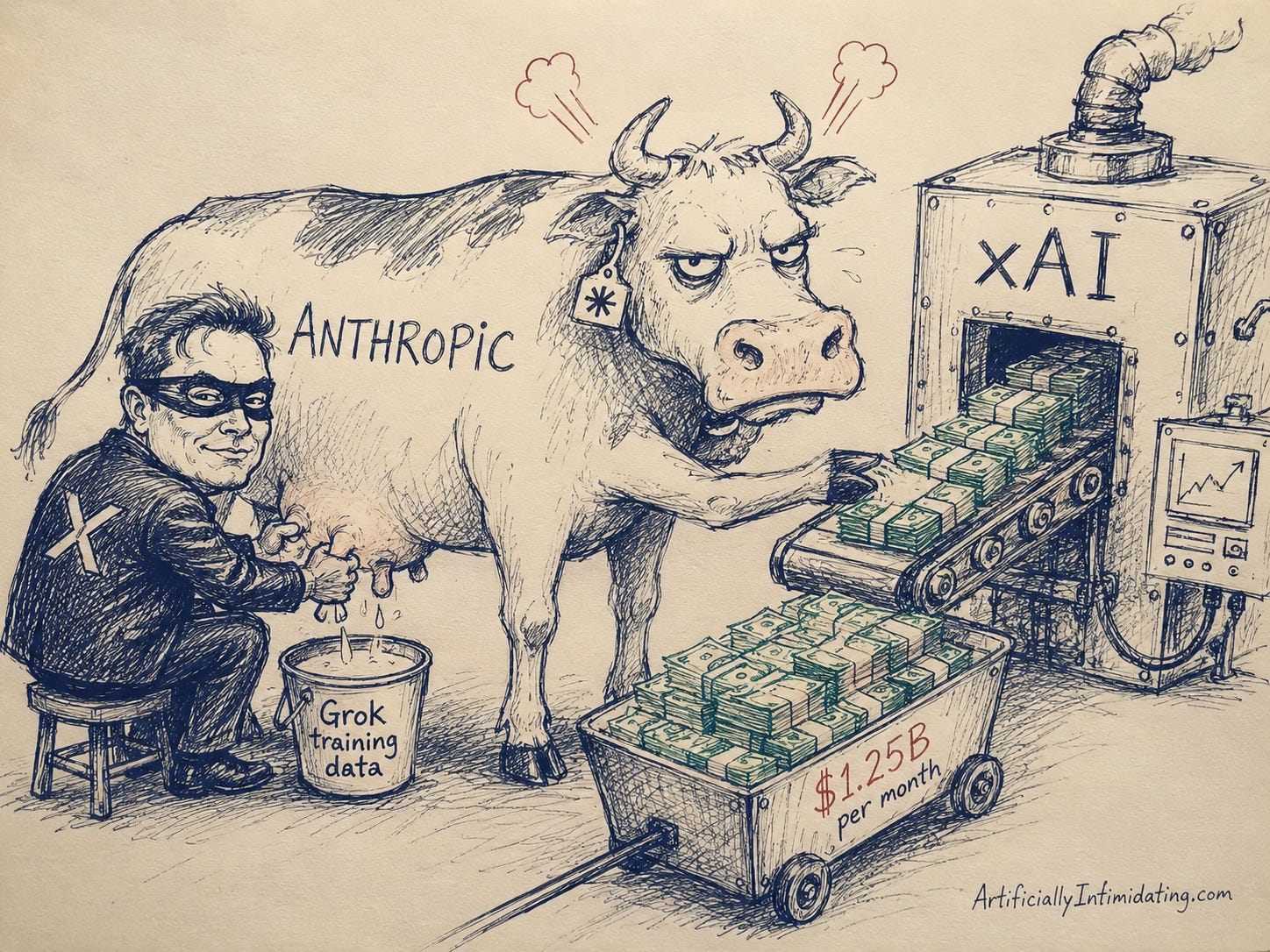
What happened: A report citing six people says Elon Musk’s xAI ran a months-long “distillation” project — using Anthropic’s Claude to generate training data for Grok’s coding models — and kept going even after Anthropic cut off its access in January, allegedly switching to personal accounts and a third-party service called Blackbox AI to keep the taps open.
Why it matters: Distillation is the AI version of photocopying a rival’s textbook: you train your model on a smarter model’s answers. Anthropic’s terms explicitly ban using Claude to build competing products, so if the report holds up, this isn’t a gray area — it’s months of knowingly walking around a locked door.
What everyone’s saying: It rhymes with Musk’s own April courtroom admission that xAI “partly” used OpenAI’s tech to train Grok, and with Anthropic’s February claim that DeepSeek and others ran “industrial-scale” distillation through 24,000 fake accounts. Everyone’s distilling everyone; the only real scandal is getting named.
My read between the lines: Here’s the awkward part: Anthropic is currently paying xAI $1.25 billion a month to rent its Colossus data center. So the company allegedly being copied is also xAI’s single biggest customer. In this industry your supplier, your rival, and your alleged victim can all wear the same logo — and nobody torches a $40 billion relationship over some borrowed homework.
📖 Further reading: AI Is a Trust Problem, Not a Tech Problem — when the labs are quietly copying each other’s outputs, “can you trust the model” quietly becomes “can you trust the company behind it.”
Bernie Wants You to Own Half of OpenAI
Source: The New York Times
What happened: Senator Bernie Sanders is introducing the American A.I. Sovereign Wealth Fund Act, which would hand the public a direct ownership stake in the largest U.S. AI companies through a one-time 50% tax — paid not in cash but in stock — on the likes of OpenAI, Anthropic, and xAI.
Why it matters: His pitch: AI was built on humanity’s collective work — our books, art, code, and conversations — so the wealth it generates should flow back to the public, Norway-oil-fund style. Earlier this week we covered Washington Wants a Piece — Sanders is just the left-flank version of an instinct the White House already shares.
What everyone’s saying: The detail Sanders keeps hammering: OpenAI itself floated a “public wealth fund” giving every citizen a stake, Anthropic proposed “national sovereign wealth funds,” and even Musk endorsed federal checks. The CEOs put the idea on the table; Sanders is calling the bet.
My read between the lines: A 50% stock tax has roughly the political odds of a snowball in a data center, and the labs know it — endorsing the vibe of public ownership costs nothing when the bill will never pass. But the framing is the real weapon: once you brand AI “a public resource built on stolen work,” every copyright suit and licensing fight inherits a much sharper moral edge.
📖 Further reading: Trump meets with every AI CEO next week. Here’s why. — the other side of the aisle wants its cut too, proof the “public stake in AI” idea isn’t a fringe Bernie position.
Palantir’s CEO Calls AI Mania a “Porn Addiction”
Source: Business Insider
What happened: Palantir CEO Alex Karp, speaking at the company’s AIPCon event, tore into “tokenmaxxing” — the corporate fad of pushing employees to burn as many AI tokens as possible to look productive — comparing it to a porn addiction and arguing it produces “slop,” not value.
Why it matters: Tokens are how AI usage gets billed and measured, so “more tokens = more productivity” became an easy, lazy KPI. Companies from Meta to Amazon built internal leaderboards crowning “Token Legends” — and Karp’s point is blunt: measuring work by tokens is like grading a novelist by keystrokes.
What everyone’s saying: He’s not alone. Uber’s COO admitted he can’t connect soaring AI bills to real gains, and Amazon reportedly scrapped its leaderboard after workers spun up agents to do busywork just to pad their stats. It all dovetails with the bubble jitters from when Wall Street had its dot-com flashbacks.
My read between the lines: Convenient timing for the man whose company sells the “no slop zone” alternative — Karp is talking his book as much as preaching restraint. But he’s right that “taste” is the one thing you can’t scale: the hard part was never generating more tokens, it was knowing which problem was worth solving. The vibe-spending era is ending, and everyone’s suddenly rediscovering the word “ROI.”
📖 Further reading: I ignored Hermes for two months. Here’s what I actually found. — the cure for tokenmaxxing is judging an AI tool by what it actually delivers, which is exactly what this hands-on review does.
The Real AI Slop Isn’t Suno — It’s Spotify
Source: The Leverage
What happened: Writer Evan Armstrong flipped the AI-music panic on its head this week: the real “slop,” he argues, isn’t generators like Suno — which just raised $400 million at a $5.4 billion valuation and actually labels its output — but Spotify, which quietly slips unlabeled AI tracks into your trusted playlists.
Why it matters: It reframes the whole “AI slop” fight around disclosure instead of generation. A tool that announces “I’m AI” is being honest; a platform that feeds you AI without saying so is the real trust violation. Spotify pulled 75 million spammy tracks last year and only started beta-testing AI labels in April — and even those are optional.
What everyone’s saying: Suno’s backers clearly aren’t spooked — $400 million says the market sees AI music as a feature, not a plague. The conversation is sliding from “should AI make music” (too late) to “do I have a right to know when it did.”
My read between the lines: Spotify’s incentives are the tell: an AI track pays out like a human one but costs the platform far less to source, so “we’re studying disclosure” is doing a lot of heavy lifting. The generators became the villains because they’re visible; the distributor quietly reshaping what you hear skates precisely because it’s invisible. Slop isn’t a sound — it’s a sourcing decision nobody told you about.
📖 Further reading: OpenAI shipped a physical camera, but that’s not the story. — when AI-made media slides into feeds you trust, the question stops being “is it good” and becomes “is it real,” the same thread this post pulls.
That’s your AI Brief for Monday. Join the conversation in the Artificially Intimidating community chat.
—Artificially Intimidating