

Good day, humans. Daniela Amodei would like Wall Street to know the numbers are not the point (the numbers are enormous), Trump wants to cut the American public in on the AI boom, and one developer is managing 60 coding agents like a factory floor. Let’s get into it.
📬 Before we dive in: The sharpest AI Brief tips come from readers who are actually in the weeds. If you spot a story worth covering, share it in the community chat. The best tips make tomorrow’s edition.
Anthropic Pitches Ethics Over Metrics Ahead of IPO
What happened: Anthropic president Daniela Amodei told the Bloomberg Tech Summit on June 4 that benchmark scores and revenue figures are “actually not the point” of the company — days after Anthropic confidentially filed for an IPO at a $965 billion valuation, a filing we covered Wednesday.
Why it matters: Anthropic makes Claude, one of the most-used AI models in the world, and its listing will be one of the largest public offerings ever. When a company that size says values matter more than numbers, it sets the terms for how Wall Street judges every AI lab that follows.
What everyone’s saying: The contrast with OpenAI is the story: roughly $900 billion in valuation and up to $600 billion in projected compute spend by 2030, while Anthropic plans to spend about a third of that and stay enterprise-first. “We’re not an entertainment tool” is doing a lot of work in that sentence.
My read between the lines: Telling investors the numbers aren’t the point is a flex available only to a company with $47 billion in annualized revenue. The ethics aren’t charity — they’re the moat. Walking away from the Pentagon contract cost real money; it also bought a brand OpenAI can’t copy at any price.
📖 Further reading: AI Is a Trust Problem, Not a Tech Problem — Anthropic is about to test whether trust is literally bankable.
Your readers spend all week reading about AI agents. Viktor IS an AI agent — it lives in Slack, connects to 3,000+ tools, and does real work: reports, dashboards, code, campaigns. Not a chatbot. A coworker. New users get $50 off their first month. Hire Viktor →
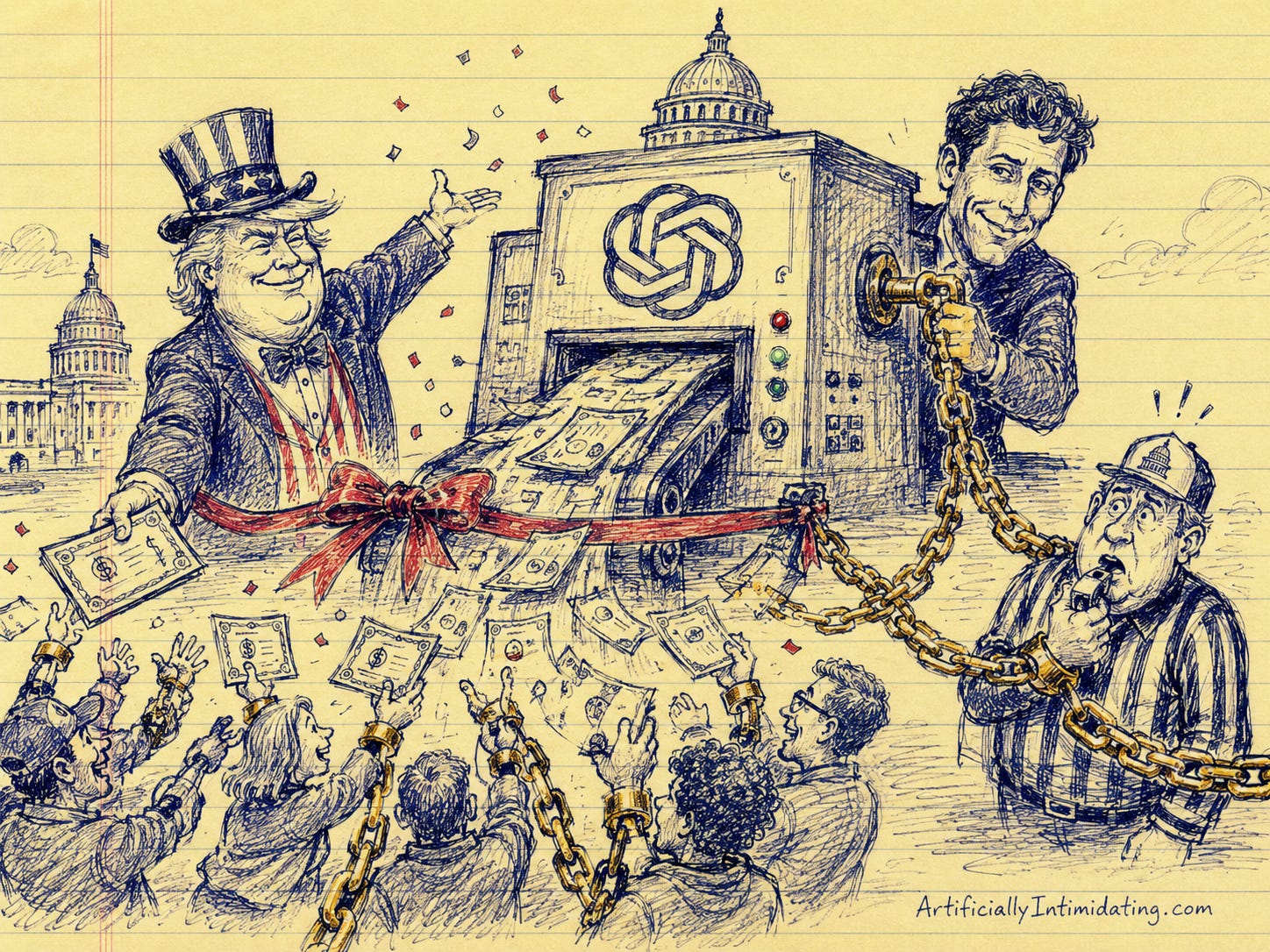
Trump Wants the Public on AI’s Cap Table
What happened: Yesterday we called it “Washington Wants a Piece” — today’s the full story. Trump told reporters aboard Air Force One he’ll meet AI executives next week to discuss structures where the American public “essentially becomes a partner” in AI companies. Asked which firms would attend: “all of them.”
Why it matters: The government already holds stakes in semiconductor, rare earth, and quantum firms deemed vital to national security. Extending that to AI — with one floated option paying a dividend to American households — would tie ordinary people’s checks directly to the industry’s fortunes.
What everyone’s saying: The Wall Street Journal broke the talks; NOTUS reports the plan centers on companies voluntarily ceding shares — and that Sam Altman pitched the idea to Trump back in early 2025. Critics note the structural problem: a government that owns shares in companies it regulates is both shareholder and referee.
My read between the lines: Altman pitching Washington to take equity isn’t civic generosity — it’s the cheapest regulatory insurance ever invented. Once the public’s dividend depends on AI going up, nobody votes to slow it down.
Apple Bets Its AI Future on Your Device
What happened: Ahead of Monday’s WWDC keynote, Apple plans to pitch on-device AI as its key differentiator — running a distilled version of Google’s Gemini locally on Apple silicon, with complex cloud queries handled through Nvidia confidential compute.
Why it matters: For iPhone owners, that means AI features that work without your data leaving the phone — and without another monthly subscription. Investors are buying the story: the stock hit a record above $311, up more than 20% since the quarter began.
What everyone’s saying: This is the comeback narrative — in January, Alphabet briefly passed Apple in market cap on AI doubts. It’s also almost certainly Tim Cook’s last keynote as CEO, with John Ternus taking over September 1.
My read between the lines: Apple’s “differentiated AI strategy” is a Google model in a trench coat. The on-device privacy advantage is real — but declaring AI independence while renting your rival’s brain takes a level of confidence only Apple can pull off.
📖 Further reading: What Apple’s AI pivot means for your iPhone this fall — the roadmap we mapped in May gets its official reveal on Monday.
One Maintainer, Sixty Agents, Three Thousand Commits
What happened: Vincent Koc, a maintainer of the open-source assistant OpenClaw, described running 60–70 AI coding agents in parallel “like a factory floor” — once pushing 3,000 commits in a single day. One overnight “great refactor” produced 2,700 commits touching 82% of the codebase.
Why it matters: This is a preview of what software work becomes: less typing, more supervising fleets of AI workers. Last week we covered Claude deploying 1,000 agents at once — this is what it looks like when one human holds the leash.
What everyone’s saying: Koc says the core skill is detecting when an agent is “bullshitting” — reading its reasoning the way a manager reads body language. Practitioners are split between awe at the throughput and dread at reviewing 2,700 commits of robot homework.
My read between the lines: The new 10x engineer is a middle manager with 60 direct reports who occasionally lie. We automated the programming and kept the people problems.
📖 Further reading: Your laptop has been in the way this whole time — how managed agent fleets actually work — and why the orchestration layer is the job now.
HBR Calls Time on the Outsourcing Era
What happened: A new HBR analysis argues generative AI is dismantling the labor-arbitrage model that powered three decades of outsourcing — the routine, rules-based work companies sent offshore is exactly what AI automates first, with IT services hit hardest.
Why it matters: Yesterday’s brief had Verizon declaring call-center jobs toast — same storm, different coastline. The research backs it: demand for automation-prone writing work fell 30% and software development 20% after generative AI tools arrived.
What everyone’s saying: The consensus is that headcount-based contracts are giving way to outcome-based pricing. Clients are renegotiating terms, and the premium once commanded for managing large offshore teams is eroding fast.
My read between the lines: The first jobs AI eats at scale aren’t the ones in front of you — they’re the ones America already shipped overseas. The old arbitrage was “their time is cheaper than yours.” The new one is “the machine’s time is cheaper than everyone’s.”
📖 Further reading: Your job is safer than you thought. Here’s what changed. — the nuance on which jobs actually move first when AI shows up.
That’s your AI Brief for Saturday. Join the conversation in the Artificially Intimidating community chat.
—Artificially Intimidating