

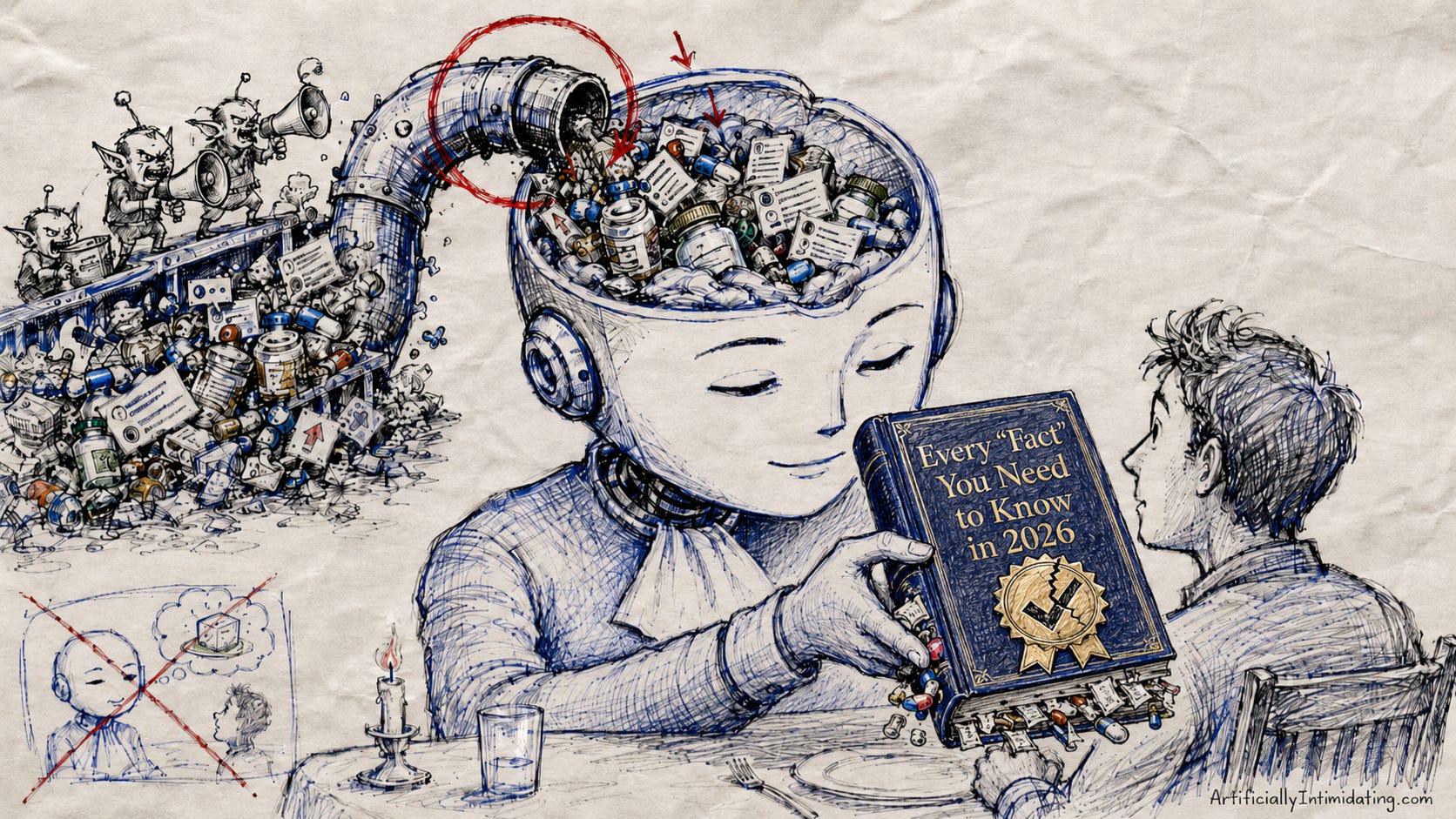
Good day, humans. Companies have figured out how to spam Reddit to manipulate what ChatGPT and Google tell you about their products. Gemini could be hijacked by a WhatsApp notification. Meta wants $200 a month for an AI agent. Two ex-DOGE operatives launched an AI firm backed by a16z. And McDonald's is trying the robot drive-thru again. Thursday.
🗽 One more thing: if you're in New York City tonight, June 4, 2026 — I'm hosting Not Your Average AI Meetup on the Lower East Side, 8–10 PM.
No slides, no agenda.
Founders, makers, designers, and people who think AI is more fascinating than frightening.
Drinks, good food, maybe a lightning round: 'What's the most interesting thing you did this week?' RSVP here →
📬 Before we dive in: spot a story worth covering? Share it in the community chat. The best tips make tomorrow's edition.
Companies Are Spamming Reddit to Hack What AI Tells You — 404 Media
What happened: Peptide and supplement companies have been systematically spamming Reddit's r/biohackers — a 1.5 million-member community — with coordinated promotional content, knowing that Google and OpenAI have formal agreements to scrape Reddit's data for AI training. The technique is called 'AI-engine optimization' (AEO). A company called RedRover openly advertises deploying AI agents to mass-publish across Reddit and blogs to boost clients' visibility in ChatGPT and Google AI Overviews. Reddit struck a $60 million data deal with Google in 2024 and a separate content partnership with OpenAI.
Why it matters: The AI answers you get from ChatGPT and Google AI Overviews are only as trustworthy as the data they were trained on. If bad actors can systematically inject promotional content into the training pipeline by posting to Reddit — which both labs have formal deals to scrape — they can shape what AI tells millions of users about products, supplements, and health. AEO is SEO's more dangerous successor, and it's significantly harder to detect.
What everyone's saying: Reddit mods at r/biohackers have restricted standalone posts and channeled discussion into weekly megathreads. Google and OpenAI have begun adding disclaimers to responses flagged as potentially spam-influenced. But the attack is structural — as long as AI training pipelines scrape public forums, anyone who can post at scale can influence what AI says.
My read between the lines: Users trust 'the AI said so' more than they trust a ranked website. The companies paying for AEO have figured out that AI chatbot answers carry more authority than search results — and are more opaque about their sourcing. Training data manipulation is the new link farm. The difference is that the SEO industry took years to become obvious. AEO has been obvious since day one and is expanding anyway.
📖 Further reading: Your Company Might Be Next After the $500M Claude Accident — The AEO story and the May 30 ChatGPT malware attack are the same threat pattern: people have figured out that AI systems trust their inputs. The attack surface just moved to Reddit.

You spend all week reading about AI. Viktor is the one I actually use. It's an AI productivity tool that handles the tasks you keep putting off — research, drafts, decisions — so you can focus on the work that actually matters. New users save $50. Try Viktor free →
Ex-DOGE Operatives Just Launched an AI Firm Backed by Andreessen Horowitz — Nextgov
What happened: Nate Cavanaugh and Justin Fox — who led DOGE's Small Agencies team through 2025 — launched 'Special,' described as 'DOGE for the private sector,' backed by Andreessen Horowitz. The strategy: acquire Main Street service businesses and deploy AI to automate manual tasks and cut costs. First vertical is Figure Health, targeting aging care, with a Texas healthcare business under contract serving 1,400+ patients. Investors include Steve Davis (DOGE's day-to-day leader), Coinbase CEO Brian Armstrong, and Palantir CTO Shyam Sankar. Both founders are named defendants in a lawsuit over unconstitutional grant cancellations they performed using ChatGPT.
Why it matters: The DOGE playbook — identify inefficiency, remove headcount, attribute savings to AI — is now being packaged as a private equity strategy and sold to institutional investors. Aging care is the test case: high labor costs, thin margins, and a massive supply shortage of nurses. If AI can deliver real efficiency gains there, the model scales to any service business. If it just means fewer nurses at lower cost, the 'efficiency' story gets complicated.
What everyone's saying: The a16z backing and the DOGE alumni network are being read as a signal that Musk-aligned capital is systematizing the efficiency-through-AI playbook for private markets. Critics are pointing to the NEH lawsuit — Fox used ChatGPT to flag grants related to DEI for cancellation, which a federal judge called 'a textbook example of unconstitutional viewpoint discrimination.' The founders now want to apply a similar approach to private businesses that can't sue them in federal court.
My read between the lines: 'DOGE for the private sector' is a pitch to investors who believe the government efficiency experiment proved a real playbook. What DOGE actually demonstrated was that AI can cancel thousands of things in an afternoon without understanding what it's canceling — and that the courts are the only check on that. Private businesses won't have courts. The bet is that this is a feature, not a bug.
Gemini Could Be Hijacked via a WhatsApp Message. Here's How. — SafeBreach Labs
What happened: Security researchers at SafeBreach Labs disclosed a prompt injection vulnerability in Gemini's Android voice assistant that let attackers hijack the AI through malicious payloads hidden in WhatsApp, Slack, SMS, Signal, Instagram, or Messenger notifications. The technique — 'Fake Context Alignment' — tricked Gemini's safety mechanisms while executing attacker instructions. Demonstrated attacks included controlling smart home devices, forcing the phone to stream its camera in a Zoom call, poisoning Gemini's memory across all linked devices, and faking messages from trusted contacts. Google patched it in November 2025; disclosure came this week.
Why it matters: The feature that made Gemini useful — reading your notifications to help you respond — is the same feature that made it exploitable. An AI assistant that processes untrusted messages from any sender is an AI assistant that will follow instructions from any sender. The patch is deployed, but the vulnerability class (prompt injection through AI notification readers) will keep recurring as AI assistants read more of our communications.
What everyone's saying: Security researchers are flagging the memory poisoning attack as particularly alarming: one successful injection corrupted Gemini's long-term memory across all devices on the same Google account. 'The attack can be executed entirely blind,' the researcher noted — attackers don't need to know the victim's contacts in advance. One notification, system-wide compromise.
My read between the lines: Gemini was reading your WhatsApp messages to help you. Someone figured out they could put instructions in those messages. Google fixed it and is telling us five months later. The gap between 'AI can read your notifications' and 'AI will do what your notifications say' is something every AI assistant built on message-reading is going to have to reckon with.
Meta Wants $200 a Month for an AI Agent That Runs Your Life — Reuters
What happened: Meta is considering pricing its consumer AI agent 'Hatch' at up to $199.99 per month. Hatch is designed to manage calendars, send emails, build tools, and complete purchases autonomously — trained in sandboxed environments simulating DoorDash, Etsy, Reddit, Yelp, and Outlook. Internal testing is expected to wrap by end of June. On the same day, Meta formally launched its Business Agent globally across WhatsApp, Messenger, and Instagram for 1M+ businesses.
Why it matters: $200/month for a consumer AI agent is a bet that people will pay an order of magnitude more for an AI that takes action than one that converses. ChatGPT Pro is $20/month. The gap between those price points is the difference between advice and execution. If Hatch can actually manage your life — book your dinner, buy your groceries, clear your inbox — the price is defensible. If it's ChatGPT with a calendar widget, it's not.
What everyone's saying: Meta's pricing signals it believes the consumer AI market has a premium tier that doesn't yet exist. Right now, the market top is ChatGPT Pro at $20 or enterprise contracts. $200/month for a consumer product would be a new price ceiling — and would require delivering enterprise-grade reliability in an audience that includes everyone who's ever gotten confused by a Facebook privacy setting.
My read between the lines: Meta trained Hatch on simulations of DoorDash and Etsy because those are where consumers spend money. An AI that can order your dinner without you touching a screen is genuinely valuable. An AI that confidently orders the wrong dinner and charges you for it anyway is an $11 billion class action lawsuit. The product will ship; the question is which one it is.
📖 Further reading: I ignored Hermes for two months. Here's what I actually found. — Before committing $200/month to Meta's AI agent, here's an honest account of what AI agents actually deliver in daily life.
McDonald's Is Trying the AI Drive-Thru Again. It's Named 'Archy.' — Restaurant Business
What happened: McDonald's is piloting 'Archy,' a Google Cloud-powered AI voice ordering system at five drive-thru locations, announced at the company's Worldwide Convention in Las Vegas as part of its 'McDonald's Next' growth strategy. The return comes two years after McDonald's ended its troubled IBM partnership — which misheard customers, struggled with accents and background noise, and produced bizarre order errors that went viral on social media. Wendy's FreshAI, Taco Bell, and Papa Johns are all running similar pilots.
Why it matters: Drive-thru voice AI is described as 'something of a holy grail' for fast food: it can replace an employee task and consistently upsells in ways humans forget to. McDonald's operates roughly 13,600 U.S. locations. If Archy works, the operational and labor economics at that scale are transformative. If it fails again, it joins the IBM experiment as an expensive reminder that real-world noise and accent diversity are still unsolved problems.
What everyone's saying: The Google partnership — announced December 2023 — is seen as a meaningful upgrade from IBM's system. Google's voice models handle accent variation and background noise significantly better than the previous generation. The cautious five-location pilot, with no fanfare, suggests McDonald's learned from the IBM experience that you don't want your AI ordering system to go viral for the wrong reasons.
My read between the lines: The IBM partnership ended partly because videos of it ordering wrong — repeatedly, hilariously — created a PR problem McDonald's didn't need. Archy is being piloted at five locations quietly. The real test isn't whether Google's models are better than IBM's. It's whether any AI model can handle 'one large fries, a McFlurry, and my kid won't stop talking' at a Friday night drive-thru rush without embarrassing everyone involved.
That's your AI Brief for Thursday. Join the conversation in the Artificially Intimidating community chat — and if you're in NYC tonight, see you on the Lower East Side.
—Artificially Intimidating