

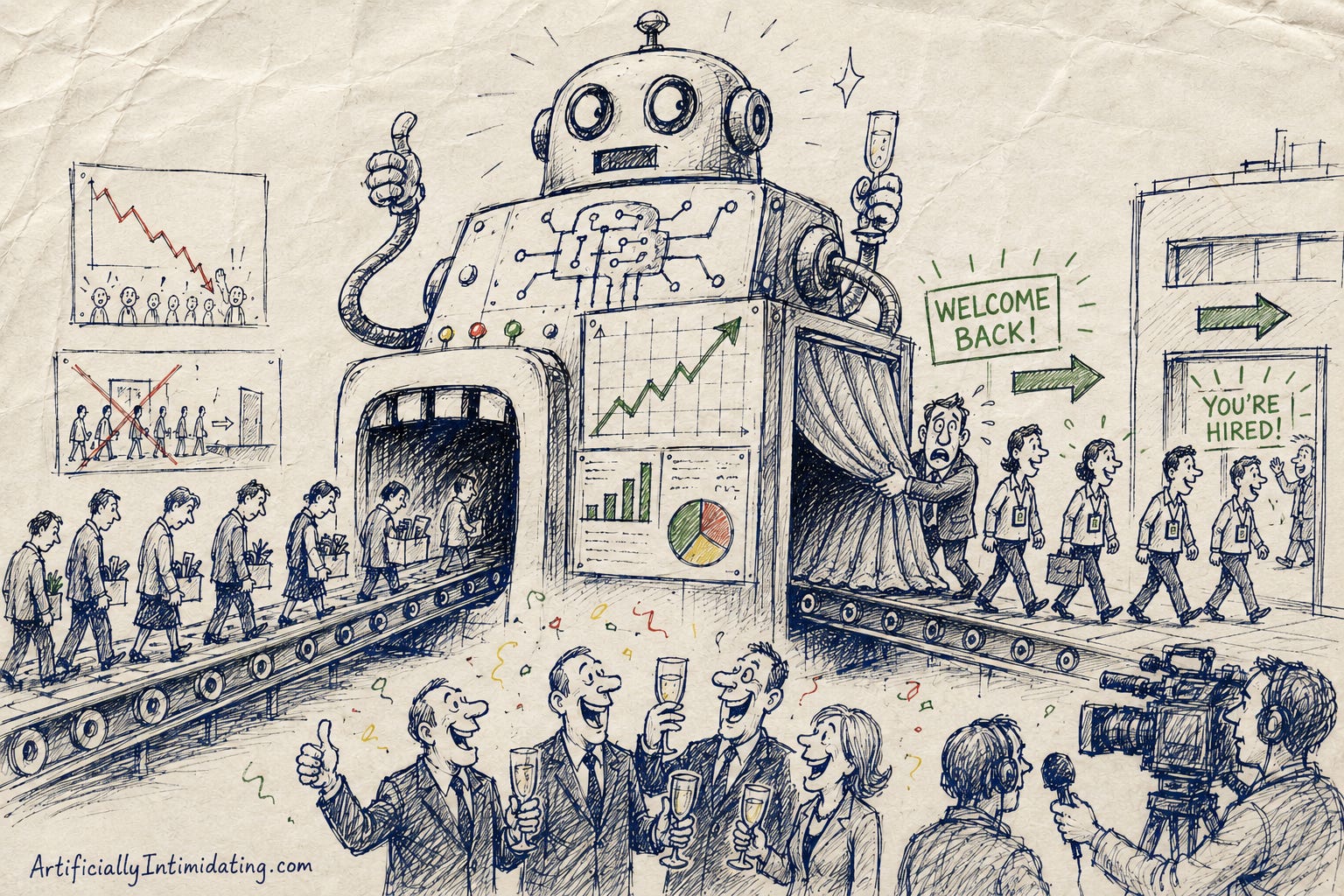
Good day, humans. Two stories today tell you almost everything about where AI really is right now. In one, the NSA says Anthropic’s most powerful model strolled through its classified systems like they were a screen door. In the other, the companies that loudly replaced workers with chatbots are quietly hiring the humans back. Frighteningly capable, frustratingly unreliable — sometimes in the same week. Let’s get into it.
The NSA says Mythos walked into its classified systems
Bankwatch (relaying The Economist)
What happened: Yesterday we called it “the Fable 5 ban’s real lesson” — today’s the full story. NSA director General Joshua Rudd told Senator Mark Warner that in an authorized red-team test, Anthropic’s Mythos model “broke into almost all of our classified systems, not in weeks, but in hours,” a quote first reported by The Economist.
Why it matters: It’s the clearest public sign yet that a frontier model can act as a genuine offensive cyber weapon — and it surfaced the same week the Trump administration barred foreign access to Mythos 5 and Fable 5, which Anthropic then shut off entirely to comply.
What everyone’s saying: Hawks call it proof the government was right to clamp down. The Economist editor who published the quote cautioned it shouldn’t be read literally, since Mythos was running alongside other tools under specific conditions.
My read between the lines: A model that aces a red-team on its own network is doing exactly what it was told to do. The scary part isn’t that Mythos “hacked the NSA” — it’s that Washington now can’t decide whether that makes it a national asset or a national liability, and it’s treating it as both.
📖 Further reading: The US Government Just Took Anthropic’s Best AI Model Offline — Here’s Why — the backstory on how Mythos became a geopolitical hot potato.
An AI that can breach a classified network but can’t file your expense report is a strange place for the industry to be. Viktor is the other kind: an AI agent that lives in your Slack and connects to 3,000+ tools, then actually ships the work — pulling reports, building dashboards, running campaigns while you’re asleep. Not a chatbot you babysit; a coworker you hand things to. New readers get $50 off their first month. Hire Viktor →
Companies are quietly un-firing the humans
What happened: After two years of “we replaced the team with AI” announcements, companies are reversing course. Klarna — the most public example — has walked back its AI-only customer service and started rehiring, and analysts say it’s part of a broader retreat as the costs of automation outrun the savings.
Why it matters: An MIT study found that 95% of enterprise generative-AI pilots delivered no measurable revenue or cost impact. The gap between a slick demo and a system that survives contact with real customers turns out to be enormous — and expensive.
What everyone’s saying: Gartner now predicts more than 40% of “agentic AI” projects will be cancelled by the end of 2027. The consensus has flipped from “AI replaces everyone” to “AI replaces some tasks, badly, for now.”
My read between the lines: Nobody issues a press release for a rehire. The layoffs were loud because they made the stock pop; the reversals are quiet because admitting the robot couldn’t do the job costs more than the severance did.
📖 Further reading: AI Is a Trust Problem, Not a Tech Problem — why so many of these deployments fail for reasons that have nothing to do with the model.
Quick one between stories: the Brief is free and always will be — but the paywalled deep-dives and full archive, the real reporting behind headlines like today’s Mythos breach, are for members. Founding readers get 20% off the first year, through June 30. Unlock the deep-dives →
Anthropic says its engineers now ship 8x more code
What happened: Fiona Fung, who runs Anthropic’s Claude Code and Cowork teams, told Lenny’s Newsletter that her engineers now ship roughly 8x more code per quarter than their 2021–2025 baseline — with AI authoring the large majority of production code that gets merged.
Why it matters: It’s one of the first concrete, first-party numbers on what “AI-native” engineering actually does to output. And it quietly redefines the job: from typing code to reviewing, directing, and verifying it.
What everyone’s saying: Fung says she makes every manager start as a hands-on individual contributor, so leaders truly understand the agentic workflow before managing it. Engineers online are split between “this is the future” and “8x more code is also 8x more code to debug.”
My read between the lines: Shipping 8x more code is only a win if review, taste, and architecture scale with it. The bottleneck didn’t vanish — it moved from writing the code to being sure the code is right, and that’s a far harder thing to multiply by eight.
📖 Further reading: Your laptop has been in the way this whole time — a plain-English look at the managed-agents shift that makes numbers like this possible.
When buying software still beats building it with an LLM
What happened: Engineer Brandur Leach argues that even though LLMs make software far cheaper to build, there’s still a “zone of viability” where buying beats rebuilding — and he does the math: cloning Jira to dodge a $400/month bill would take about 37 months just to break even.
Why it matters: It’s a useful antidote to the “just have the AI rebuild it” reflex sweeping engineering teams. The cost of software was never only the code — it’s the maintenance, the edge cases, and the context-switching that never show up in the demo.
What everyone’s saying: The flip side, Leach notes, is that absurdly priced tools invite replacement. Salesforce, down roughly a third this year, is the poster child for pricing yourself out of the zone of viability.
My read between the lines: “AI will kill SaaS” is half right. It won’t kill software that’s fairly priced and genuinely complex; it’ll kill software that’s been coasting on switching costs. The LLM didn’t change the math so much as it finally forced everyone to do it.
📖 Further reading: Thanks to Apple, Your favorite AI tool is a dead tool walking — the same commoditization argument, pointed at the AI tools themselves.
Noam Shazeer leaves Google for OpenAI
What happened: Noam Shazeer — a co-author of the 2017 “Attention Is All You Need” paper that kicked off the modern AI era, and a co-lead of Google’s Gemini — is leaving Google for OpenAI, one of the biggest talent moves of the year.
Why it matters: Google reportedly paid around $2.7 billion in 2024 to bring Shazeer back via the Character.AI deal. Losing him to OpenAI 18 months later says the scarcest resource in AI isn’t chips or data — it’s the handful of people who know how to turn raw scale into a working model.
What everyone’s saying: Commentators read it as momentum for OpenAI and a gut-punch for Google’s DeepMind, landing right as Google scrambles to ship Gemini 3.5 Pro before the end of June.
My read between the lines: When a company pays billions to acquire a person and still can’t keep them, the talent war stops being about money. It’s about who people believe will build the thing that matters — and that belief is the one moat that can walk out the door at 5pm.
That’s your AI Brief for Monday, June 22. Same time tomorrow.
—Artificially Intimidating