

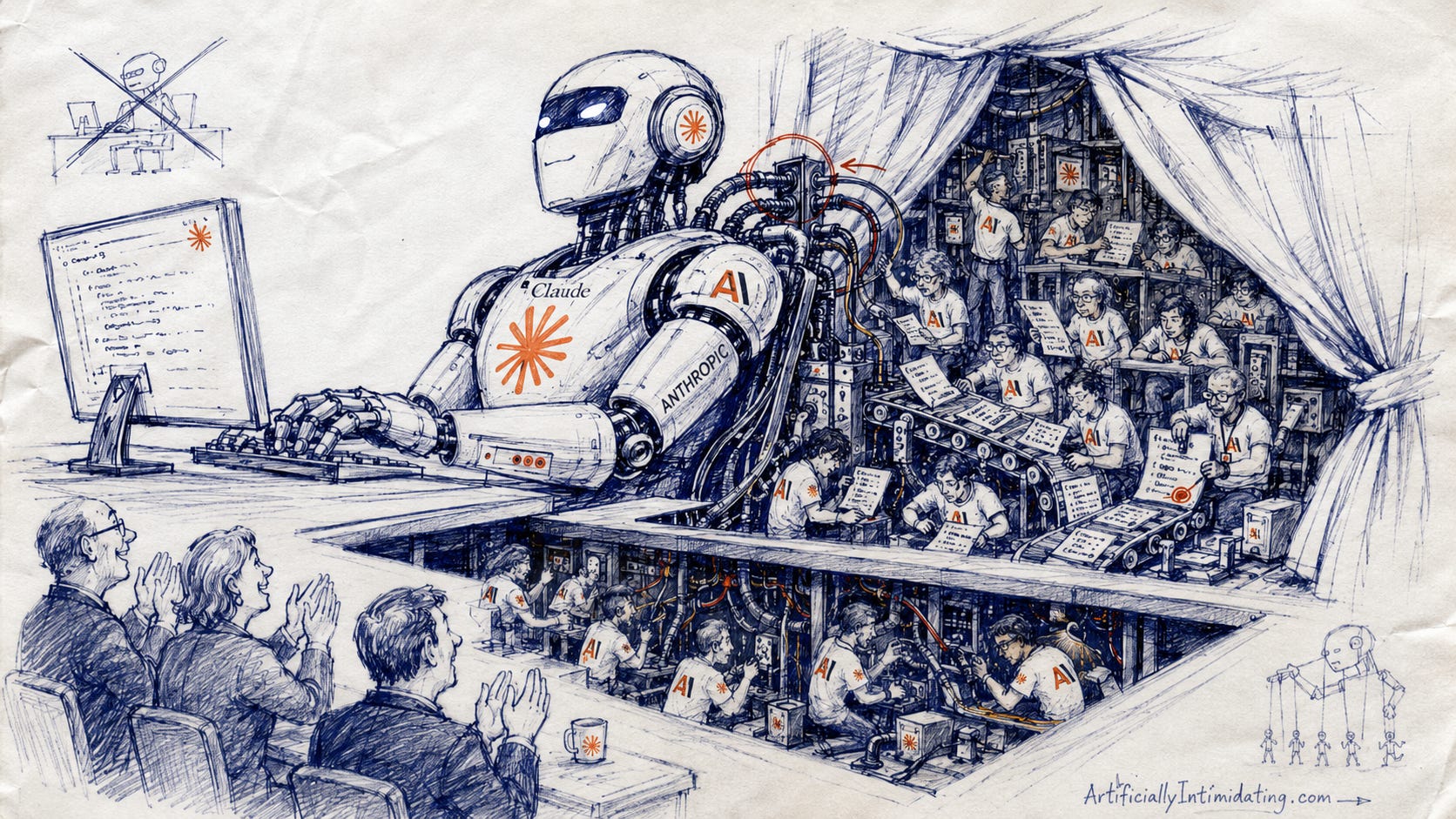
Good day, humans. PewDiePie — yes, that PewDiePie — shipped a privacy-first, no-subscription, open-source AI workspace that hit 10,000 GitHub stars in under 24 hours. Anthropic has 1,000 contract engineers quietly fine-tuning Claude Code behind closed doors. MiniMax launched a Chinese open-weight model that claims to rival GPT-5.5. And Bridgewater published a counterargument to the AI jobs panic just as tech layoffs hit 85,000 in four months. Let's go.
🗽 One more thing: if you're in New York City this Thursday night (June 4th, 2026), come meet us. We're hosting Not Your Average AI Meetup on the Lower East Side — drinks, no slides, good conversation, and an informal lightning round: "What's the most interesting thing YOU did this week?" It's for founders, makers, designers, and anyone who finds AI more fascinating than frightening.
Request your spot →
📬 Before we dive in: The sharpest AI Brief tips come from readers who are actually in the weeds. If you spot a story worth covering, share it in the community chat. The best tips make tomorrow's edition.
PewDiePie Released a Free, Private AI Workspace. 10,000 People Starred It Overnight. — GitHub
What happened: Felix Kjellberg — known as PewDiePie, the most-subscribed individual creator on YouTube — launched Odysseus, a free, open-source, self-hosted AI workspace on May 30. Built over twelve months on his own custom PC, it runs entirely on local hardware, connects to local LLMs or external APIs, lets users run autonomous AI agents, compare multiple models side by side, and includes a document editor, email client with auto-reply, calendar, and deep research tool. MIT license. No subscriptions, no tracking, no telemetry. It cleared 10,000 GitHub stars in under 24 hours.
Why it matters: The number that matters is the GitHub stars — 10,000 in a day from an audience that includes millions of people who've never touched a terminal. Odysseus is the clearest signal yet that the privacy-first, local AI movement is breaking out of the developer niche. PewDiePie's distribution reaches people who've never heard of Ollama or Open WebUI.
What everyone's saying: Developer communities on r/LocalLLaMA noted its potential to bring local AI tools to a mainstream audience far larger than any prior open-source project in the space. The self-hosted AI ecosystem — already served by tools like Ollama and Open WebUI — just got a very large distribution channel it didn't have before.
My read between the lines: "It is out. It is free. No tracking, no subscriptions, no funny business. It's yours and yours forever." That's Kjellberg's launch line — and it's a better positioning statement than most AI startups have managed. Whether the product is polished enough to retain mainstream users is a different question. But as a signal that there's a large, underserved market for privacy-first AI tools, the 10,000 stars say everything.
You spend all week reading about AI. Viktor is the one I actually use. It's an AI productivity tool that handles the tasks you keep putting off — research, drafts, decisions — so you can focus on the work that actually matters. New users save $50. Try Viktor free →
Anthropic Is Running a Secret Operation With 1,000 Engineers to Fine-Tune Claude Code — Business Insider
What happened: Business Insider reported that Anthropic is running a large-scale, non-public operation called "Project Marlin" through data vendor Snorkel AI, enlisting roughly 1,000 contract software engineers to evaluate and improve Claude Code's output. Engineers earn up to $280 per task — each roughly an hour — A/B testing code generated by different model versions on real GitHub pull request scenarios. Neither Anthropic nor Snorkel AI commented publicly.
Why it matters: Claude Code already holds 51% of the AI coding market and generated $2.5 billion in revenue in its first year. Anthropic's own CFO said AI now writes more than 90% of the company's internal code. Project Marlin reveals that even the market leader is running massive human evaluation pipelines to maintain its edge — advanced AI training still requires thousands of expert humans making thousands of individual judgments.
What everyone's saying: The project illustrates a shift in AI training labor from simple data labeling toward advanced technical expertise. Similar platforms — Scale AI, Snorkel AI, Mercor — operate globally, paying skilled engineers more than $3,000 per week. The demand for expert human evaluators is growing alongside the capability of the models being evaluated.
My read between the lines: Claude Code is being sold as the tool that lets AI write your code. The invisible part of that story is 1,000 human engineers writing the rubric for what 'good code' means so the AI knows what to aim for. The AI is only as good as the human judgment baked into its training — and Anthropic is quietly spending a lot of money on that judgment.
📖 Further reading: Anthropic Raises $65B, Mythos Goes Public, and the Internet Has a Tell — The full picture on Anthropic's week: the funding, the model launch, and what Project Marlin adds to it.
China's MiniMax Launched an Open-Weight Model That Claims to Rival GPT-5.5 — AI Base
What happened: Chinese AI startup MiniMax unveiled its M3 model, claiming it's the first open-weights LLM to combine frontier-level coding, a 1-million-token context window, and native multimodal capabilities in a single package. On SWE-Bench Pro, M3 scored 59% — which MiniMax claims beats both GPT-5.5 and Gemini 3.1 Pro while approaching Claude Opus 4.7. Open weights and a technical report are due on Hugging Face within ten days. MiniMax's Hong Kong-listed stock surged 5% then reversed, dropping 15% from highs after the company disclosed plans for a secondary STAR Market listing.
Why it matters: If the performance holds under independent scrutiny, M3 changes the economics of agentic AI development. API pricing starts at $20/month — a fraction of what closed-source frontier models cost. Open weights mean enterprises can self-host. The combination of frontier performance plus open-weight pricing is the value proposition that every Chinese lab is racing to deliver, and MiniMax is claiming to have done it.
What everyone's saying: Independent observers are flagging the caveats: SWE-Bench Pro is described as a 'contaminated benchmark,' and MiniMax's claims are self-reported pending third-party verification. The ten-day window for open weights will be the real test. Still, the pricing argument is hard to dismiss even before the benchmarks are verified.
My read between the lines: The stock fell 15% from its high on the same day the model launched. The market is pricing in skepticism about the benchmark claims while the product ships. That's the right prior — Chinese AI labs have a history of leading with impressive self-reported numbers and delivering real but more modest independent results. Ten days for the open weights. We'll see.
📖 Further reading: AI Caught Ghostwriting the Pope's Encyclical — AI Brief May 28 — We covered Alibaba's Qwen climbing the coding leaderboard. MiniMax is the next Chinese lab making that same move.
Zoom Launched an AI Agent That Turns Your Meetings Into Finished Work — Zoom
What happened: Zoom launched ZoomMate — a $20/user/month agentic AI "work surface" that ingests context from Zoom Meetings, Phone, and Chat, as well as Google Meet and Microsoft Teams, and connects to Salesforce, ServiceNow, Workday, Jira, and Slack to turn meeting decisions into completed tasks automatically. Alongside it, Zoom launched an AI Productivity Suite — Canvas, Slides, Sheets, and Paper — that transforms meeting transcripts into polished documents compatible with Microsoft 365 and Google Workspace.
Why it matters: Zoom's bet is that the meeting — not the document, inbox, or calendar — is where business decisions are actually made, and that an AI agent sitting inside that context has an advantage that Microsoft Copilot and Google Gemini can't replicate from the document layer. ZoomMate ingesting competitors' meeting platforms (Google Meet, MS Teams) is the aggressive move: it turns Zoom into an intelligence layer on top of everyone else's infrastructure.
What everyone's saying: Analysts are framing this as Zoom's pivot from a one-trick video conferencing company into an enterprise AI platform. Moor Insights noted ZoomMate "sits inside the conversations where decisions unfold" — giving it live business context that document-layer competitors lack. Whether enterprises pay $20/user on top of existing Zoom subscriptions is the adoption question.
My read between the lines: Zoom became a verb during the pandemic and then watched its stock fall 90% as the world went back to offices. ZoomMate is the company's argument that it owns a data asset nobody else has: the full audio, transcript, and context of every business conversation. If that's true, the timing is right — every enterprise is looking for AI agents that don't require a six-month integration. Zoom's data is already there.
📖 Further reading: I ignored Hermes for two months. Here's what I actually found. — Before ZoomMate, here's what it's actually like to use an AI agent in your daily work. The gap between the demo and the reality is instructive.
Bridgewater Says AI Job Fears Are Overblown. Dario Amodei Disagrees. — New York Times
What happened: U.S. tech companies announced 85,411 job cuts in the first four months of 2026 — up 33% year-over-year — with AI cited as the leading reason for the second consecutive month. The NYT asked whether AI is genuinely replacing workers or providing cover for pandemic overhiring corrections. On Monday, Bridgewater published an assessment arguing that AI-driven displacement will remain low near-term due to limited adoption and compute constraints. Separately, Anthropic CEO Dario Amodei has predicted AI could eliminate 50% of entry-level white-collar jobs within five years.
Why it matters: 85,000 tech layoffs in four months is a real number. Whether it's attributable to AI or to pandemic-era overcorrection is a meaningful distinction for anyone whose job falls in both categories. Bridgewater's counterpoint — 'growth without jobs' because AI capex is equipment-intensive but not labor-intensive — is worth understanding. The $650B Big Tech AI infrastructure spend creates data center jobs, not office jobs.
What everyone's saying: The Mercer survey found only 44% of employees report thriving at work in 2026, down from 66% in 2024. Bridgewater flags AI cost pressures as a near-term economic risk even as it argues displacement is overstated. The NYT framing — 'AI displacement or excuse for cuts?' — captures the genuine ambiguity: both things can be true at once.
My read between the lines: Amodei is both warning about job displacement and running the company most responsible for accelerating it. Bridgewater manages money for clients whose portfolios benefit from AI efficiency gains. Neither party is a neutral observer. The number that matters is 85,000 tech layoffs in four months — regardless of the cause, those are real people with real consequences, and 'it's just pandemic correction' is cold comfort when you're in it.
📖 Further reading: Your job is safer than you thought. Here's what changed. — Last week we covered the more optimistic reading of the jobs data. Today's story is the other side of that argument.
That's your AI Brief for Tuesday. And don't forget — if you're in NYC this Thursday, come join us on the Lower East Side → Join the ongoing conversation in the community chat.
—Artificially Intimidating