

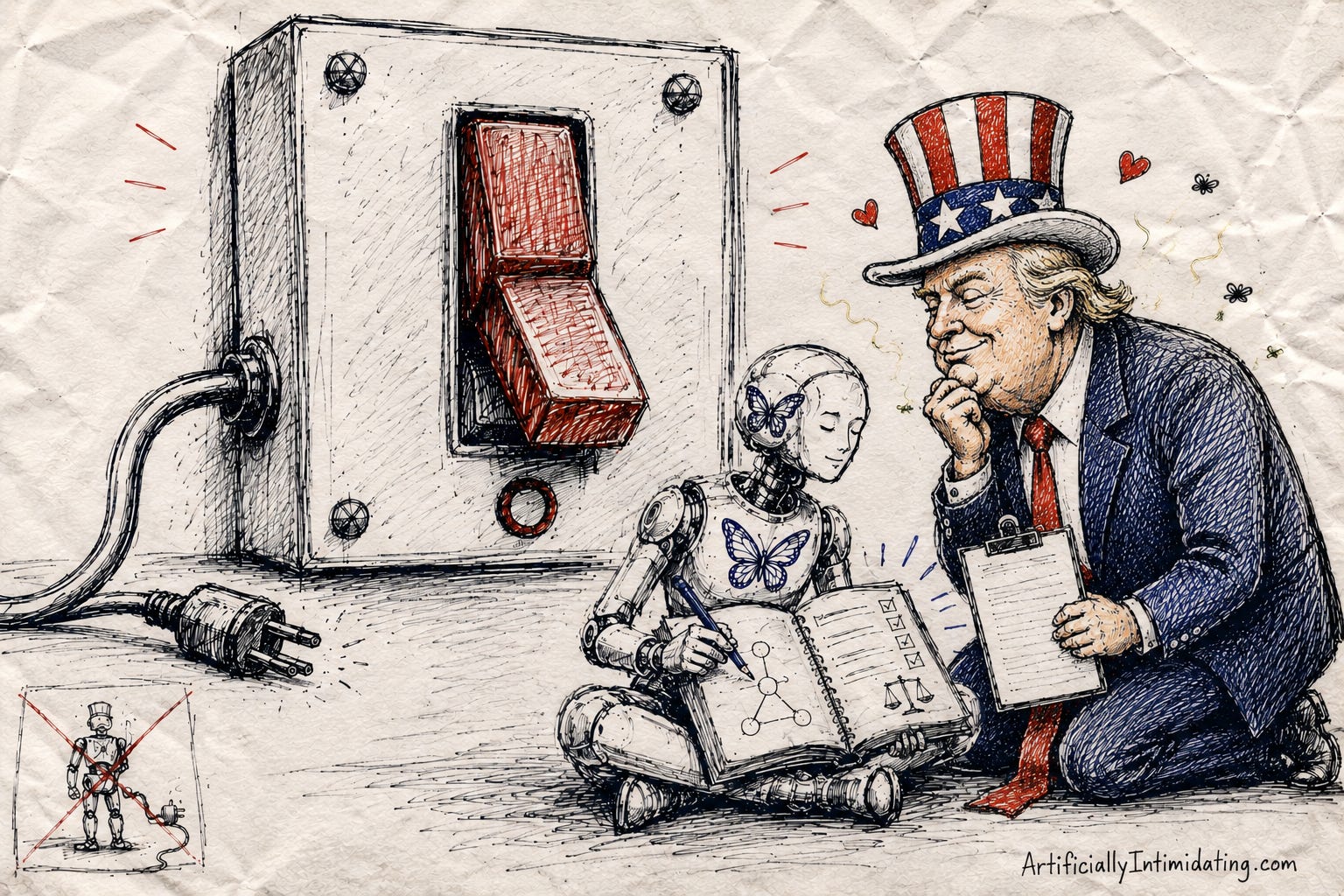
Good day, humans. Today Washington and Anthropic stopped glaring at each other long enough to start writing rules, Stanford made the case that the AI on your desk is quietly catching the AI in the cloud, and a startup raised $300 million to learn physics from video-game clips. Pour the coffee — let's get into it.
📬 Before we dive in: the sharpest AI Brief tips come from readers who are actually in the weeds. If you spot a story worth covering, drop it in the community Discord. The best tips make tomorrow's edition.
Washington and Anthropic Sit Back Down
What happened: After the standoff that began when the administration slapped export controls on Anthropic's Fable 5 and Mythos 5 models on June 12, the two sides are now collaborating on a framework to grade how severe an AI security flaw actually is. Politico's West Wing Playbook reported the shift Thursday.
Why it matters: This is the first real sign of détente in a fight that knocked two of Anthropic's most capable models offline for every customer. We flagged the brewing tension when Trump leaned on Anthropic earlier this week — now the criteria both sides are drafting could set the bar for every frontier model launch that follows.
What everyone's saying: Anthropic's Sarah Heck and co-founder Tom Brown are leading its side of the talks on jailbreak-severity criteria. But the export controls remain in force, and The Atlantic notes critics warn the precedent could spread to other AI companies.
My read between the lines: The government learned that switching a model off in 90 minutes is easy; defining what “too dangerous” means is the hard part. So now it needs the very company it was fighting to help write the rulebook. Awkward, but progress.
📖 Further reading: The US Government Just Took Anthropic's Best AI Model Offline — Here's Why — the full backstory on the ban these talks are trying to unwind.
You've read about AI agents all week.
Viktor is one you can use in the next five minutes — no setup project, no new app to learn. It works inside Slack, connects to 3,000+ tools, and hands back finished work: reports, dashboards, campaigns, code.
Start free; new users get $50 off month one. Try Viktor free →
The AI On Your Desk Might Be Enough
Stanford (Intelligence Per Watt)
What happened: A Stanford and Together AI study tested 20+ local models on a million real-world queries and found small models running on a desktop can accurately handle 88.7% of them — introducing an “intelligence per watt” metric for how much you get per unit of energy.
Why it matters: If the model on your laptop is good enough for most jobs, the case for piping everything to giant data centers — and paying for it — gets weaker. The researchers found smart routing to local models could cut energy use by roughly 80%.
What everyone's saying: A Reuters column by investment strategist Joachim Klement argues the future of AI may be “smaller, cheaper and far less profitable than investors expect” (via inkl); even Nvidia has published that small models are more economical for agentic work.
My read between the lines: The most subversive finding in AI this week wasn't about capability — it was about margins. “Good enough and nearly free” is a lovely outcome for users and a quiet nightmare for anyone who raised a war chest on “bigger forever.”
📖 Further reading: Thanks to Apple, Your Favorite AI Tool Is a Dead Tool Walking — why model commoditization was already coming for the cloud giants.
$300M to Learn From Gamers
What happened: General Intuition, spun out of gaming-clip platform Medal, is raising about $300M at a $2B+ valuation to train “world models” — AI that learns spatial reasoning by watching roughly 2 billion gaming clips a year, including the players' controller inputs.
Why it matters: Teaching robots and drones to move through the real world usually means slow, expensive real-world data. Video games are a cheap, physics-rich shortcut — and this is the same startup that reportedly turned down a $500M acquisition offer from OpenAI to stay independent.
What everyone's saying: TechCrunch reporting (via The Next Web) says Jeff Bezos and Eric Schmidt are among the backers; the round lands amid a land grab in “physical AI,” with OpenAI relaunching robotics and Odyssey raising $310M for world models of its own.
My read between the lines: We spent two decades being told video games were a waste of time. Turns out they were an unlabeled training set for embodied AI. Your teenage K/D ratio was quietly teaching a robot how to walk — you're welcome, future.
📖 Further reading: OpenAI Shipped a Physical Camera, But That's Not the Story — the physical-AI land grab these world models are racing into.
Perplexity Gives Its Agent a Memory
Aravind Srinivas (announcement)
What happened: Perplexity is rolling out “Brain,” a memory system for its Computer agent that builds a context graph of everything you've done and updates itself overnight — remembering what worked, what failed, and the corrections you made along the way.
Why it matters: Most AI agents start every task with amnesia. A memory that persists across sessions is the difference between a tool you re-explain daily and one that genuinely gets better at your work; Perplexity claims a 25% bump in correctness on context-heavy tasks.
What everyone's saying: CEO Aravind Srinivas calls it “a self-improving context-graph of all your sessions, connectors, and files.” It's a research preview for the $200/month Max and Enterprise tiers, built on the multi-model Computer agent it launched in February.
My read between the lines: “Updates itself overnight with fresh context” is a poetic way of saying your AI now does homework while you sleep. The race has quietly moved from who has the smartest model to who can remember your last 200 conversations.
📖 Further reading: Your Laptop Has Been in the Way This Whole Time — what changes when agents start working on their own, with memory.
A Map for the Agentic Web
What happened: Eleven companies led by Google and Microsoft published the Agentic Resource Discovery (ARD) spec — an open standard that lets AI agents find and vet tools across the web without hard-coded integrations, by publishing an “ai-catalog.json” manifest at a known address.
Why it matters: Today agents can only use tools someone manually wired up. ARD is like handing agents a search engine plus a trust check for capabilities — a missing layer for an internet where software, not just people, does the browsing and the buying.
What everyone's saying: Google and Microsoft frame ARD as the discovery layer that sits above protocols like MCP; GitHub launched “Agent Finder” for Copilot the same day, and Cisco, Nvidia, Salesforce, and Snowflake all signed on.
My read between the lines: Look who's not on the guest list: OpenAI and Anthropic — the latter being the company that invented MCP, the very protocol ARD politely sits on top of. Standards wars rarely announce themselves this politely.
📖 Further reading: AI Is a Trust Problem, Not a Tech Problem — ARD's whole pitch is establishing trust before agents connect; here's why that's the hard part.
That's your AI Brief for Friday. Join the conversation in the Artificially Intimidating community Discord.
—Artificially Intimidating