

Good day, humans. The week’s biggest plot twist isn’t a new model — it’s a rocket company buying a code company. SpaceX just agreed to spend $60 billion on the startup behind Cursor, days after the largest IPO in history, and that’s only the opening act. We’ve also got Microsoft quietly shopping for a cheaper brain, Adobe declaring AI “essential” for creators, Washington squeezing Anthropic, and a genuinely unsettling case that the internet itself is no longer safe. Grab coffee.
Everyone’s talking about AI agents.
Viktor is one you can actually put to work today — it lives in Slack, plugs into 3,000+ tools, and ships the real deliverables (the weekly report, the dashboard, the campaign, the code) while you’re stuck in meetings.
Not a chatbot you babysit. Viktor is A coworker who just handles it.
Try it free — new users get $50 off their first month.
SpaceX Buys Cursor for $60 Billion
Source: CNBC
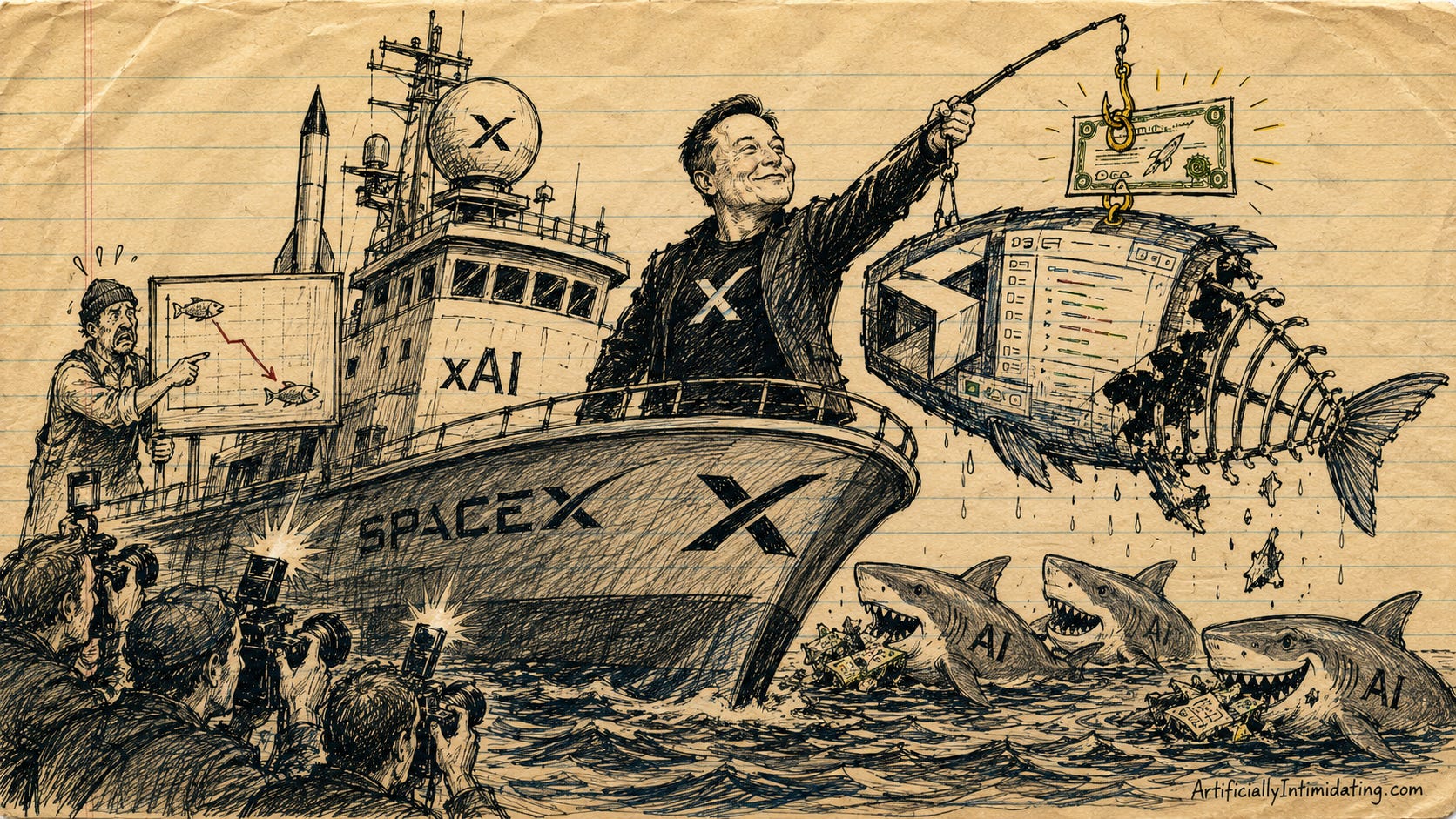
What happened: SpaceX will acquire Anysphere — the company behind the wildly popular AI coding tool Cursor (We use it daily, do you?) — in an all-stock deal worth $60 billion, just days after Elon Musk’s rocket-maker pulled off the biggest IPO ever. Reuters pegged the same number, with the merger expected to close in Q3 per an SEC filing.
Why it matters: Cursor crossed $1 billion in annualized revenue last November and became a default coding assistant for developers. Folding it into SpaceX (which merged with Musk’s xAI earlier this year) builds a vertically integrated empire aimed squarely at Anthropic’s and OpenAI’s coding businesses.
What everyone’s saying: The market roared — SpaceX stock jumped roughly 16%, vaulting past Amazon and Microsoft to become the fourth most valuable company in the US. President Gwynne Shotwell told CNBC the pairing “makes a huge amount of sense.”
My read between the lines: Here’s what the price tag hides: Cursor’s market share has slid from 41% last June to about 26%, with Anthropic now owning half the category. Musk isn’t buying a rocket ship on the rise; he’s paying a record sum for a fading leader — mostly to make sure his rivals can’t have its developers. A $60B all-stock flex days after a record IPO is a moat dug in public.
📖 Further reading: Thanks to Apple, Your favorite AI tool is a dead tool walking — when your favorite AI tool can change hands overnight, betting your whole workflow on any single one looks riskier than ever.
The sharpest AI Brief tips come from readers who are actually in the weeds. If you spot a story worth covering, share it in the community chat. The best tips make tomorrow’s edition.
Microsoft’s Copilot Cowork Goes Global — and Shops for a Cheaper Brain
Source: Axios
What happened: Microsoft made its Copilot Cowork enterprise agent generally available worldwide and switched it to usage-based pricing the same day. Axios reports the company is weighing a fine-tuned version of China’s DeepSeek V4 to power a cheaper tier.
Why it matters: Cowork doesn’t just chat — it plans multi-step tasks, retrieves context, and calls tools, burning model tokens on every loop. Exec Charles Lamanna says heavy users run hundreds of tasks a week, pushing costs “very high,” so Microsoft now bills in “Copilot Credits” and is hunting for a cheaper engine. Just yesterday we flagged Nadella’s “token capital” and Anthropic charging by the token in The $20 AI subscription era is ending — this is that same math, now reshaping Microsoft’s own agent.
What everyone’s saying: Cowork runs on Anthropic’s Opus 4.8 and Sonnet 4.6, with OpenAI’s GPT-5.5 in a Frontier tier. Microsoft claims Cowork is 30–40% cheaper than Anthropic’s Claude Cowork paired with a Microsoft 365 connector, and says a lower-cost option lands within weeks.
My read between the lines: “Agents are here” is the headline; “agents are too expensive to run at flat rates” is the fine print — which is why a multitrillion-dollar company is quietly auditioning a Chinese model to cut its own compute bill. Azure hosting keeps the data in-tenant, but “Chinese model inside your productivity suite” is a sentence destined to light up CISO and government group chats.
📖 Further reading: Your laptop has been in the way this whole time — the clearest primer on why these always-on agents cost what they cost.
Adobe: 75% of Creators Now Call AI “Essential”
Source: Adobe Newsroom
What happened: Adobe’s second annual Creators’ Toolkit Report — a survey of more than 16,000 creators across eight countries with The Harris Poll — found 75% of AI-using creators now describe the technology as integrated or essential to their workflow, and 87% say it has accelerated their business or audience growth.
Why it matters: It’s the clearest signal yet that generative AI has gone from novelty to standard practice for the people making the content you watch and read. 93% say it helps them produce faster, and 58% say they can now compete with bigger teams and studios. Yesterday we noted the Disney–NYT–Adobe pact in the June 16 brief — Adobe clearly wants to own the creator-AI story.
What everyone’s saying: The optimistic framing dominates — AI as a great equalizer for solo creators. Adobe’s Mike Polner stresses that “voice, taste and judgment remain what set great creators apart,” casting AI as amplifier rather than replacement.
My read between the lines: Read past the headline and the report quietly argues with itself: 57% say AI output needs moderate-to-extensive editing before it’s shareable, and 42% say AI work is crowding out unique voices. Adobe — which sells the AI tools — is also the one assuring you human taste is the scarce asset. Convenient. And the sample skews Gen Z semi-pros, so “creators love AI” may say more about TikTok than about working photographers.
📖 Further reading: I stopped writing. My output doubled. — a first-hand take on what it actually feels like to fold AI into a creative workflow.
Trump Puts Anthropic’s Top Models Under Export Control
Source: Axios
What happened: The Trump administration placed two of Anthropic’s most advanced models — Fable 5 and Mythos 5 — under export controls, forcing the company to abruptly cut off access. Axios reports critics are calling it “a licensing system by another name,” weeks after the White House explicitly barred mandatory AI licensing.
Why it matters: It’s a whiplash month for AI policy: Trump first delayed a voluntary reporting order to protect America’s lead over China, then banned mandatory licensing — and has now yanked a frontier model off the shelf. We covered the opening act earlier this week in Washington Pulled the Plug, So China Gave It Away — this is the next chapter.
What everyone’s saying: The worry is reliability: foreign governments and companies may look elsewhere if US AI starts to look politically unstable, with Carnegie’s Anton Leicht noting open-source Chinese models become “an attractive back-up.” Google DeepMind’s Demis Hassabis has said China is only about six months behind on frontier AI.
My read between the lines: Washington wants America to win the AI race and to control who drives the fastest cars — and those two goals just collided in public. Every time it pulls a frontier model off the table, it hands the open-source pitch straight to Beijing. The real export here might not be the model; it’s the uncertainty.
📖 Further reading: The US Government Just Took Anthropic’s Best AI Model Offline — Here’s Why — the full backstory on exactly how Fable 5 got pulled.
The Atlantic: “Nothing on the Internet Is Secure Anymore”
Source: The Atlantic
What happened: In a widely shared essay, The Atlantic argues AI is enabling “a deluge of cyberattacks the likes of which we’ve never seen before” — making hackers more capable while making the web more fragile.
Why it matters: It’s a two-sided squeeze. AI coding agents hallucinate and ship insecure code that vibe-coders don’t verify (reportedly causing outages even at Amazon), while the AI now embedded in banks, retailers, and customer service is itself new and exploitable — criminals recently talked Meta’s customer-service AI into handing over access to roughly 30,000 accounts.
What everyone’s saying: Researchers have warned about AI-assisted phishing and automated exploitation for a while, and the NSA is reportedly rattled by the spike. The mainstream prescription is hardening: better defaults, AI-assisted defense, “assume breach.”
My read between the lines: The unsettling part isn’t any single hack — it’s the asymmetry. Attackers get a force multiplier that runs 24/7 and never gets bored; defenders get the same tool plus a backlog and a budget meeting. When the author of a sober tech essay admits he’s eyeing gold as a panic buy, the story stopped being about cybersecurity and became about trust.
📖 Further reading: AI Is a Trust Problem, Not a Tech Problem — exactly the lens this story demands.
That’s your AI Brief for Wednesday. Join the conversation in the Artificially Intimidating community chat.
—Artificially Intimidating