

Good day, humans. The all-you-can-eat era of AI is quietly ending — Anthropic starts charging by the token in a week, and OpenAI may follow. Meanwhile the Anthropic shutdown went fully geopolitical over the weekend (a G7 prime minister is now invoking 2008), OpenAI is recruiting an army of 300,000 consultants, and a Texas judge just decided your ChatGPT chats might be a legal secret. Let’s get into it.
🎟️ Before we dive in — we're taking this offline.
"Not Your Average AI Meetup: Creativity, Culture & Curiosity" is Tomorrow, Tuesday, June 16 · 8 PM · Lower East Side, NYC.
Drinks, real conversation, no slides — plus a lightning round: "What's the most interesting thing AI did this week?" You're holding this week's answers.
It's a $3 ticket on purpose, to keep the room full of people who actually show up. RSVP here →
The $20 AI Subscription Era Is Ending
Source: Cafétech
What happened: Anthropic confirmed that starting June 23, its newest flagship model won’t be included in any subscription — not even the $200-a-month plan. You’ll pay per token used, on top of the monthly fee, and OpenAI is reportedly weighing the same move. And it’s already in motion: as of today (June 15), Anthropic moved Agent SDK and headless claude -p usage off subscriptions onto a separate metered credit pool ($20 Pro / $100 / $200, billed at API rates). Interactive chat is untouched — but automation now runs on a meter.
Why it matters: For two years, “AI” meant a flat fee and all-you-can-eat access. That deal is quietly dying. Your bill is about to track how much you actually use — and for heavy users, it can balloon fast.
What everyone’s saying: Cafétech and the Wall Street Journal frame this as the end of flat-rate AI, while CNBC notes Wall Street is cramming on the word “tokens” ahead of Anthropic’s and OpenAI’s IPOs. Companies like Uber are already capping employee AI spend. Developers met the June 15 change far less warmly than Anthropic’s “free credit” framing — many called it a dressed-up cap that turns a subscription into a prepaid API wallet, with some threatening to cancel Max plans.
My read between the lines: This isn’t a price hike so much as a business-model confession. Flat subscriptions only work when the product is cheap to serve — frontier AI isn’t. The metered taxi is replacing the buffet right as both labs need their margins to look real for public markets.
📖 Further reading: Thanks to Apple, Your Favorite AI Tool Is a Dead Tool Walking — the pricing pressure quietly commoditizing the models you depend on.
Today’s brief is brought to you by Viktor.
You just read that OpenAI is hiring 300,000 humans to deploy AI — Viktor skips the middleman.
It’s an AI agent that lives in your Slack, plugs into 3,000+ tools, and ships the actual work: reports, dashboards, code, campaigns. Not a chatbot you babysit — a coworker that delivers.
New users get $50 off their first month. Hire Viktor →
Washington’s Anthropic Ban Goes Global
Source: The Next Web
What happened: The fallout from Washington pulling Anthropic’s Fable 5 and Mythos 5 offline went international this weekend. Canada’s PM Mark Carney called the shutdown proof of the danger of leaning on a few US models, while Defense Secretary Pete Hegseth doubled down, posting that kicking Anthropic out of the Pentagon “forever” was “the right move.”
Why it matters: We’ve tracked this all week — but it’s no longer just a US export-control story. A G7 leader is now comparing over-reliance on one AI model to the systemic risk that blew up the 2008 financial crisis, days before AI governance tops the agenda at the G7 summit in France.
What everyone’s saying: Carney’s line — “It is never a good idea to have one option” — is becoming the rallying cry for sovereign-AI advocates. The R Street Institute calls the ban “a bad idea applied badly,” warning it’s an advertisement for every nation to build its own models instead of depending on American ones.
My read between the lines: Washington wanted to look tough on security and instead handed the rest of the world a reason to decouple from US AI. When the Canadian prime minister is publicly shopping for redundancy, the export ban didn’t contain the technology — it exported the distrust.
📖 Further reading: The US Government Just Took Anthropic’s Best AI Model Offline — Here’s Why — the full breakdown of how the ban happened and what it means.
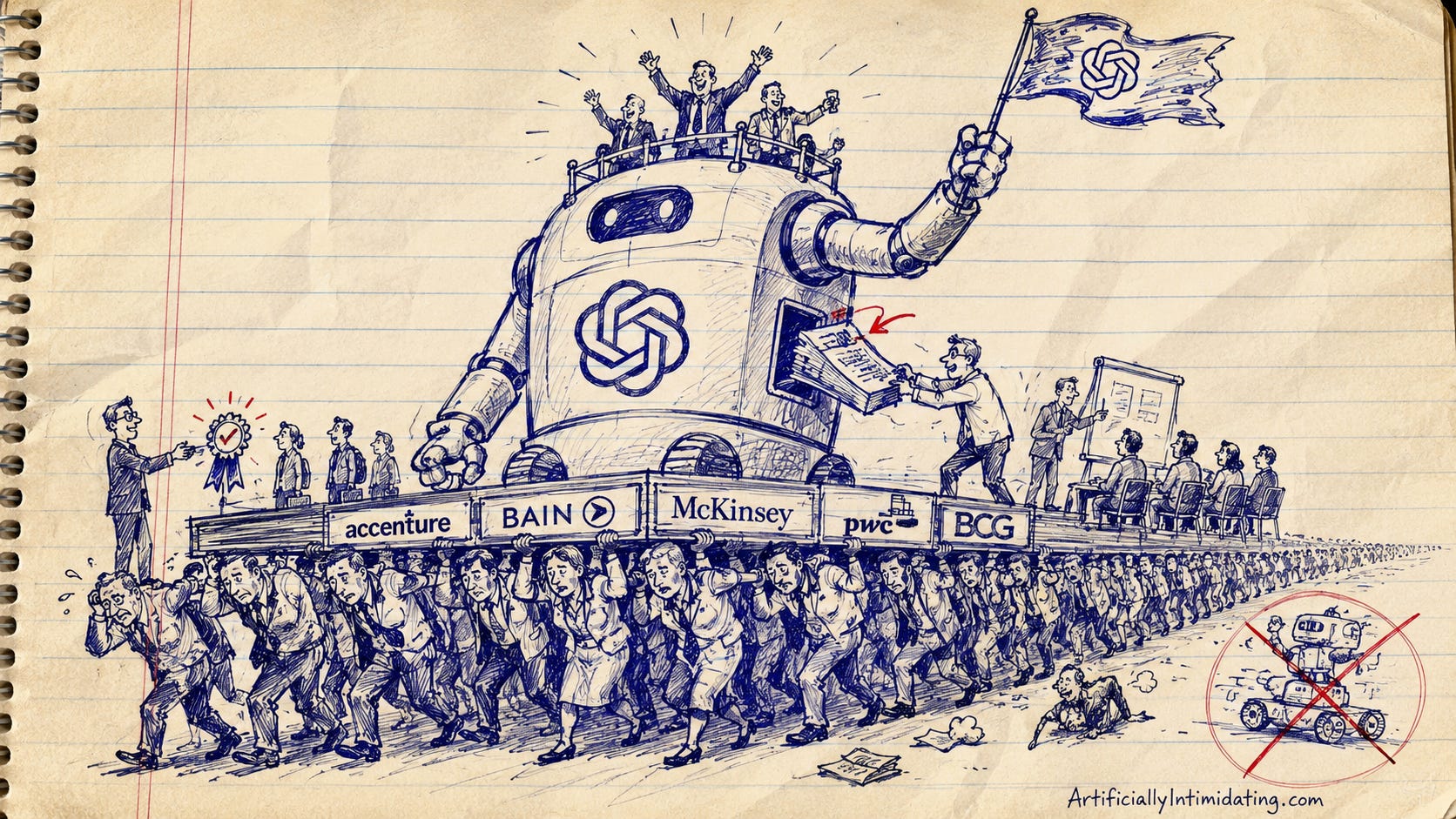
OpenAI Bets $150M on a Consultant Army
Source: OpenAI
What happened: OpenAI launched the OpenAI Partner Network, its first formal partner program, backed by a $150 million investment and a goal of certifying 300,000 consultants by the end of 2026. Launch partners include Accenture, Bain, BCG, McKinsey and PwC.
Why it matters: OpenAI is admitting the hard part of AI is no longer the model — it’s getting companies to actually use it. This is OpenAI building the consultant-and-integrator machine that made Microsoft and Salesforce nearly unkillable in the enterprise.
What everyone’s saying: CRN’s channel watchers call it one of the most anticipated partner-program launches in years and “a massive opportunity.” The three tiers — Select, Advanced, Elite — plus specializations in Codex, cybersecurity and agents are textbook enterprise-vendor playbook.
My read between the lines: 300,000 certified consultants is an army whose paychecks depend on OpenAI staying the default. That’s not distribution, it’s a moat made of people — and a quiet tell that the model wars are cooling into a boring, lucrative land grab for enterprise IT budgets.
📖 Further reading: AI Is a Trust Problem, Not a Tech Problem — why adoption, not capability, is the bottleneck OpenAI is now buying its way around.
The sharpest AI Brief tips come from readers who are actually in the weeds. If you spot a story worth covering, drop it in the Discord. The best tips make tomorrow’s edition.
Nadella: Own Your AI, or Lose It
Source: India Today
What happened: Microsoft CEO Satya Nadella warned in a widely shared post that if AI’s value ends up captured by a handful of model providers, entire industries could be “commoditized right out from underneath them.” His fix: every company should build “token capital” — AI capability trained on its own data and judgment.
Why it matters: This is one of the most powerful figures in enterprise software telling his own customers not to become dependent on a few models — including, implicitly, the ones he sells. It reframes AI from a tool you rent into a capability you’d better own.
What everyone’s saying: Nadella drew a parallel to globalization hollowing out manufacturing towns, warning “there is no societal permission for an AI future that hollows out entire industries.” Reid Hoffman and others amplified the “token capital” framing all week.
My read between the lines: It’s remarkable for Microsoft — whose whole pitch is renting you intelligence — to warn against renting your intelligence. Read cynically, “own your token capital” also means “build it on Azure.” The warning and the sales pitch are the same sentence.
📖 Further reading: AI Wants $12 Billion and 6.4 Hours of Your Week — the real cost of letting AI eat your workflow.
Texas Court Shields Your AI Chats
Source: The Texas Lawbook
What happened: A Texas Business Court judge ruled that a company executive’s private ChatGPT conversations, prepared in anticipation of litigation, are protected attorney work product — meaning the other side can’t force you to hand them over. The June 3 ruling (Tate Group Automotive v. Legacy Automotive Capital) is one of the first of its kind.
Why it matters: Millions of people now think through problems by talking to a chatbot. This is among the first decisions saying those conversations can carry the same legal protection as a private strategy memo — at least in Texas, at least sometimes.
What everyone’s saying: Firms are racing to publish takes — Nelson Mullins, Foley and Hicks Johnson all weighed in within days — noting it splits from a New York federal court that went the other way. The protection has limits: you still must disclose which documents you fed the AI and which tool you used.
My read between the lines: The law is quietly deciding what a chatbot is — a confidant, a tool, or a witness against you — and the answer changes by zip code. File the same AI brainstorm in two states and one is shielded, the other is evidence. “It depends on the forum” is about to become the most expensive sentence in AI law.
That’s your AI Brief for Monday. Join the conversation in the Artificially Intimidating Discord.
—Artificially Intimidating