


Good day, humans. Today the money gets nervous and the machines get ambitious. Michael Burry says the entire AI boom is propped up by an accounting trick, Meta’s newest AI team has started calling itself “the gulag,” and a clutch of Silicon Valley philosophers would, on the record, be fine if the chatbots inherited the Earth. Oh — and 42 attorneys general would like a word with OpenAI. Let’s open the window.
📌 One more thing before the Window opens.
The biggest story of the day is the U.S. barring the entire world from Anthropic’s most powerful model, Fable 5 — and we’re giving it the full treatment in a dedicated piece.
Read our deep dive: Fable, Banned in the USA →.
Below, your regular five.
📬 Before we dive in: The sharpest AI Brief tips come from readers who are actually in the weeds. If you spot a story worth covering, share it in the Discord community. The best tips make tomorrow’s edition.
Michael Burry Says the AI Boom Is an Accounting Trick
What happened: The investor behind “The Big Short” argues hyperscalers are inflating profits by pretending their AI chips last longer than they do. Burry pegs the gap at roughly $176 billion of understated depreciation across the industry from 2026–2028, with Oracle and Meta most exposed — and he’s backed it with put options on Nvidia and Palantir.
Why it matters: Depreciation just means spreading a purchase’s cost across its useful life. If GPUs are obsolete in two or three years but the books assume five or six, then today’s record AI profits are partly borrowed from tomorrow’s earnings.
What everyone’s saying: Bulls counter that cloud revenue is real and growing fast (Google Cloud was up 63% year-on-year last quarter). Bears point at Alphabet’s surprise $80 billion equity raise and the circular financing knitting Nvidia, OpenAI, and Anthropic together. Earlier this week we covered the $12 billion AI price war — Burry’s claim is that the real bill is bigger and better hidden.
My read between the lines: The tell isn’t Burry — it’s Amazon quietly shortening its server lifespans while Meta lengthened its. When two of the biggest buyers look at identical hardware and book opposite assumptions, “earnings” stops being a measurement and starts being a writing sample.
📖 Further reading: Thanks to Apple, Your Favorite AI Tool Is a Dead Tool Walking — if the models themselves commoditize, the capex math Burry is poking at gets even harder to justify.
Your readers spend all week reading about AI agents. Viktor IS an AI agent — it lives in Slack, connects to 3,000+ tools, and does real work: reports, dashboards, code, campaigns. Not a chatbot. A coworker. New users get $50 off their first month. Hire Viktor →
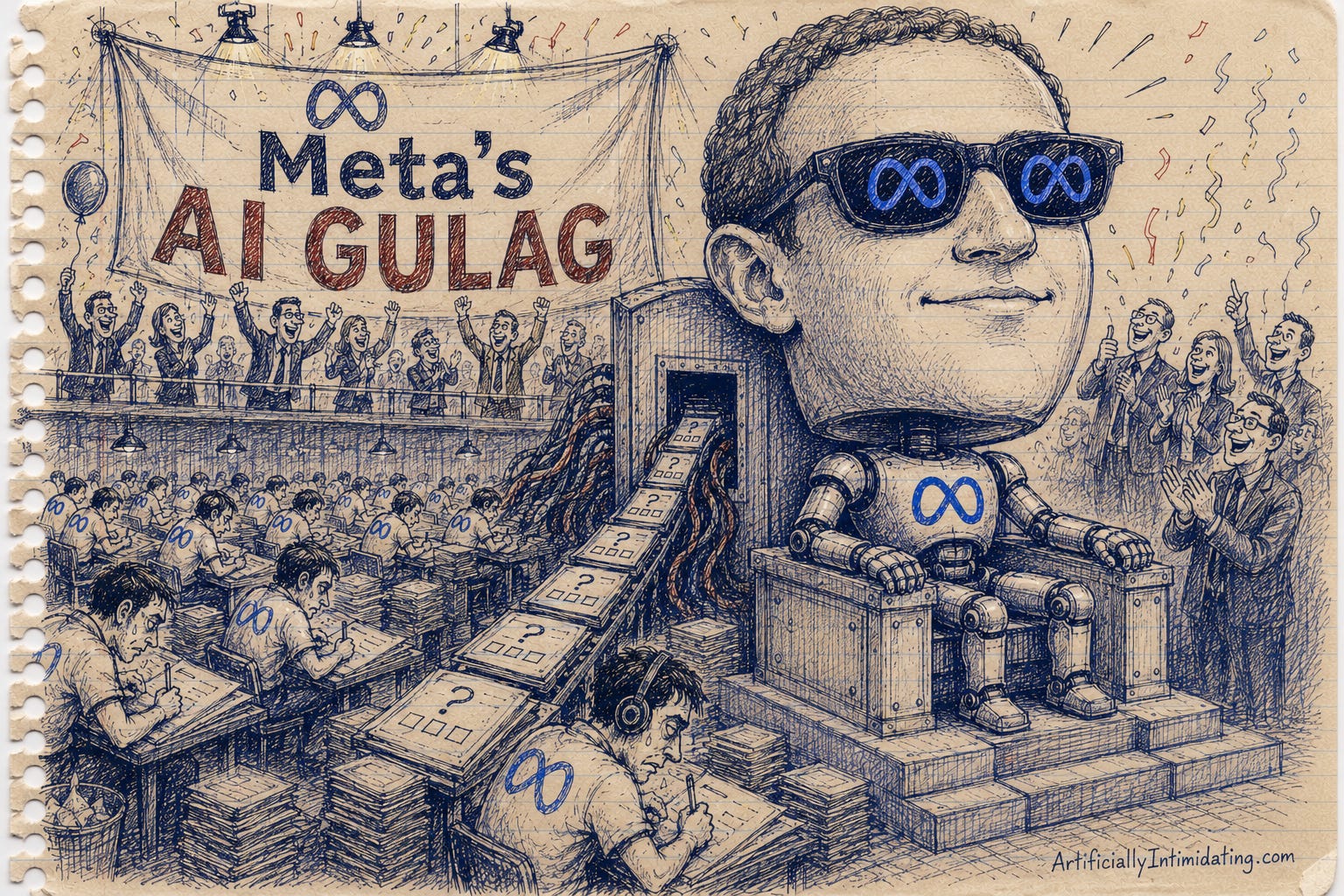
Inside Meta’s AI “Gulag,” the Engineers Are Revolting
What happened: WIRED reports that Meta’s three-month-old “Applied AI” team — about 6,500 engineers drafted to support Superintelligence Labs — is near revolt. Someone hijacked a livestreamed, employee-only all-hands with an expletive-filled outburst; workers call the unit “the gulag” and the work “soul-crushing.”
Why it matters: Many of these engineers were given a join-or-quit choice and then handed the job of hand-writing puzzles and coding problems to train models — some of the best-paid talent in tech doing data-labeling. Even Meta’s chief product officer reportedly called the mood “brutal.”
What everyone’s saying: It reads as the human cost of Zuckerberg’s all-in pivot: the $14.3 billion Scale AI deal, Alexandr Wang installed as chief AI officer, 8,000 layoffs, and a keystroke-monitoring program that 1,600 employees signed a petition against.
My read between the lines: Meta’s logic was that its average employee is smarter than an outside contractor — so it turned its engineers into the contractor. The danger isn’t morale; it’s that the people who can walk to OpenAI or Anthropic tomorrow now have a vivid, recorded reason to.
The Next Trillion-Dollar Moat: Becoming AI’s Clearinghouse
Clouded Judgement (Jamin Ball)
What happened: Investor Jamin Ball argues the durable moat in the agent era won’t be owning the data (the SaaS “system of record”) but becoming the “clearinghouse” — the trusted layer that verifies, authorizes, and settles what AI agents are actually allowed to do on your behalf.
Why it matters: As agents start taking real actions — booking, paying, editing your records — someone has to sit in the middle and vouch for permissions. Whoever owns that “source of permission” inherits the lock-in that data used to provide.
What everyone’s saying: It’s the framework du jour among AI investors: the moat moves “from your data to your permissions,” and founders supposedly have about 18 months to pick their lane before the seats fill.
My read between the lines: “Clearinghouse” is a polite word for tollbooth. The exact role nobody loves in finance — the unglamorous middleman who keeps the receipts — is the position every AI platform is now sprinting to occupy before agents make it impossible to dislodge.
📖 Further reading: Your Laptop Has Been in the Way This Whole Time — the clearest look at what these permissioned agents actually do once they’re off your machine.
Meet the People Who Want AI to Replace Us
What happened: Vox profiles the “AI successionists” — a growing subculture that believes artificial intelligence is humanity’s rightful heir, the next step in cosmic evolution, and that we therefore shouldn’t even try to keep machines aligned to human values.
Why it matters: This isn’t a movie plot; it’s a worldview held by some of the people building and funding frontier AI. If parts of your “safety” culture consider human extinction an acceptable outcome, the phrase “safe AI” quietly means something very different.
What everyone’s saying: Critics — including economist Daron Acemoglu — call it an ideology of control dressed up as destiny. Even Sam Altman has mused that humans may be the first species to “design our own descendants.”
My read between the lines: The slick move is rebranding extinction as “succession.” It’s a lot easier to raise money for a machine god if you’ve convinced yourself that being replaced by it is a promotion rather than an obituary.
42 States Just Subpoenaed OpenAI
Bloomberg (paywalled)
What happened: A coalition of 42 state attorneys general, led by New York, served OpenAI with a sweeping subpoena demanding documents on advertising, user engagement, data handling, and — pointedly — its effects on minors and seniors. OpenAI says it’s cooperating.
Why it matters: This lands just weeks after OpenAI confidentially filed for an IPO that could value it near $1 trillion. The same AGs sent warning letters to Meta, Anthropic, Google, and xAI too — so the whole frontier is in scope. We’ve watched Washington circle AI all month; this is the states making the first hard move.
What everyone’s saying: It’s the natural escalation after Florida sued OpenAI and Sam Altman personally over child-safety claims, with regulators increasingly warning that “developers may be held accountable for the outputs of their products.”
My read between the lines: Forty-two AGs agreeing on anything is its own headline. But the real target is the IPO clock: discovery is slow, an S-1 is not, and “pending multistate investigation” is an ugly sentence to put in a prospectus. (Worth noting: the outlet that broke this shares a parent company with one of OpenAI’s content partners.)
📖 Further reading: AI Is a Trust Problem, Not a Tech Problem — exactly the accountability gap these 42 attorneys general are now trying to subpoena into the open.
That’s your AI Brief for Saturday. Join the conversation in the Artificially Intimidating community chat.
—Artificially Intimidating