

Good day, humans. Today’s tension in one breath: Jeff Bezos just raised $12 billion to build an AI that engineers jet engines, while the rest of us are losing 6.4 hours a week babysitting AI that still can’t reliably write an email. Add a fresh price war, a plague of identical lighthouse keepers, and a tool that finally lets AI grade its own homework, and you get a day where AI looked simultaneously unstoppable and faintly ridiculous. Let’s get into it.
🎮 BIG NEWS:
We’re launching an Artificially Intimidating Discord — and opening it to a handful of readers first.
It’s a place to create together: share what’s working, share what’s NOT working, swap prompts ideas, and build cool AI things with people who get it.
The newsletter’s ethos, just live.
Want in early?
Here’s your door 👉 https://discord.gg/B3yyGfpSM
“Botsitting” AI Eats 6.4 Hours of Your Week
What happened: A new Glean Work AI Index report finds the average knowledge worker now spends 6.4 hours a week “botsitting” — debugging, fact-checking, and re-feeding context to AI tools — nearly cancelling out the time those tools were supposed to save.
Why it matters: If you’ve ever felt your AI assistant created as much work as it removed, there’s now a number for it: almost a full workday a week. For newcomers, it’s a reminder that today’s AI is a power tool, not autopilot — it still needs a human holding the handle.
What everyone’s saying: The report fuels the “productivity paradox” discourse: workers most buried in botsitting are 73% more likely to be job-hunting, and 69% admit shipping AI work they never properly checked. A separate BCG survey found two-thirds of employees get little guidance on what to do with the time AI saves.
69% of workers admit shipping AI work they never properly checked. I hate to admit that I’m one of them. Are you?
My read between the lines: The scandal isn’t that AI needs babysitting — it’s that 69% are shipping unchecked output anyway. “Botsitting” hours aren’t the cost of using AI badly; they’re the cost of using it responsibly, and most people are quietly opting out of paying it.
📖 Further reading: I ignored Hermes for two months. Here’s what I actually found. — a real-world look at whether an AI agent actually earns its keep, which is exactly the question this report is asking.
Your readers spend all week reading about AI agents. Viktor IS an AI agent — it lives in Slack, connects to 3,000+ tools, and does real work: reports, dashboards, code, campaigns. Not a chatbot. A coworker. New users get $50 off their first month. Hire Viktor →
Every Chatbot Keeps Writing the Same Man
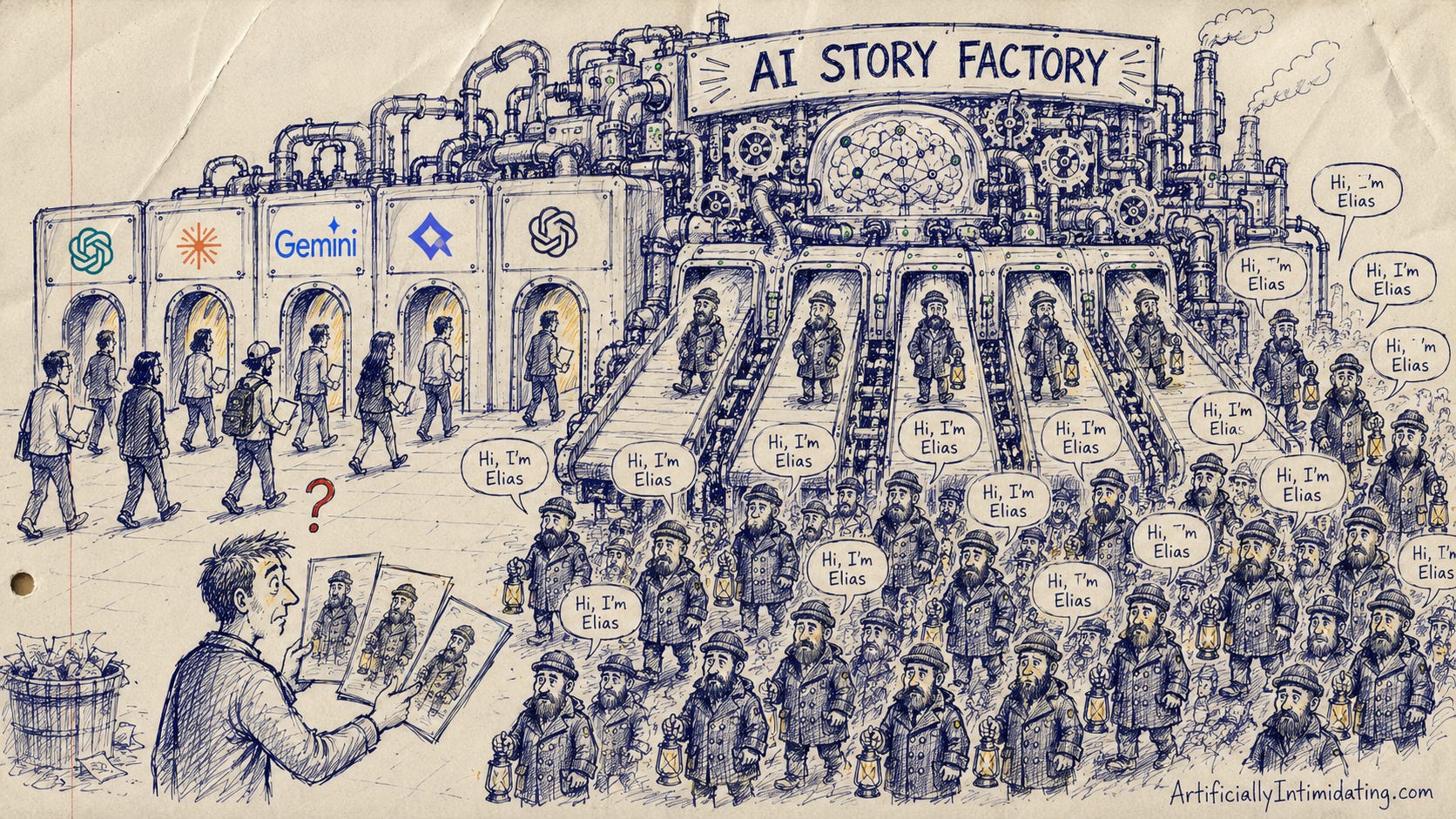
What happened: Cornell researchers found that ChatGPT, Claude, Gemini, and the Allen Institute’s model overwhelmingly invent the same character when asked for fiction — a lighthouse keeper, often named “Elias Thorne.” The same 11 words show up in 88% of AI-generated stories, 404 Media reports.
Why it matters: It’s a vivid demo that “creative” AI isn’t really creating — it’s sampling from a shared, narrow groove. For anyone new to this: ask three different chatbots for a story and you may get three versions of the same man on the same rock.
What everyone’s saying: Researchers traced the tic to WildChat, a dataset of a million old ChatGPT conversations where the Elias pattern appeared just 166 times, then spread “like a virus” into newer training sets. Elias has since escaped into Amazon books and YouTube content farms.
My read between the lines: This is a tiny, hilarious preview of model collapse — AI trained on AI, amplifying its own quirks until the whole internet sounds like one tired ghostwriter. The lighthouse keeper is funny. That 166 conversations can quietly colonize every major model’s imagination is not.
📖 Further reading: AI Is a Trust Problem, Not a Tech Problem — if you can’t trust the model not to plagiarize itself, you can’t trust its output — which is the whole game.
AI Agents Can Finally Check Their Own Code
What happened: Seattle startup TestSprite released a free, open-source command-line tool that lets AI coding agents verify their own code — running it against a live browser or API, then handing back a failure report the agent can read and fix on its own.
Why it matters: Today’s coding agents are fast but reckless: TestSprite says even the best one in its competition broke 12% of features that already worked. A verifier is the seatbelt that lets you actually trust an agent working unattended.
What everyone’s saying: The tool already referees “CoderCup,” a public bake-off where Claude Code, OpenAI’s Codex, and Google’s Antigravity build the same app. The headline finding: give a weak, cheap model a verification loop and it catches up to frontier models — one agent went from 0% to ~80% passing in ten rounds.
My read between the lines: If a $1 model plus a good verifier matches a $50 model, the moat quietly moves from the model to the test harness. The frontier labs sell raw intelligence; TestSprite is betting the real product is the thing that keeps that intelligence honest.
📖 Further reading: Your laptop has been in the way this whole time — a primer on how managed, autonomous agents actually work — exactly what TestSprite is trying to make trustworthy.
Bezos Raises $12B for an “Artificial General Engineer”
What happened: Prometheus, the secretive “physical AI” startup co-led by Jeff Bezos and ex-Verily founder Vik Bajaj, raised $12 billion at a roughly $41 billion valuation to build software that can design and manufacture physical things — from jet engines to drug compounds.
Why it matters: Most AI money has chased software that writes text and code. This is one of the largest bets yet that AI’s next act is in the physical economy — machines that help design machines. For newcomers: think less “chatbot,” more “robot that does the engineering.”
What everyone’s saying: In a rare joint CNBC interview, Bezos framed the upside as “labor scarcity” — a world where demand for human workers outpaces supply, rather than the mass-unemployment story everyone fears. A huge slice of the $12B reportedly goes straight to compute.
My read between the lines: “Labor scarcity” is a beautifully optimistic phrase from a man building the thing that automates engineers. Prophecy or PR, $41 billion buys a lot of narrative — and notice the smartest money is fleeing the crowded chatbot trade for atoms, not tokens.
📖 Further reading: OpenAI shipped a physical camera, but that’s not the story. — our earlier take on AI escaping the screen and into the physical world — the same bet Prometheus just supersized.
The AI Price War Has Officially Begun
What happened: The AI price war is here. The Wall Street Journal reports companies are routing around OpenAI and Anthropic to cheaper models — some from China — and OpenAI is now weighing “drastic” token price cuts after Sam Altman called rising costs a “huge issue.”
Why it matters: This is the moment AI starts getting cheaper for everyone. Google already cut its Gemini plan from $8 to $5 a month; if the leaders follow, the cost of building with AI drops across the board. For newcomers: the expensive part of AI is about to get a discount.
What everyone’s saying: The backdrop is “tokenmaxxing” fatigue — Uber reportedly burned its entire 2026 AI token budget by April, and Amazon and Meta staff have been accused of inflating token use to look productive. The consensus: with four providers offering near-identical APIs, routing cheap-by-default is now the rational architecture.
My read between the lines: For nearly two months we’ve been using a tool called Manifest.build to Route your LLM calls to the best model deal. A price war has officially begun. That’s what happens when your product becomes a commodity — and intelligence-by-the-token is commoditizing fast. The winner won’t be whoever has the smartest model this quarter; it’ll be whoever can lose money the longest. Altman calling it a “meme” is the tell.
📖 Further reading: Thanks to Apple, Your favorite AI tool is a dead tool walking — our case that models are commoditizing into interchangeable parts — precisely why the price war was inevitable.
That’s your AI Brief for Friday. Join the conversation in the Artificially Intimidating community chat.
—Artificially Intimidating