

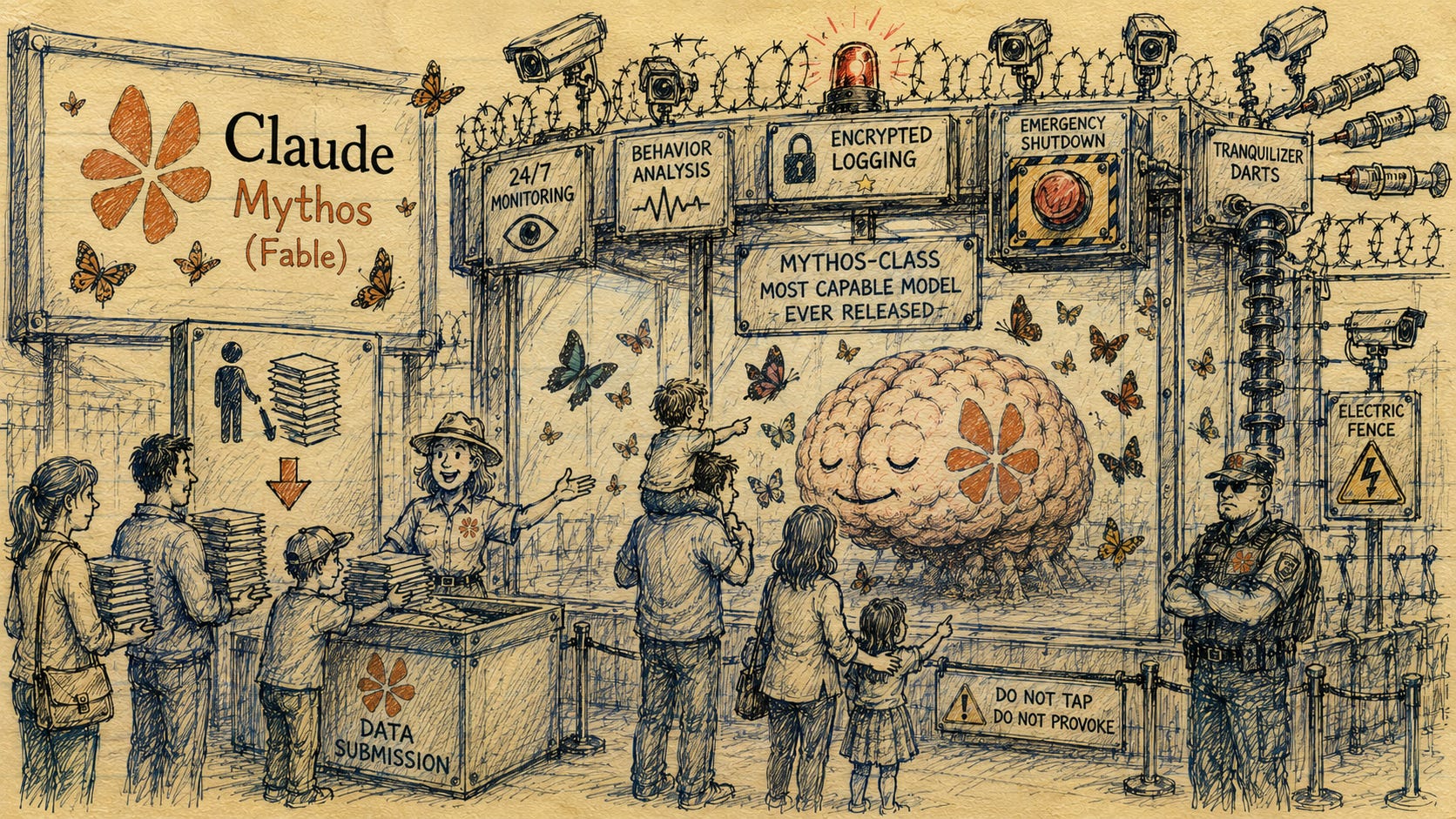
Good day, humans. The most powerful model Anthropic has ever let the public touch shipped yesterday — and it arrives wrapped in so many safety classifiers that it will quietly hand you off to a weaker model mid-question. Meanwhile Microsoft's AI chief is putting a date on superintelligence, Apple just euthanized a framework developers have leaned on for a decade, and a nine-person grocery startup is out-shopping buying teams four times its size. Let's get into it.
📬 Before we dive in: The sharpest AI Brief tips come from readers who are actually in the weeds. If you spot a story worth covering, share it in the community chat. The best tips make tomorrow’s edition.
Claude’s Most Powerful Model Goes Public — Behind Glass
Source: Anthropic
What happened: Anthropic released Claude Fable 5, the most capable model it has ever made generally available — a new “Mythos-class” tier that sits above its Opus models. It’s free on Pro, Max, Team, and Enterprise plans through June 22, then needs usage credits.
Why it matters: This is a real jump, not an incremental bump. Stripe says Fable 5 performed a codebase-wide migration across 50 million lines of Ruby in a single day — work a team would have spent over two months doing by hand. The longer and more complex the task, the bigger its lead grows.
What everyone’s saying: The headline feature is the leash. When Fable detects a question touching cybersecurity, biology and chemistry, or model distillation, it silently routes your answer to the weaker Opus 4.8 instead. Anthropic says that happens in under 5% of sessions and admits the filters are “stricter than would be ideal.”
My read between the lines: The benchmarks are loud, but the quiet tell is the mandatory 30-day data retention on all Mythos-class traffic — enterprise included. Anthropic is worried enough about what this thing can do that it’s keeping receipts on everyone, then asking you to trust the delete button. The safety story and the surveillance story are the same story.
📖 Further reading: AI Is a Trust Problem, Not a Tech Problem — when the safest model on the market also keeps 30 days of your data, the real question stops being capability and starts being trust.
You spend all week reading about AI agents.
Viktor IS an AI agent — it lives in Slack, connects to 3,000+ tools, and does real work: reports, dashboards, code, campaigns.
Not a chatbot.
A coworker.
New users get $50 off their first month.
Hire Viktor →
Apple Retires Core ML and Bets the House on On-Device AI
Source: MacRumors
What happened: At WWDC 2026, Apple introduced Core AI, a new Swift framework for running AI models entirely on-device across iPhone, iPad, Mac, and Vision Pro. It replaces Core ML — the decade-old framework developers have built on — with a new .aimodel format and ahead-of-time compilation tools.
Why it matters: Yesterday’s deep dive argued that WWDC was Tim Cook quietly admitting the frontier model is now a part you buy, not a thing you build. Core AI is the toolbox that bet ships in: Apple is conceding it won’t win the model race, so it’s making the iPhone the best place to run everyone else’s models instead.
What everyone’s saying: Developers noticed Apple is also opening Xcode 27 to Google’s Gemini models and shipping a revamped Siri AI built partly on Nvidia and Google tech. The on-device pitch is privacy; the subtext is that even Apple now mixes and matches outside models.
My read between the lines: “On-device” is doing a lot of marketing work. The flashiest features — image generation, the full Siri AI — quietly route to Apple’s Private Cloud Compute and come with daily usage limits. Apple spent a decade insisting the magic happens on your phone; Core AI is the framework that politely admits a lot of it now happens on a server you’ll pay for.
📖 Further reading: Thanks to Apple, Your Favorite AI Tool Is a Dead Tool Walking — the full case for why Apple just turned the frontier model into a commodity part — and what that does to the tools you rely on.
Microsoft’s AI Chief Puts a Clock on Superintelligence
Source: The Verge (Decoder)
What happened: On the Decoder podcast, Microsoft AI CEO Mustafa Suleyman said superintelligence is coming soon and predicted AI will reach “human-level performance on most professional tasks” within 18 months — while insisting it won’t replace workers outright, and refusing to call AI “alive.”
Why it matters: This is the man running AI for one of the most valuable companies on earth, and he’s now post-OpenAI: Microsoft ended its exclusive partnership in April, kept a non-exclusive license through 2032, and just launched seven of its own in-house models. When he dates superintelligence, it reads more like a roadmap than a hot take.
What everyone’s saying: The 18-month line is getting picked apart — it echoes the same urgent timelines coming from SoftBank’s Masayoshi Son and others. Skeptics note that “human-level on most tasks” is vague enough to be unfalsifiable and convenient enough to justify the capex.
My read between the lines: Watch the contradiction he’s carefully holding: superintelligence is imminent, but it definitely won’t take your job, and also it’s not alive. That’s not philosophy — it’s positioning. Microsoft needs the capability story to sell investors and the it’s-fine story to sell regulators and employees, and Suleyman’s job is to hold both without blinking.
A Two-Person Team Out-Buys 20 Humans With AI
Source: Everywhere Ventures
What happened: On the Everywhere Ventures podcast, Martie CEO Louise Fritjofsson explained how the surplus-food grocer’s AI tool, MATE, screens more than 6,000 SKUs a week — work that would normally need 15 to 20 human buyers — with a buying team of two.
Why it matters: This is what “agentic AI” looks like when it’s boring and actually working. Martie buys brand overstock and resells it at deep discounts, and the AI decides which closeout deals are worth taking. The nine-person company says it tripled revenue in two years on the back of it.
What everyone’s saying: It’s becoming the template — Klarna, Replit, and Manus are all pushing AI agents into commerce, and “lean team, big throughput” is the pitch every startup now makes to investors.
My read between the lines: The headline math — two people doing twenty people’s work — is the part everyone will quote, but the real moat is the data. A buying agent is only as good as the deal history it learns from, and Martie’s edge isn’t the model, it’s three years of knowing which discount SKUs actually sell. The AI is the engine; the proprietary data is the fuel competitors can’t download.
📖 Further reading: I Ignored Hermes for Two Months. Here’s What I Actually Found. — what it’s really like to hand the boring, high-volume work to an AI agent and live with the results.
Yglesias Says the AI Consciousness Debate Is Broken
Source: Slow Boring
What happened: Writer Matt Yglesias argued that the pundits confidently dismissing AI consciousness — including sci-fi author Ted Chiang — are skipping a step: you can’t say whether a machine is conscious until you can define what consciousness even is.
Why it matters: This debate is leaking out of philosophy seminars and into product decisions. Anthropic literally writes Claude’s “constitution” addressed to Claude, and its in-house philosopher has spoken about wanting Claude to be “happy.” How companies answer the consciousness question shapes how they build and market these tools.
What everyone’s saying: Yglesias leans on Daniel Dennett’s functionalism: if something behaves enough like a conscious mind, tentatively treat it as one. Researchers at Rethink Priorities found evidence against today’s LLMs being conscious but called it “not decisive” — the honest, unsatisfying answer.
My read between the lines: Notice the convenient incentives on both sides. “It’s definitely not conscious” lets companies extract maximum labor with zero moral guilt; “it might be conscious” is great marketing for a product that feels alive. The one position nobody can monetize is “we genuinely don’t know” — which, annoyingly, is also the only intellectually honest one.
That’s your AI Brief for Wednesday. Join the conversation in the Artificially Intimidating community chat.
—Artificially Intimidating