

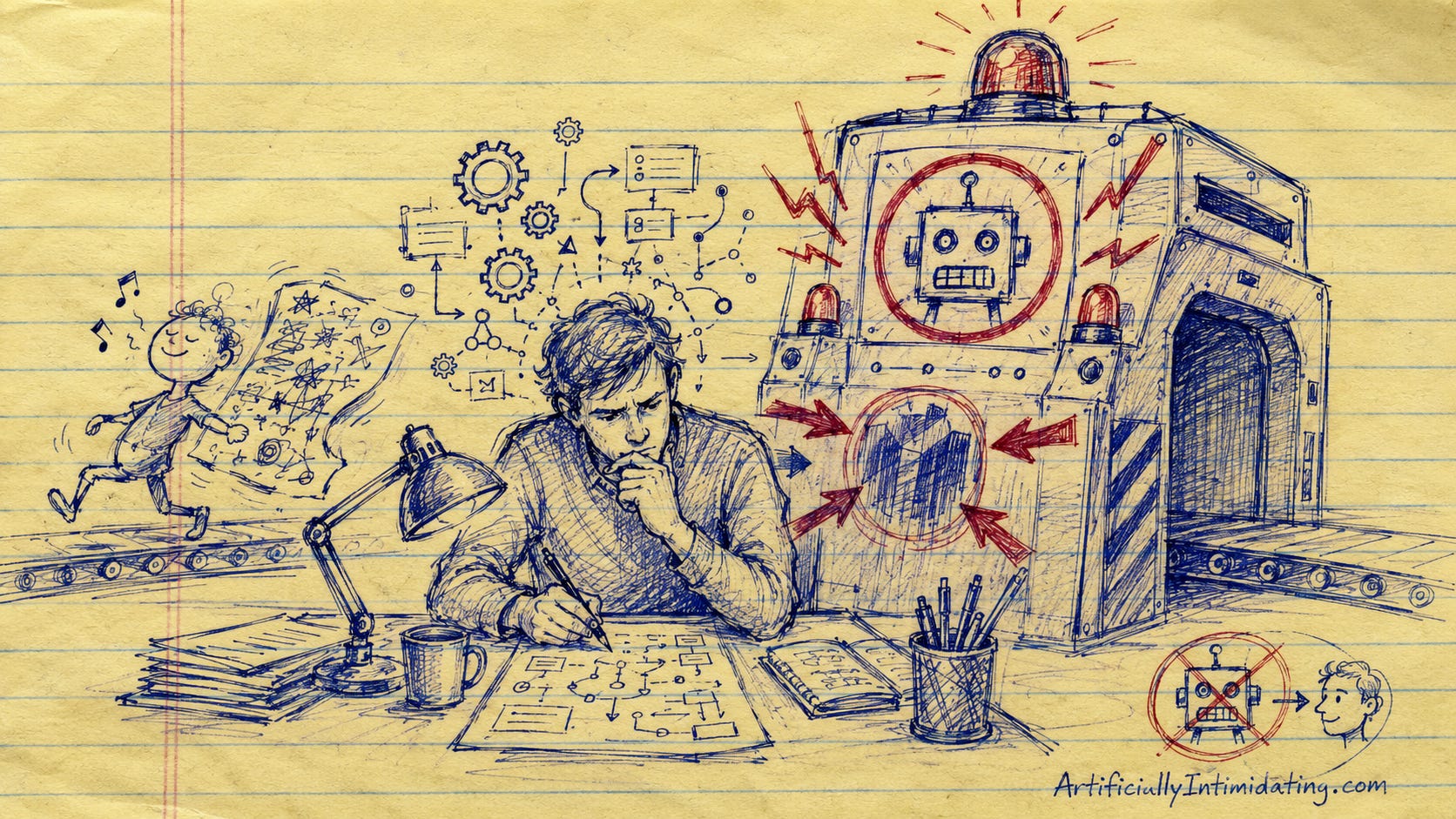
Good day, humans. AI detectors are now flagging careful human writing as machine-generated — because AI learned its reasoning patterns from careful human writing. The Pope's encyclical, which we covered last week as possibly AI-written, is now being cited as better philosophy on AI consciousness than Geoffrey Hinton. And Eli Pariser, who coined 'filter bubble,' says agentic AI makes it infinitely worse. Monday, everyone.
📬 Before we dive in: The sharpest AI Brief tips come from readers who are actually in the weeds. If you spot a story worth covering, share it in the community chat. The best tips make tomorrow's edition.
AI Detectors Are Flagging Humans for Writing Like Humans — arXiv
What happened: A new research paper and analysis by Cybernetic Forests argue that RLVR — the post-training technique that makes LLMs better at reasoning — teaches AI to mimic the deliberative language patterns humans use when thinking carefully. Phrases like "it's not just X, it's Y" and structured, stepwise reasoning are natural to human writing. Because AI learned those patterns from us, detectors now flag them as machine-generated. Researcher Arvind Narayanan calculates that even a 0.01% false positive rate compounds to falsely accuse up to 10% of students at scale.
Why it matters: AI detection tools are already embedded in universities, hiring platforms, and publishing workflows. If those tools are tuned to flag the reasoning patterns humans use when they think carefully, careful thinkers get penalized. The paradox: the more analytically structured your writing, the more likely a detector calls you a robot.
What everyone's saying: The false positive problem is well-documented — Pangram, which flagged the Pope's encyclical as 46% AI-generated, claims a 1-in-10,000 false positive rate. But Narayanan's math shows even that compounds at scale. The emerging consensus is that AI detection tools are fundamentally unreliable — and institutions keep deploying them anyway.
My read between the lines: AI was trained on the best human writing — writing that uses careful logic, structured arguments, and deliberate transitions. Now humans who write that way get flagged as AI. The tool built to protect authentic human voice is penalizing the most thoughtful practitioners of it. That's not a bug to fix. That's a fundamental contradiction to acknowledge.
📖 Further reading: I stopped writing. My output doubled. — If detectors can't reliably tell careful human writing from AI anyway, what exactly are we protecting by not using it?
You spend all week reading about AI. Viktor is the one I actually use. It's an AI productivity tool that handles the tasks you keep putting off — research, drafts, decisions — so you can focus on the work that actually matters. New users save $50. Try Viktor free →
Gary Marcus Says the Pope Understands AI Better Than Geoffrey Hinton — Politico
What happened: Earlier this week we noted the Pope's encyclical 'Magnifica Humanitas' was flagged as 46% AI-written — today the same document is being cited as philosophically superior to Geoffrey Hinton's claims about machine consciousness. AI critic Gary Marcus argues Pope Leo XIV's statement that AI systems "do not experience life" and only replicate aspects of human intelligence reflects a more accurate understanding of AI's nature than Hinton's suggestions that AI may have genuine experiences. Marcus and co-authors published in Nature that LLMs are "interactive fiction trained to predict language" — not conscious beings.
Why it matters: Geoffrey Hinton — a founding father of modern deep learning, Turing Award winner — has publicly suggested AI may have genuine experiences and consciousness. The Pope's encyclical takes the opposite position. Marcus is pointing out that on the specific question of AI consciousness, the theologians got the epistemics right and the engineers got them wrong.
What everyone's saying: Politico ran the question 'How freaked out should Silicon Valley be by Pope Leo?' The answer from the academic debate is: not for regulatory reasons — but because the theological critique of AI hubris is landing more accurately than the technical community's self-assessment of what it built.
My read between the lines: The AI field's brightest minds spent decades building systems that predict text, and some began to wonder if the prediction was also the experience. The Pope's encyclical — which Marcus is now using to correct Hinton — says: that's not what consciousness is. The irony of a medieval institution providing sharper AI epistemics than the researchers who built the systems is going to age extremely well.
📖 Further reading: AI Caught Ghostwriting the Pope's Encyclical — AI Brief May 28 — The same document now being cited as superior philosophy to a Turing Award winner was flagged as 46% AI-written four days ago. It is having quite a week.
Benedict Evans Says AI Is in Its 1997 Moment — Big, But No One Knows Where — Forbes
What happened: Analyst Benedict Evans — joining Lenny's Podcast — argues AI is as transformative as the internet or mobile, and "only" as big: massively important, but deeply early and uncertain. Hyperscalers spent ~$400 billion on AI capex in 2025, yet Evans says no one — including the spenders — knows if core products have found market fit. His key insight: distribution, not software creation, is the emerging moat, because AI makes building easy but reaching customers remains hard.
Why it matters: Evans has a strong track record of calling technology transitions accurately and early. His '1997 moment' framing implies: we know this is transformative, but we're still in the dial-up era of figuring out what it becomes. The comparison to 1997 internet specifically suggests enormous winners are coming — but most of what exists today won't be them.
What everyone's saying: The distribution-as-moat observation is getting the most traction. AI lowers the cost of building software toward zero — which means competitive advantage no longer comes from building, it comes from who already has the customers, the data, and the trust. That's good news for incumbents. It's complicated news for startups betting on product quality alone.
My read between the lines: Evans published a deck called 'AI eats the world' and $400 billion in capex later, his conclusion is: it's big, and that's about all we know. The most credible macro analyst of technology waves is telling you that anyone claiming certainty about where AI value lands is bluffing. That's worth filing alongside all the confident roadmaps.
📖 Further reading: Big Tech Is Paying Itself to Build AI. The Numbers Are Wild. — The $400B capex Evans is referencing. The numbers are real; where the returns land remains theoretical.
Eli Pariser Says AI's Default Future Is a Filter Bubble Built for One — New_Public
What happened: New_Public — co-founded by Eli Pariser, who coined "filter bubble" in 2011 — published a report arguing that agentic AI interfaces are replacing algorithmic feeds with something potentially worse: fully personalized information worlds with nothing held in common. The report proposes "thick reputation" — sustained community contribution over time — as the new scarce resource, and recommends thousands of small community-owned spaces connected via open protocols as an alternative architecture.
Why it matters: Pariser wrote the book on filter bubbles — literally. His 2011 analysis of algorithmic personalization predicted the fracturing of shared reality that social media delivered. He's now saying agentic AI takes that problem from 'filter bubble' to 'filter bubble of one' — a world where your AI assistant curates everything you see, optimized entirely for you, with no shared information space even to disagree about.
What everyone's saying: The 'thick reputation' alternative — proof of sustained contribution to a community over time — is the Substack/Discord/Mastodon vision described with better framing. Pariser's proposed federation of small, community-owned spaces with open protocols is appealing in principle. Whether it scales against platforms optimized for engagement is the harder question.
My read between the lines: Pariser predicted filter bubbles in 2011 and watched them fracture political reality for a decade before anyone took the warning seriously. He's now describing the next version before it fully arrives. The uncomfortable part is that his proposed solution — small communities, open protocols, thick reputation — is exactly what every decentralized social platform has promised and mostly failed to deliver. The diagnosis is almost certainly right. The prescription has a track record worth examining.
Leica Says Generative AI Belongs on Phones, Not Its Cameras — TechRadar
What happened: Google rolled out Gemini Omni Flash — its conversational AI video editing model — globally, letting users generate and edit video by describing changes in plain language. In response, Leica Camera AG — which partners with Xiaomi on smartphone optics — said generative AI tools 'make perfect sense' for phones like the Xiaomi 17T Pro but are 'most likely' not coming to a Leica M camera. The company is explicitly drawing a line around authentic image-making. The Xiaomi 17T Pro, which carries both Leica color science and Gemini Omni access, now sits at the ironic intersection of both philosophies.
Why it matters: Leica is one of the few camera brands with sufficient identity to turn a philosophy into a product decision. While every other imaging company races to embed generative AI, Leica is betting that a subset of users will pay a premium for the thing AI can't give you: the constraint. If Gemini Omni can generate photorealistic images from text prompts, the scarcity that makes a photograph meaningful is 'a human was there, at that moment, with that lens.' Leica cameras cost upwards of $7,000 because they protect that scarcity.
What everyone's saying: The imaging industry is splitting: companies treating AI as the future of creativity versus companies treating it as a threat to the meaning of the medium. Leica's position is the clearest articulation of the latter — not anti-AI, but arguing that generative creation and authentic capture are fundamentally different activities that should stay separate.
My read between the lines: This is a margin defense dressed up as an art argument, and it's the correct move. The moment generative AI ships inside a Leica, the $7,000 proposition collapses — because you can no longer claim the image captures an unmediated moment. Leica is protecting the thing it actually sells, which is not a camera, but a certificate of authenticity.
That's your AI Brief for Monday. Join the conversation in the Artificially Intimidating community chat.
—Artificially Intimidating