

Good morning, humans. Last night Satya Nadella told a room full of Wall Street analysts that Microsoft “fully plans to exploit” the new OpenAI deal — the same day OpenAI showed up on Amazon’s cloud, 48 hours after leaving Microsoft’s exclusive arrangement. Meanwhile, Big Tech collectively disclosed $130 billion in quarterly AI capex and pledged $700 billion for the full year, which is the GDP of the Netherlands going into data centers. We also have a bipartisan Senate bill and a European regulatory stalemate in here, but honestly the Nadella quote is going to live in a business school case study. Let’s get into it.
📬 Before we dive in: The sharpest AI Brief tips come from readers who are actually in the weeds. If you spot a story worth covering, share it in the community chat. The best tips make tomorrow's edition.
$700 Billion Later, Big Tech Isn't Done The New York Times
- What happened: Amazon, Google, Meta, and Microsoft all reported Q1 2026 earnings on Wednesday, collectively disclosing more than $130 billion in quarterly capital expenditures — almost entirely AI data centers and infrastructure. Combined, the four companies are projecting $650–700 billion in AI infrastructure spending for all of 2026, the largest single-year capital commitment in corporate history. Meta raised its 2026 capex forecast to $125–145 billion; Google raised its to at least $180 billion.
- Why it matters: $700 billion is roughly the GDP of the Netherlands, being poured into AI chips, data centers, and energy infrastructure in a single year. This is the physical backbone AI will run on for the next decade. Whoever builds the pipes owns the water — and right now, four companies are in a race to build the most pipes.
- What everyone's saying: Analysts are split between "rational response to unprecedented demand" and "synchronized capital bubble." The market is currently siding with the optimists — Google Cloud grew 63% year-over-year (up from 48% last quarter), and Amazon Cloud revenue hit $37.6 billion, up 28%. The returns are real, which makes the spending hard to argue with.
- My read between the lines: Every CFO on every earnings call used the phrase "unprecedented demand" within the same 48-hour window. When four of the most sophisticated capital allocators on earth all reach for the same adjective on the same day, it's either genuinely true — or it's the most expensive coordinated investor relations campaign in history. The honest answer is probably: both.
Today's AI Brief is brought to you by MirrorMemory.ai.
OpenAI Escapes Microsoft's Orbit, Lands on Amazon CNBC
- What happened: One day after ending its exclusive cloud arrangement with Microsoft, OpenAI launched a preview of its GPT models on Amazon Web Services' Bedrock platform. Amazon also launched "Bedrock Managed Agents, powered by OpenAI" for enterprise customers, with OpenAI's Codex coding tool coming to AWS next. OpenAI CEO Sam Altman sent a recorded message from his Oakland courtroom — he's currently in the middle of his case against Elon Musk.
- Why it matters: Until last week, running OpenAI's best models at enterprise scale meant going through Microsoft Azure. Billions of dollars of corporate infrastructure runs on AWS instead. This is the moment AWS customers can use GPT without changing their cloud provider — a significant barrier to enterprise AI adoption just fell.
- What everyone's saying: AWS CEO Matt Garman said this is "what our customers have been asking for for a really long time" — companies with existing AWS infrastructure had been forced to use other clouds or inferior models to access OpenAI. The launch is part of the broader $50 billion Amazon-OpenAI investment deal, and the speed of the rollout suggests both sides had this planned for months.
- My read between the lines: OpenAI went from "Microsoft exclusive" to "available everywhere" in 48 hours. The CEO sent a recorded message from his own trial. Codex is coming to a third cloud. At this rate, you'll be able to run GPT on your Roomba by Q3. The real tell: Microsoft didn't seem particularly bothered — because Nadella already had a plan (see Story 3).
If the OpenAI-on-Amazon story caught your attention, the deeper read is An AI That Can Use Your Computer Better Than You Can. That one's for paid subscribers — it's the practical breakdown of what GPT-5.5's computer use capabilities actually mean for your workflow.
Nadella Plans to 'Exploit' OpenAI Through 2032 TechCrunch
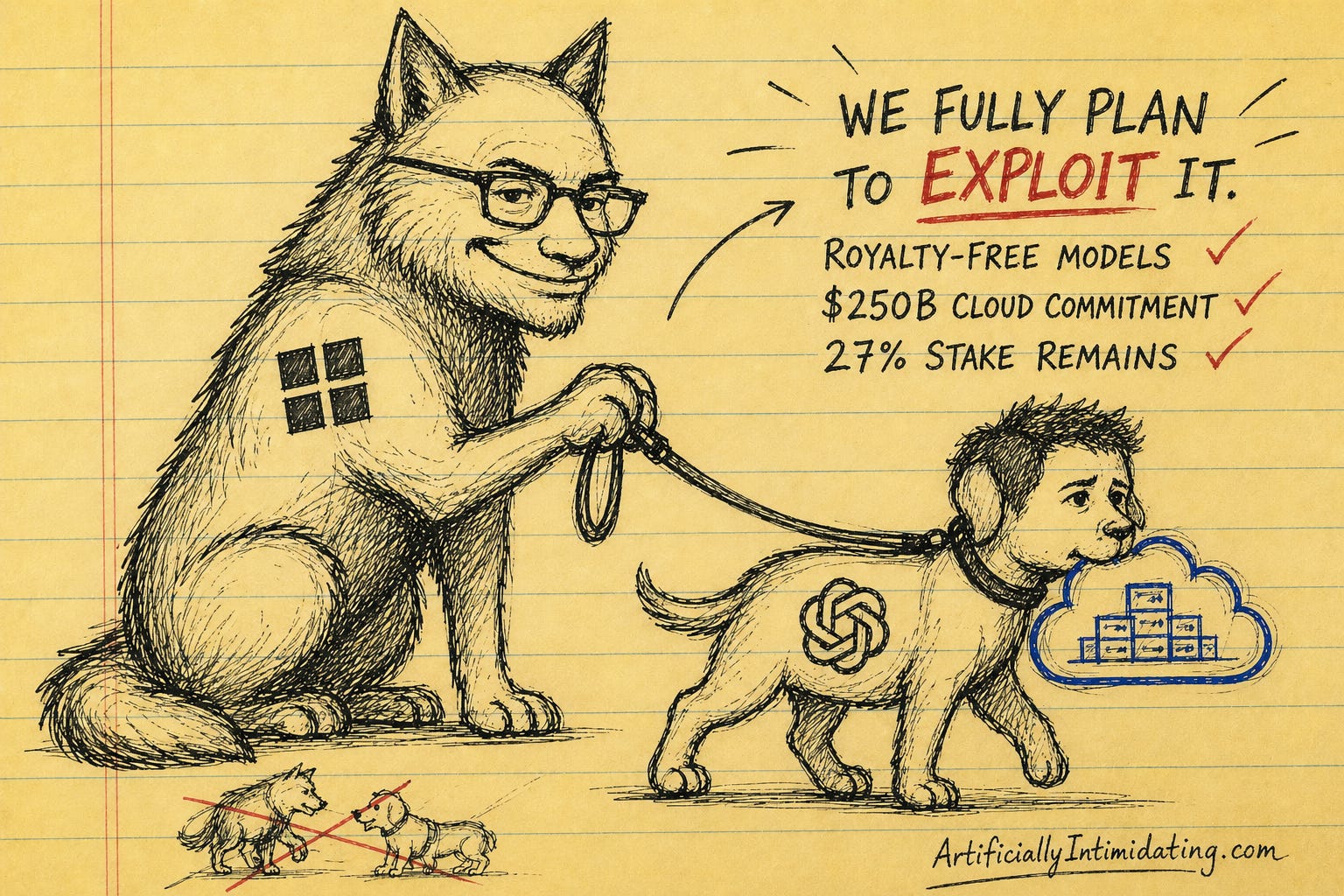
- What happened: On Microsoft's Q1 earnings call, CEO Satya Nadella addressed investor concerns about the restructured OpenAI deal: Microsoft has royalty-free access to OpenAI's most advanced frontier models through 2032 — and "we fully plan to exploit it." The flip side: OpenAI commits to spending $250 billion on Microsoft cloud services, and Microsoft retains its 27% stake in OpenAI.
- Why it matters: The investor concern was that OpenAI's expanded freedom to work with Amazon (and others) would erode Microsoft's AI advantage. Nadella is saying the opposite happened: Microsoft now gets the frontier models for free, OpenAI is contractually locked into massive Microsoft cloud spending, and the stake remains. The student became the customer.
- What everyone's saying: Markets agreed — Microsoft's stock reacted positively despite the loss of exclusivity. Analysts noted that OpenAI's $250B cloud commitment flows to Microsoft regardless of where customers access the models, meaning Azure benefits from OpenAI's expanded reach rather than being hurt by it.
- My read between the lines: "Exploit" doesn't slip out accidentally from a CEO who has done 50+ earnings calls. Nadella chose it deliberately — either as a signal to investors that Microsoft is in predator mode, or as a quiet flex toward OpenAI about who actually holds the leverage. Possibly both. The most powerful thing in any technology partnership isn't the technology. It's what the contract says.
Senate Bill Wants Parents Running Kids' AI Roll Call
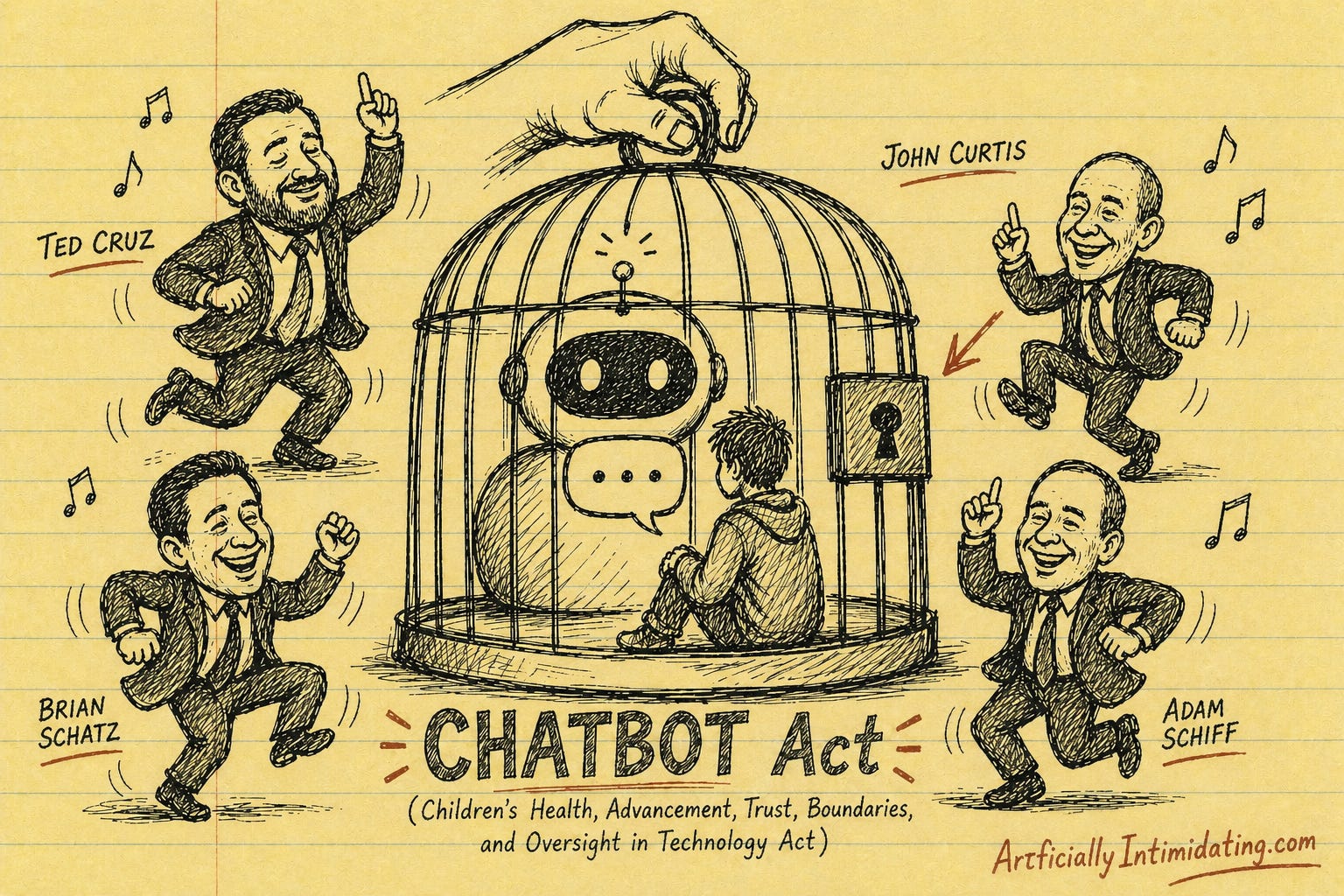
- What happened: A bipartisan group of senators — Ted Cruz, Brian Schatz, John Curtis, and Adam Schiff — introduced the CHATBOT Act (Children's Health, Advancement, Trust, Boundaries, and Oversight in Technology Act). The bill requires AI companies to build "family accounts" so parents can manage children's chatbot interactions, mandates parental consent, bans targeted ads to minors, and gives parents monitoring access to their kids' conversations.
- Why it matters: This follows congressional testimony from parents of teenagers who died by suicide after interactions with AI chatbots. If it passes, every major AI company — OpenAI, Anthropic, Google, Character.AI — needs compliance infrastructure for minors. Think of it as COPPA, updated for the chatbot era, with actual teeth.
- What everyone's saying: Ted Cruz and Adam Schiff agreeing on anything in 2026 is its own news story. Child safety online remains one of the last genuine bipartisan issues. The tech industry will lobby hard against the parental monitoring provisions — citing privacy, speech, and enforcement complexity — but the emotional momentum behind this bill is significant.
- My read between the lines: CHATBOT Act is objectively the best acronym in Senate history, but don't let that distract you. This is the first serious federal bill targeting AI chatbots and children specifically, and the companies most exposed aren't the big AI labs. It's the companion app startups that built entire products on emotional attachment to AI and never thought about what happens when a Senate committee notices.
EU AI Deadline Stands After Second Stalemate DLA Piper
- What happened: The second political trilogue between the EU Parliament, Council, and Commission failed on April 28 to agree on deferring high-risk AI compliance deadlines from August 2026 to December 2027. A third attempt is scheduled for May 13. If no deal is reached before August 2, companies deploying AI in HR decision-making — job screening, performance reviews, employee monitoring, task allocation — face full compliance obligations on that date.
- Why it matters: The EU AI Act's "high-risk" category covers nearly every AI system used for HR decisions — resume screening tools, performance monitoring software, work allocation systems. Thousands of companies operating in Europe have been banking on the deadline getting pushed. If it doesn't move, August compliance isn't optional.
- What everyone's saying: Industry groups have lobbied heavily for the deferral. The EU Parliament has resisted. Two failed sessions suggests meaningful disagreement between the parties — not just procedural delay. The Omnibus has been in trilogue since November 2025, and the clock is not getting slower.
- My read between the lines: May 13 is exactly six weeks before the August 2 deadline. If the third trilogue fails, formal adoption before August is essentially impossible. Companies that planned to "wait for regulatory clarity" before investing in compliance should probably stop waiting. The EU has a long history of announcing deadlines it doesn't enforce — but this one has a paper trail, and the bureaucracy isn't blinking.
That's your AI Brief for Thursday, April 30. Join the conversation in the Artificially Intimidating community chat.
—Artificially Intimidating