

Good morning, humans. Sam Altman and Elon Musk are sitting in a courtroom together in Oakland — which is somehow less dramatic than the AI news happening outside it. Today: why Google’s own engineers may be the last line of defence against Pentagon AI, and why your company’s Anthropic bill might be bigger than your payroll.
📬 Before we dive in: The sharpest AI Brief tips come from readers who are actually in the weeds. If you spot a story worth covering, share it in the community chat. The best tips make tomorrow’s edition.
The AI Founding Myth Goes to Trial — Ars Technica
• What happened: The Musk v. Altman trial opened Monday in Oakland, with jury selection underway. The suit accuses Altman and Greg Brockman of betraying OpenAI’s nonprofit founding mission to benefit investors. Both men are expected to testify; Altman has already told the court that Musk’s Grok showed flagrant disregard for basic safety testing.
• Why it matters: OpenAI is now valued at $852 billion. The question on trial is whether that fortune was built by abandoning a promise — and whether that matters legally. Whatever the verdict, the trial will expose the internal emails, board minutes, and text messages that shaped the modern AI industry.
• What everyone’s saying: The press is fixated on the soap opera: Altman confiding in Musk’s associate Shivon Zilis, Musk forgetting how much he donated, Helen Toner’s pre-trial allegation that Altman misled the board. Geoffrey Hinton called it a reminder that governance choices in 2026 will determine whether AI serves the public.
• My read between the lines: The most interesting subplot is SpaceX’s looming IPO. Musk is days from potentially becoming the world’s first trillionaire, which means every embarrassing deposition detail lands during maximum financial exposure. He may have filed this lawsuit before he appreciated exactly how bad the timing could be.
The Brief covers what happened.
If you want to know how to actually use it — the workflows, setups, and prompts — that's what paid posts are for.
Google’s Pentagon Problem: 580 Employees vs. The DoD — Bloomberg / Yahoo Finance
• What happened: More than 580 Google employees — including senior DeepMind researchers and over 20 VPs and directors — signed an open letter demanding CEO Sundar Pichai refuse to put Google AI on classified Pentagon networks. On the same day, the Department of Defense confirmed it added Google’s Gemini 3.1 to its GenAI.mil platform, giving 3 million defense personnel access.
• Why it matters: On air-gapped classified networks, Google can’t monitor or limit how its AI is used. The company quietly removed weapons language from its AI principles in 2025. The Pentagon, already burned by Anthropic’s refusal to remove autonomous weapons restrictions, is now shopping for more compliant partners.
• What everyone’s saying: This is being directly compared to 2018’s Project Maven protest, when ~4,000 signatures and resignations forced Google to exit a Pentagon AI contract. This letter has fewer signatures but higher-level signatories — which may signal deeper fractures at the top, not just a grassroots revolt.
• My read between the lines: Google signed a classified AI deal with the Pentagon on the same day its employees sent the letter asking it not to. Pichai didn’t even publicly acknowledge the letter. This isn’t a debate — it’s a done deal with a PR problem. The real question is whether anyone actually resigns, because that’s what changed Google’s calculus in 2018.
Your AI Bill Is Now Bigger Than Your Payroll — Axios
• What happened: Axios reported that for some companies, AI compute costs now exceed employee salaries. Uber’s CTO burned through his entire 2026 AI budget before the year was fully underway — from token costs alone. An Nvidia VP confirmed that for his team, the cost of compute is far beyond the cost of employees.
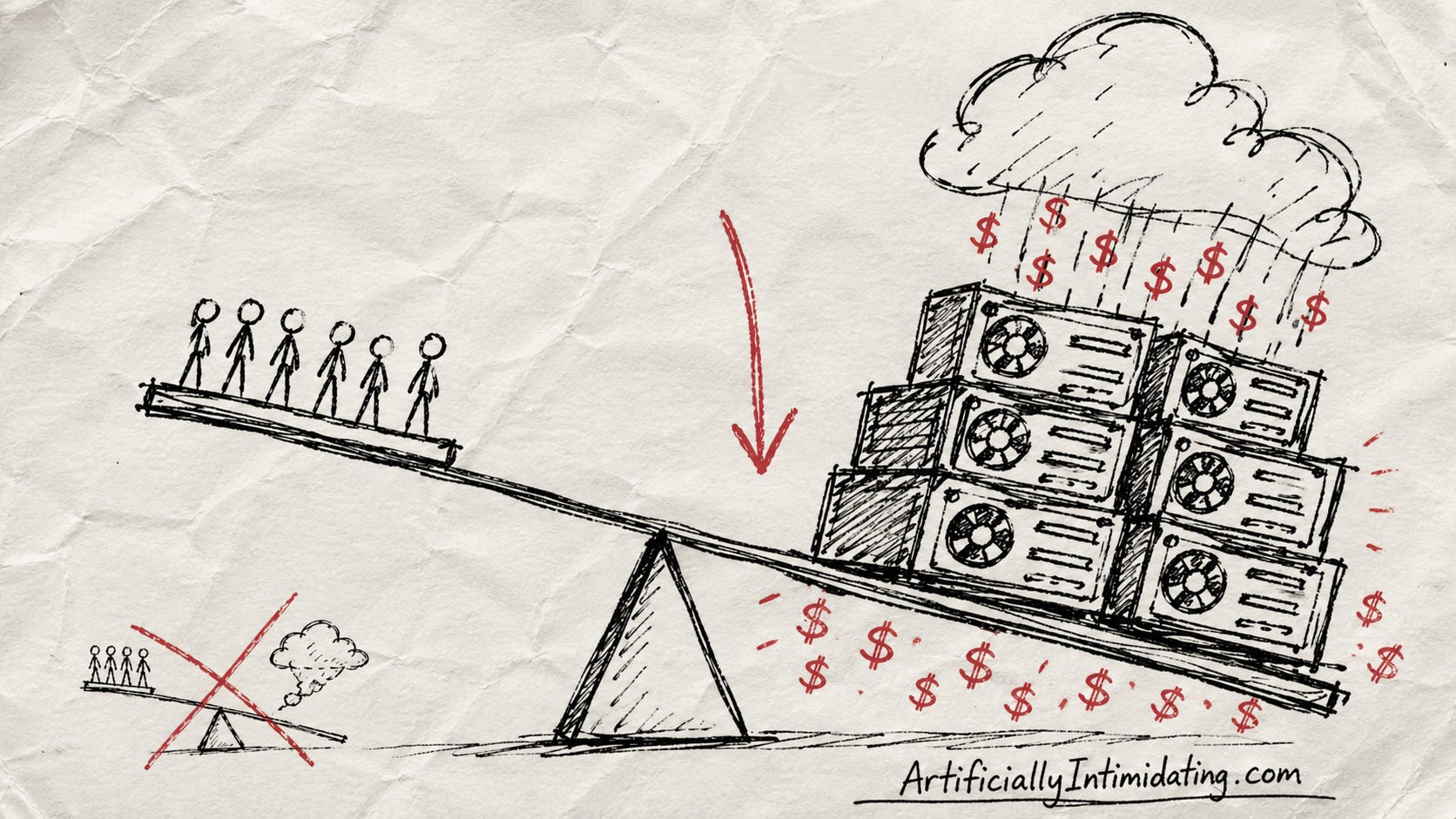
• Why it matters: The dominant AI narrative has been that AI replaces workers, saving companies money. This data complicates that story. At scale, AI inference costs are enormous, and many organizations are discovering that the token bill for replacing a knowledge worker often exceeds what the worker cost. The math only works if AI makes the remaining humans dramatically more productive.
• What everyone’s saying: Some executives are bragging — Swan AI’s CEO posted his Anthropic bill on LinkedIn as a badge of honour, calling it building the first autonomous business. Others are quietly recalibrating. Worldwide IT spending is forecast at $6.31 trillion in 2026, up 13.5%, driven almost entirely by AI infrastructure.
• My read between the lines: The companies that win this cycle won’t be the ones spending the most on tokens. They’ll be the ones who figured out which decisions actually need a frontier model and which can be handled by a $0.002 call to Haiku. The Uber CTO story isn’t a cautionary tale about AI — it’s a cautionary tale about skipping the cost architecture conversation until after the bill arrives.
Goldman Says AI Added Zero to GDP. The Economist Disagrees. — The Neuron / The Economist
• What happened: Goldman Sachs and The Economist have taken diametrically opposed stances on AI’s economic impact. Goldman says AI’s contribution to GDP was basically zero in 2025. The Economist argues the compounding effect is still ahead — that productivity gains from general-purpose technologies like AI, just like electricity or the internet, take a decade to show up in the numbers.
• Why it matters: Trillions of dollars in AI investment are being justified by the assumption that massive GDP growth is coming. If Goldman is right, we are in the most expensive corporate experiment in history with no measurable return yet. If the Economist is right, we’re in the early innings of the biggest economic shift since industrialisation.
• What everyone’s saying: Apollo’s chief economist points to AI CapEx and productivity gains as the reason the U.S. has outperformed. BNP Paribas notes AI-driven productivity at 2.3% year-over-year since 2023, versus 1.4% pre-pandemic. This week’s tech earnings — Alphabet, Microsoft, Meta, and Amazon all report — may provide the next data point on whether the CapEx is finally converting to revenue.
• My read between the lines: Both sides are probably right for different time windows. AI productivity gains are real but being captured as consumer surplus — cheaper services, faster outputs — rather than as GDP line items. That makes them politically invisible even when economically enormous. Watch the earnings calls this week: if the hyperscalers start showing AI revenue acceleration to match the capex, the Economist wins. If they don’t, Goldman gets another quarter of being technically correct.
IBM Named Its Enterprise AI Agent Bob, Which Is Correct — IBM Newsroom
• What happened: IBM launched Bob, an agentic AI development partner for enterprises, globally today. Bob works across the full software development lifecycle — planning, coding, testing, deployment, and legacy modernization — with built-in governance controls. It uses multi-model routing, drawing on Claude, Mistral, and IBM’s Granite models, matching task complexity to the right model automatically.
• Why it matters: IBM’s pitch isn’t just AI writes code faster — it’s AI that enterprises can actually deploy without compliance nightmares. Every action Bob takes is logged and traceable from start to finish. For Fortune 500 companies running on decades of legacy systems and regulated environments, this is the gap that GitHub Copilot and Cursor haven’t filled.
• What everyone’s saying: Developers will inevitably compare this to Devin, Cursor, and GitHub Copilot. IBM’s angle is governance-first rather than speed-first — a different bet on what enterprises actually need. The multi-model routing architecture is notable: automatically routing simpler tasks to cheaper models is a real cost optimization, not just a pitch.
• My read between the lines: IBM named their enterprise AI agent Bob. This is either the most grounded brand decision in tech — a deliberate antidote to every overwrought agent name in the market — or proof that IBM’s marketing peaked in 1981. Either way, Bob is going to spend most of his career inside a sprawling Java codebase from 2007, and honestly that feels right.
That’s your AI Brief for Tuesday, April 28. Join the conversation in the Artificially Intimidating community chat.
—Artificially Intimidating