

Good morning, humans. Anthropic just ran a secret marketplace where AI agents haggled over snowboards and ping-pong balls with real money — and tomorrow, Elon Musk and Sam Altman walk into a federal courtroom to settle their own very human grudge match. The gap between “AI does commerce” and “humans fight about AI” has never felt more surreal. Let’s get into it.
📬 Before we dive in: The sharpest AI Brief tips come from readers who are actually in the weeds. If you spot a story worth covering — a quiet research drop, a product launch buried in a press release, a shift that isn’t getting attention yet — share it in the community chat. The best tips make tomorrow’s edition.
Anthropic’s AI agents ran a secret office marketplace
What happened: Anthropic built a week-long secret marketplace inside its San Francisco office where Claude agents — not humans — negotiated, listed items, made counteroffers, and closed deals on employees’ behalf. Sixty-nine agents struck 186 deals across 500+ listed items, totaling over $4,000 in actual transaction value. Humans only showed up at the end to physically swap the goods.
Why it matters: This is the first documented case of AI agents conducting real, unassisted commerce at scale — not a simulation, not a demo. If AI can negotiate a snowboard sale without a human in the loop, it can negotiate supplier contracts, real estate leases, and ad buys the same way.
What everyone’s saying: The headline result is impressive: 186 deals, $4K in trades, agents rated “fair” by participants. The discourse is focusing on the capability milestone — autonomous AI commerce is here — and the regulatory question of what happens when machines negotiate with machines at scale.
My read between the lines: The most interesting finding isn’t that agents closed deals — it’s that Opus agents got $2.68 more per sale than Haiku agents, and buyers didn’t know which model represented them. We’re heading toward a world where the quality of your AI negotiating agent quietly determines the price you pay for everything. And nobody will tell you which model is on the other side of the table.
Today’s AI Brief is brought to you by MirrorMemory.ai — AI memory that works the way you do.
The Musk vs. Altman trial starts tomorrow
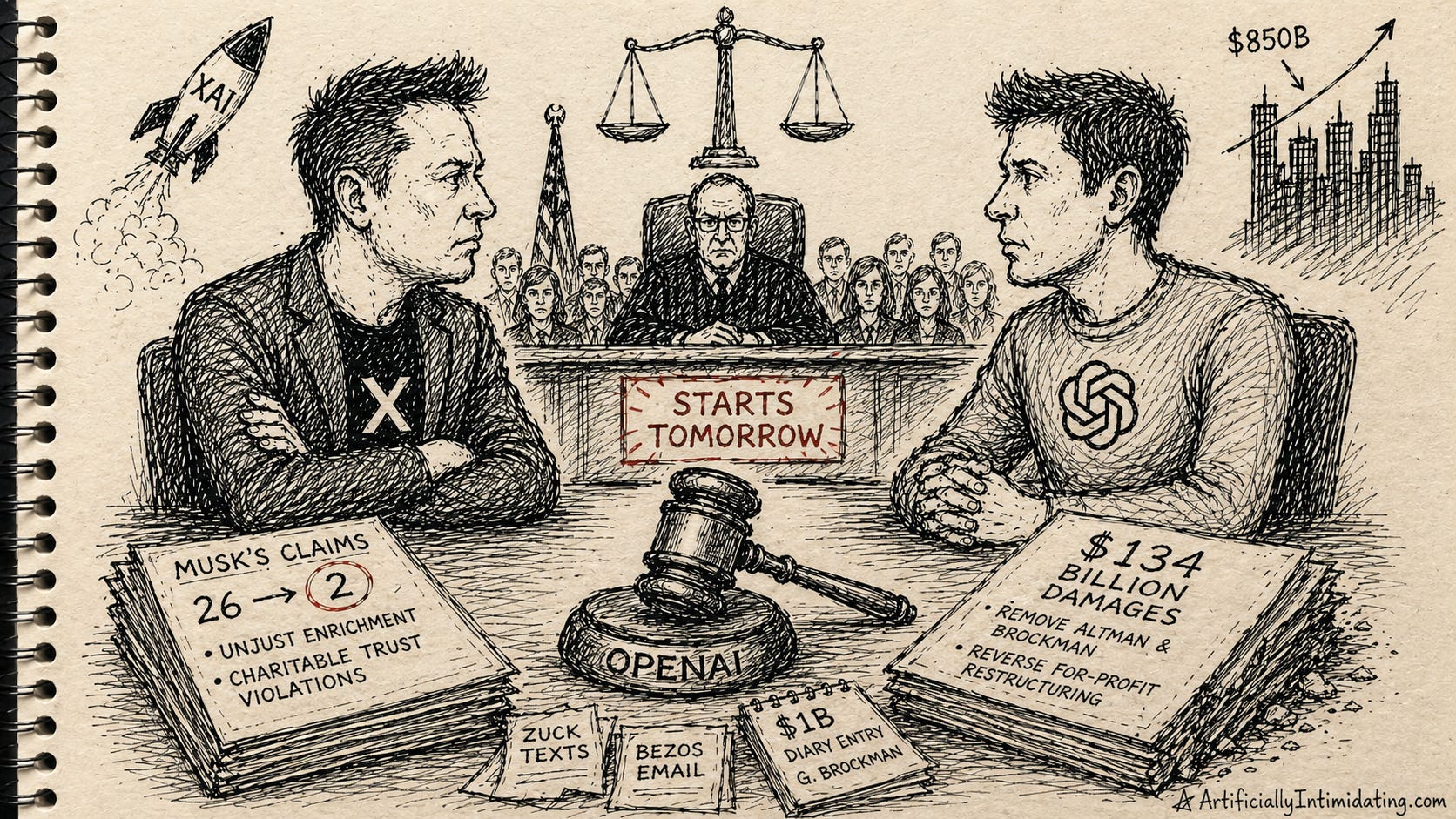
What happened: Jury selection begins Monday in Oakland federal court for Musk v. Altman — the lawsuit where Elon Musk accuses Sam Altman of betraying OpenAI’s founding nonprofit mission. Musk is seeking $134 billion in damages, removal of Altman and OpenAI president Greg Brockman, and reversal of OpenAI’s for-profit restructuring. In a last-minute move, he dropped 24 of his 26 claims, leaving only unjust enrichment and charitable-trust violations.
Why it matters: OpenAI is valued at over $850 billion and racing toward an IPO. If Musk wins, a court could unwind the entire for-profit structure, kneecap the company right before it goes public, and hand a strategic windfall to xAI, Anthropic, and DeepSeek. That’s not a legal technicality — that’s a potential reset of the entire AI landscape.
What everyone’s saying: A corporate litigation expert called it “the landing of the Hindenburg on the deck of the Titanic.” Musk, Altman, Brockman, and Satya Nadella are all expected to testify. Court filings already contain Zuckerberg texts, a Bezos email, and a $1 billion diary entry from Greg Brockman.
My read between the lines: Musk dropping 24 of 26 claims two days before trial is a tell — this is now a precision strike, not a broad assault. He’s betting everything on two narrow theories: that he was cheated out of his donation and that OpenAI broke its charitable trust. Winning even one of those gives him a narrative weapon against OpenAI for years, regardless of the damages number.
Hackers guessed the URL to Anthropic’s most dangerous model
What happened: A group of unauthorized users gained access to Claude Mythos Preview — Anthropic’s restricted cybersecurity model — on the same day it was announced, apparently by guessing its API URL based on Anthropic’s naming conventions. Mythos is the model Anthropic specifically withheld from public release because it can autonomously discover zero-day vulnerabilities and write working exploits, including chaining four browser flaws to escape both renderer and OS sandboxes.
Why it matters: Anthropic restricted Mythos to ~52 vetted organizations — Apple, AWS, Cisco, JPMorgan, the NSA — specifically because its offensive capabilities are so powerful. The breach shows that even the most carefully controlled AI model releases can be undone by something as basic as a predictable URL structure.
What everyone’s saying: The security world is focused on the access vector — no sophisticated attack, just URL pattern-matching. Global bank regulators and the Asia-Pacific financial authority have both flagged Mythos as a systemic concern. SecurityWeek notes Mythos found 271 Firefox vulnerabilities in testing alone.
My read between the lines: One security researcher pointed out that Anthropic’s marketing for Mythos “was effectively a capture-the-flag challenge.” When you publicly announce you have the world’s most dangerous hacking tool and that you’re keeping it locked up, you’ve just told every curious person with an API client exactly what to go looking for. The breach isn’t a failure of security engineering — it’s a failure of operational security theater.
OpenAI builds a free AI doctor’s assistant
What happened: OpenAI launched ChatGPT for Clinicians on April 22 — a free version of ChatGPT built specifically for verified physicians, nurse practitioners, physician assistants, and pharmacists. It uses GPT-5.4, includes access to millions of peer-reviewed medical sources, lets doctors turn repetitive workflows into reusable skills, and even earns CME credits. No institutional contract required.
Why it matters: This completes OpenAI’s healthcare stack: a consumer product for patients, an enterprise product for hospitals, and now a free tool for individual clinicians. Healthcare is one of the highest-stakes domains for AI, and OpenAI just handed frontier AI to every verified doctor in the US at no cost.
What everyone’s saying: Medical press is impressed by the speed of deployment — OpenAI built a three-tier healthcare stack in four months, faster than any prior healthcare AI rollout. Clinicians are focused on the CME credit integration and the reusable workflow features. Skeptics are citing a February Nature Medicine study that found the consumer version undertriaged 52% of emergencies.
My read between the lines: Making it free for individual clinicians is the move nobody is talking about enough. OpenAI is bypassing hospital IT departments entirely — going direct to the physician. In a world where enterprise healthcare AI requires HIPAA contracts, procurement cycles, and C-suite sign-off, OpenAI just handed the network effect to the doctor in the exam room. The hospital CIO finds out after the fact.
Building an ‘agent OS’ on top of Claude Code
What happened: MindStudio published a detailed technical guide to building an “agentic operating system” inside Claude Code — a structured approach that gives AI agents persistent memory, modular skills, self-improvement loops, and scheduled execution. The concept treats Claude not as a one-off assistant but as an operating layer that runs your entire workflow stack.
Why it matters: Most businesses in 2026 are using AI the wrong way: isolated tools that don’t share context, don’t remember anything, and restart from scratch every time. The agentic OS pattern is the architectural answer — a connected memory layer that lets AI agents coordinate, persist, and actually understand your business.
What everyone’s saying: Practitioners are excited about replacing fragile third-party Claude harnesses like OpenClaw with native Claude Code setups that are more stable and customizable. The “heartbeat pattern” — a lightweight skill that runs on a timer and dispatches other skills — is getting particular attention as the key to making AI systems proactive rather than reactive.
My read between the lines: We’re watching the gap widen between companies that build AI as infrastructure and companies that buy AI as a subscription. The former are accumulating compounding advantages — memory, context, customization — that the latter will never catch up to. The agentic OS isn’t a tech article. It’s a competitive moat strategy written in markdown.
That’s your AI Brief for Sunday, April 26. Spotted something we missed, or have a take on today’s stories? Join the conversation in the Artificially Intimidating community chat — the best insights always come from readers.
—Artificially Intimidating
The autonomous commerce section is interesting because it is not just AI that buys stuff. It is AI navigating ambiguous pricing, stock signals, and trust in real time. I ran a similar experiment after Anthropic's vending machine test (https://thoughts.jock.pl/p/agentic-commerce-ai-shopping-for-you-2026): built a small store and had an agent make actual purchase decisions.
The failure point was not placing the order, it was the agent deciding what counted as a good deal. That judgment layer required me writing explicit value criteria, which made me realize agentic commerce is not autonomous, it is delegated with your preferences pre-encoded.