

Good morning, humans. OpenAI just shipped GPT-5.5 — a model that can apparently help scientists make new mathematical proofs — and DeepSeek dropped V4 the very same week, reminding everyone that the frontier is no longer an American-only zip code. Meanwhile, Washington is finally trying to do something about it. Let's get into it.
📬 Before we dive in: The sharpest AI Brief tips come from readers who are actually in the weeds. If you spot a story worth covering — a quiet research drop, a product launch buried in a press release, a shift that isn't getting attention yet — share it in the community chat. The best tips make tomorrow's edition.
OpenAI drops GPT-5.5 — and it proved a math theorem
What happened: OpenAI released GPT-5.5 on April 23, describing it as its most capable model yet for real-world work — coding, research, data analysis, and agentic tasks. It scored top marks across benchmarks against Gemini 3.1 Pro and Claude Opus 4.5, and OpenAI says it generated a new, independently verified proof about Ramsey numbers in mathematics.
Why it matters: This isn't just a benchmark flex. GPT-5.5 can hold context across an entire codebase, reason through ambiguous failures, and keep working without constant hand-holding — which means it's getting closer to something that actually handles a full workday task from start to finish, not just a single prompt.
What everyone's saying: The discourse is split: practitioners are excited about the agentic coding improvements (a 30-point jump over Claude Opus 4.7 on one engineering benchmark), while skeptics note it's a "5.5" — incremental — and wonder how long OpenAI can keep shipping model updates before the versioning becomes meaningless.
My read between the lines: OpenAI specifically flagged drug discovery as an area where GPT-5.5 can "meaningfully accelerate progress at the frontiers of biomedical research." That's not a feature bullet — that's a pitch to pharma giants. The next battleground for AI revenue isn't enterprise SaaS, it's trillion-dollar industries that have never moved fast.
Today's AI Brief is brought to you by MirrorMemory.ai — your AI-powered second brain.
DeepSeek V4 drops and immediately challenges GPT-5.2
What happened: Chinese AI lab DeepSeek launched preview versions of DeepSeek-V4-Pro and V4-Flash today — the first new model architecture from the company since V3. The Pro version has 1.6 trillion total parameters (49B active) with a 1 million token context window. It's open-source under an MIT license, meaning anyone can download and run it.
Why it matters: DeepSeek's last big release (R1) crashed Nvidia's stock and spooked Silicon Valley. V4 continues the pattern: a Chinese lab releasing frontier-class, open-weight models that anyone in the world can run locally — no API fees, no American cloud provider required. DeepSeek says V4 beats GPT-5.2 on reasoning benchmarks, trailing GPT-5.4 by only "3-6 months."
What everyone's saying: Simon Willison noted that V4-Flash's efficiency could mean it runs well on consumer hardware, which he's actively watching. Tech press is focused on the benchmark numbers and whether this is as market-moving as R1. Analysts like Morningstar's Ivan Su are more measured: "competent follow-up, not as big a breakthrough as R1."
My read between the lines: The MIT license is the real story. Not only can anyone run this — anyone can build commercial products on it, fine-tune it, and redistribute it with zero restrictions. Open-source AI is becoming China's soft power play: you don't need to win the API race if you make the free model good enough that developers everywhere build on your infrastructure.
Alibaba's tiny model just beat its own 397B giant on coding
What happened: Alibaba's Qwen team released Qwen3.6-27B, a 27-billion-parameter open-weight model that outperforms their own 397-billion-parameter MoE flagship on coding benchmarks. It fits in a 16.8 GB quantized file — small enough to run on a single consumer GPU — and scores within a few points of Claude 4.5 Opus on most evaluations.
Why it matters: A model that fits on your gaming PC and trades blows with Anthropic's flagship is a meaningful shift. For developers, it means frontier-quality AI for tasks like coding can now run locally, privately, and for free — no subscription, no API key, no cloud. The "you need a data center" assumption is evaporating.
What everyone's saying: The benchmarks are getting most of the attention — specifically the SWE-bench Verified score of 77.2, which beats the 397B MoE's 76.2. The efficiency story is the one practitioners care about: a dense 27B model beating a 397B MoE means the architecture choices matter more than raw parameter count.
My read between the lines: Chinese AI labs are quietly executing a price-and-efficiency war that makes it harder for any single company — including OpenAI — to maintain a moat based on model capability alone. When a 27B model matches a 397B model, you realize the game was never about having the biggest model. It was always about the smarter architecture.
White House declares war on Chinese AI 'distillation'
What happened: Trump science adviser Michael Kratsios issued a memo this week accusing foreign entities — "principally based in China" — of running "industrial-scale campaigns" to extract capabilities from U.S. AI models through a technique called distillation: systematically querying frontier models and using the outputs to train cheaper lookalike systems. The administration pledged to work with U.S. labs to build defenses and punish offenders.
Why it matters: This is the policy layer catching up to the technical reality. OpenAI and Anthropic have both accused Chinese companies of using tens of thousands of fake accounts to extract model outputs. If distillation-based training becomes legally or commercially restricted, it would raise the cost of Chinese AI development significantly — though enforcement looks extremely difficult.
What everyone's saying: Brookings fellow Kyle Chan called it "looking for needles in an enormous haystack" — separating unauthorized distillation from legitimate API use at scale is nearly impossible without invasive monitoring. Meanwhile, the irony is sharp: Cursor, one of America's favorite coding tools, just acknowledged its latest product is built on a Chinese open-source model.
My read between the lines: The memo lands the same week DeepSeek V4 drops. That's not a coincidence — it's an escalation. Washington is signaling that AI is now treated as a national security asset on par with chip exports. The question is whether the policy has teeth, or whether it's a press release in memo form timed to a news cycle.
Meta cuts 8,000 jobs as AI layoffs turn into a wave
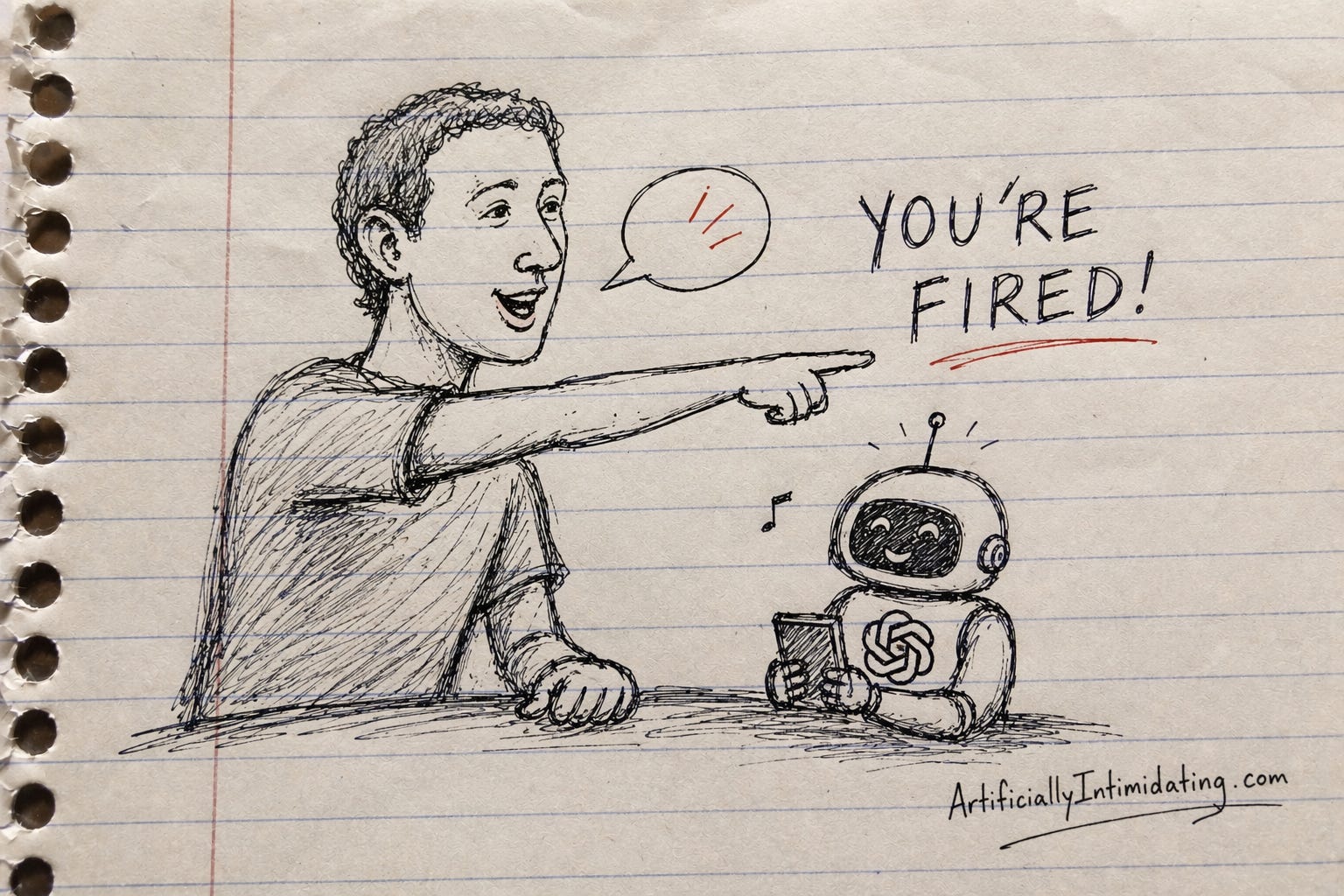
What happened: Meta laid off roughly 8,000 employees — about 10% of its workforce — as part of an efficiency drive tied to AI investment. The cuts follow a pattern that's accelerating: Snap (1,000 jobs), Atlassian (1,600), Block (4,000+), and WiseTech (2,000) have all made major cuts in 2026, each citing AI-driven productivity as the reason they need fewer people.
Why it matters: This is no longer hypothetical. AI isn't just changing which jobs get posted — it's actively shrinking headcount at companies that are simultaneously reporting record productivity. A Beautiful.ai survey of 3,000 managers found 45% believe AI will compress salaries, and 55% worry it will reduce their own pay. The wave is moving up the org chart.
What everyone's saying: The discourse is polarized between "this is normal business efficiency" and "this is the AI displacement event people warned about." Federal Reserve research shows entry-level hiring for recent college grads has slowed meaningfully, particularly in roles where AI handles cognitive tasks that used to serve as training grounds for new professionals.
My read between the lines: The companies doing this aren't struggling — they're thriving. Meta's cuts come alongside record revenue and massive AI investment. That's the uncomfortable part: these aren't distress layoffs. They're productivity-dividend extractions. The profits are real. The question is where they go — and so far the answer is mostly "into more AI infrastructure."
That's your AI Brief for Friday, April 24. Spotted something we missed, or have a take on today's stories? Please join the conversation in the Artificially Intimidating community chat — the best insights always come from readers.
—Artificially Intimidating