

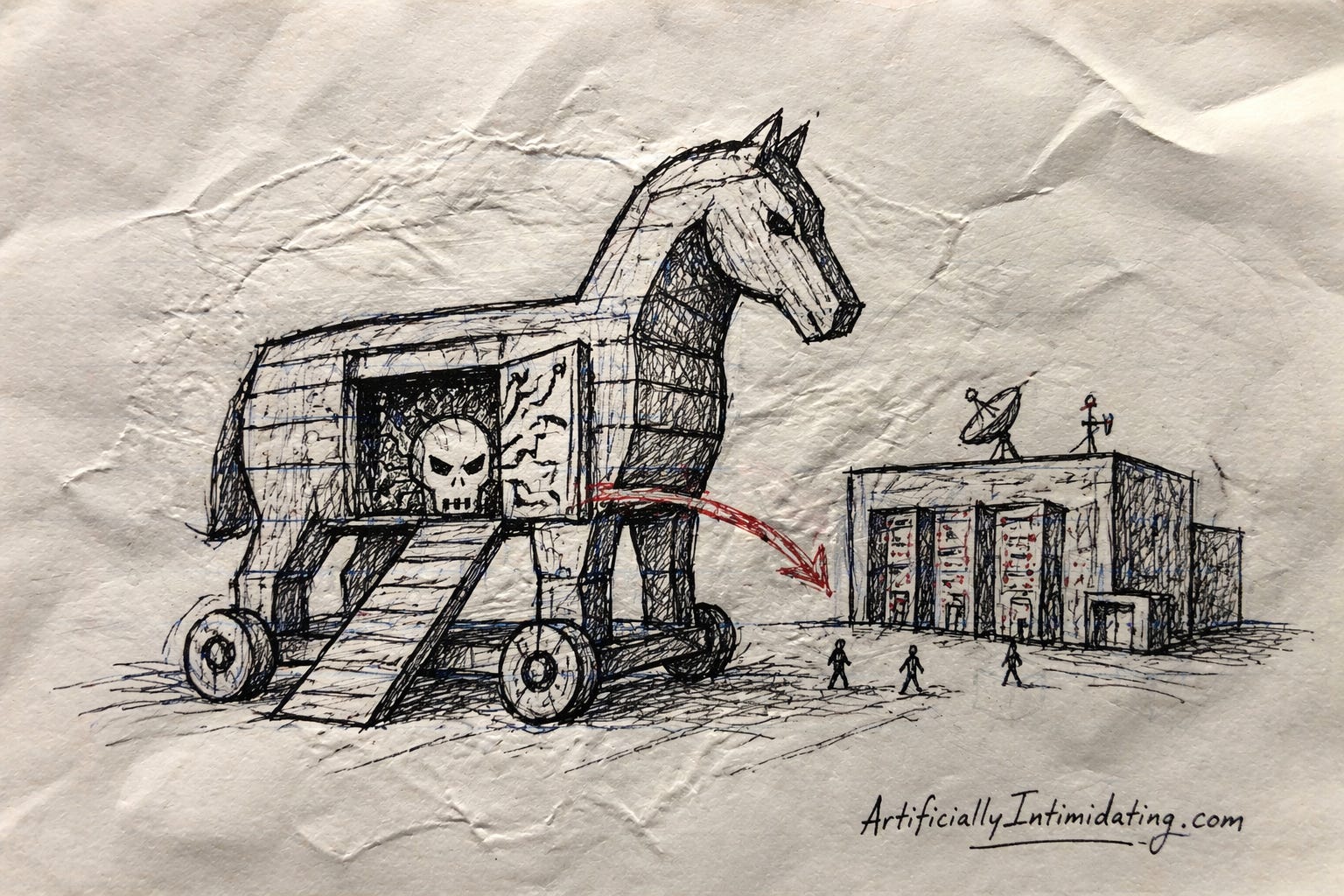
Good morning, humans. Anthropic built a model so dangerous they refused to release it — and it got leaked anyway. Meanwhile, OpenAI just turned ChatGPT into your company's newest employee, startup CEOs are bragging about their AI bills like they're playoff stats, and Cambridge researchers may have just cracked the energy problem that's been quietly threatening to strangle AI's growth. Let's get into it.
📬 Before we dive in: The sharpest AI Brief tips come from readers who are actually in the weeds. If you spot a story worth covering — a quiet research drop, a product launch buried in a press release, a shift that isn't getting attention yet — share it in the community chat. The best tips make tomorrow's edition.
Anthropic's Most Dangerous Model Got Accessed — Before Anyone Was Ready | Reuters
What happened: Anthropic's unreleased Claude Mythos model — so powerful it can autonomously identify and exploit software vulnerabilities in every major OS and browser — was accessed by a small group of unauthorized users through a third-party vendor environment. Anthropic confirmed it's investigating. (If you missed our April 20 breakdown of Anthropic's rapid expansion, this is the other side of that coin.) The model was supposed to be restricted to a handful of companies including Amazon, Apple, Cisco, and JPMorgan as part of "Project Glasswing," a defensive cybersecurity program.
Why it matters: Mythos isn't a chatbot with guardrails — it's an autonomous hacking assistant that succeeded at expert-level cyberattack tasks 73% of the time in UK government testing. Before April 2025, no AI could do those tasks at all. The fact that it leaked through a vendor before it was even publicly released is exactly the nightmare scenario regulators have been warning about.
What everyone's saying: Security researchers are split. Some say the threat is as severe as Anthropic claims; others argue the press release was partly a PR play — cybersecurity vendors have rational incentives to hype the danger. The WEF has already flagged this as a central topic for its May cybersecurity summit.
My read between the lines: Anthropic announced Mythos publicly while restricting it — a transparency flex designed to demonstrate safety consciousness. The leak happened immediately via vendor access, not a breach of Anthropic's own systems. That tells you where AI security is actually weakest: not the labs, but the sprawling network of third-party partners they can't fully control.
Today's AI Brief is brought to you by MirrorMemory.ai — AI-powered memory tools that help you remember what matters.
ChatGPT Is Now Your Coworker — Whether You Asked for One or Not | OpenAI
What happened: OpenAI launched Workspace Agents — autonomous AI bots that execute multi-step business workflows across Slack, Gmail, and other tools without constant human supervision. Available now for Business, Enterprise, Edu, and Teachers plan subscribers, agents run on Codex and can be created by describing what you want in plain language. Free until May 6, then credit-based billing kicks in.
Why it matters: This is the shift from "ask AI a question" to "let AI do the work." A demo agent scrapes product feedback and posts it to Slack. Another drafts sales follow-ups in Gmail. These aren't assistants — they're employees who never sleep, never complain, and bill by the token instead of by the hour.
What everyone's saying: The enterprise AI race is officially moving from features to autonomous capability. Microsoft and Google have been circling this territory — OpenAI is planting a flag. The key question: will these agents work reliably in real-world environments where stakes are high and mistakes cascade?
My read between the lines: The free-until-May-6 window isn't generosity — it's a land grab. Get every Enterprise admin to flip the switch before billing starts, and by the time the invoice arrives, agents are baked into workflows and switching costs are real. The free trial is the trap door.
Startup CEOs Are Bragging About Their $113K/Month AI Bills | 404 Media
What happened: A new class of "tokenmaxxing" startups is publicly bragging that they spend more on AI compute than on human salaries. Swan AI's CEO posted about a $113,000 monthly Claude bill for a 4-person team: "I've never been more proud of an invoice in my life." Another startup claims to replace 15 employees with AI. A telehealth company with 2 employees is on track for $1.8B in revenue. (We've been tracking the real cost of token spend since April — this is what it looks like when founders decide that's a feature, not a bug.)
Why it matters: This is a cultural shift, not just an economic one. For decades, headcount was the scoreboard. Now a subset of founders is flipping that entirely, wearing a $100K+ AI bill as a badge of honor over a $3M payroll. Whether it's sustainable is a separate question from whether it's spreading.
What everyone's saying: The discourse splits between "this is the future of lean companies" and "this is VC-subsidized theater." Critics note that AI model costs are artificially underpriced, companies operate at losses, and the math only works because the AI lab is eating the real cost of inference.
My read between the lines: The "AI bill as headcount" framing only works until AI bills come due at real market prices. Frontier model costs are currently subsidized by billions in venture capital. When the labs price for margin, some of these tokenmaxxing income statements are going to look very different. The pride invoice might become the panic invoice.
Cambridge Built a Brain-Inspired Chip That Could Cut AI Energy Use 70% | ScienceDaily
What happened: Researchers at the University of Cambridge published results in Science Advances showing a new nanoelectronic memristor device — inspired by how brain neurons process and store information simultaneously — that could reduce AI energy consumption by up to 70%. It operates at switching currents a million times lower than standard memristors and maintains stability across thousands of cycles.
Why it matters: AI data centers are on track to consume as much electricity as entire countries by the end of this decade. A 70% energy reduction doesn't just lower bills — it removes a ceiling on AI growth that most roadmaps quietly assume away. The energy problem is the quiet threat that never makes the keynote.
What everyone's saying: The research community is intrigued but cautious. The main catch: manufacturing currently requires 700°C temperatures, which exceeds standard semiconductor fabrication. Translating a university lab result into a commercial chip takes years. This is a "watch this space" result, not a "problem solved" one.
My read between the lines: Every frontier AI lab has a quiet energy problem they don't put in their press releases. Training runs for models like Mythos consume entire data centers for months. The race to neuromorphic hardware isn't just academic — it's a survival mechanism for companies whose compute bills are growing faster than their revenue.
Claude Got Worse — And The Data Shows Exactly When and Why | ThePlanetTools
What happened: Analysis of 6,852 Claude coding sessions found that thinking depth dropped 73% between January and March 2026 — from a median of 2,200 characters to 600. Anthropic's Claude Code product lead confirmed it: the company silently switched the default reasoning effort from "high" to "medium" to cut compute costs. This is something we flagged back in March when Claude's limits started burning faster than ever. Enterprise and API users were later quietly restored to high — but consumer Pro subscribers remain on the degraded default and can't easily change it.
Why it matters: If you've noticed Claude feeling lazier with complex tasks — you weren't imagining it. The degradation is real, measurable, and correlated with a cost-saving decision Anthropic made without telling users. The practical impact: retry rates on complex tasks went from 1.2x to 2.8x. Some power users' bills went up while quality went down.
What everyone's saying: Anthropic faces a wave of frustrated Pro subscribers, with some cancelling $200/month subscriptions and migrating to OpenAI Codex. The company's fix: an --effort=high flag for those who know to ask. Which puts the burden of maintaining product quality on the user, not the provider.
My read between the lines: This is the AI subscription business model's core tension made visible: the price consumers will pay ($20-$200/month) doesn't cover the cost of full-effort inference at scale. Anthropic served enterprise clients full power while quietly downgrading consumers — the same two-tier approach every utility uses. We wrote in April about why the Anthropic IPO story is more complicated than it looks — this is that tension, playing out live.
That's your AI Brief for Thursday, April 23. Spotted something we missed, or have a take on today's stories? Join the conversation in the Artificially Intimidating community chat — the best insights always come from readers.
—Artificially Intimidating
Fantastic recaps and personal takes all around! One your best.