

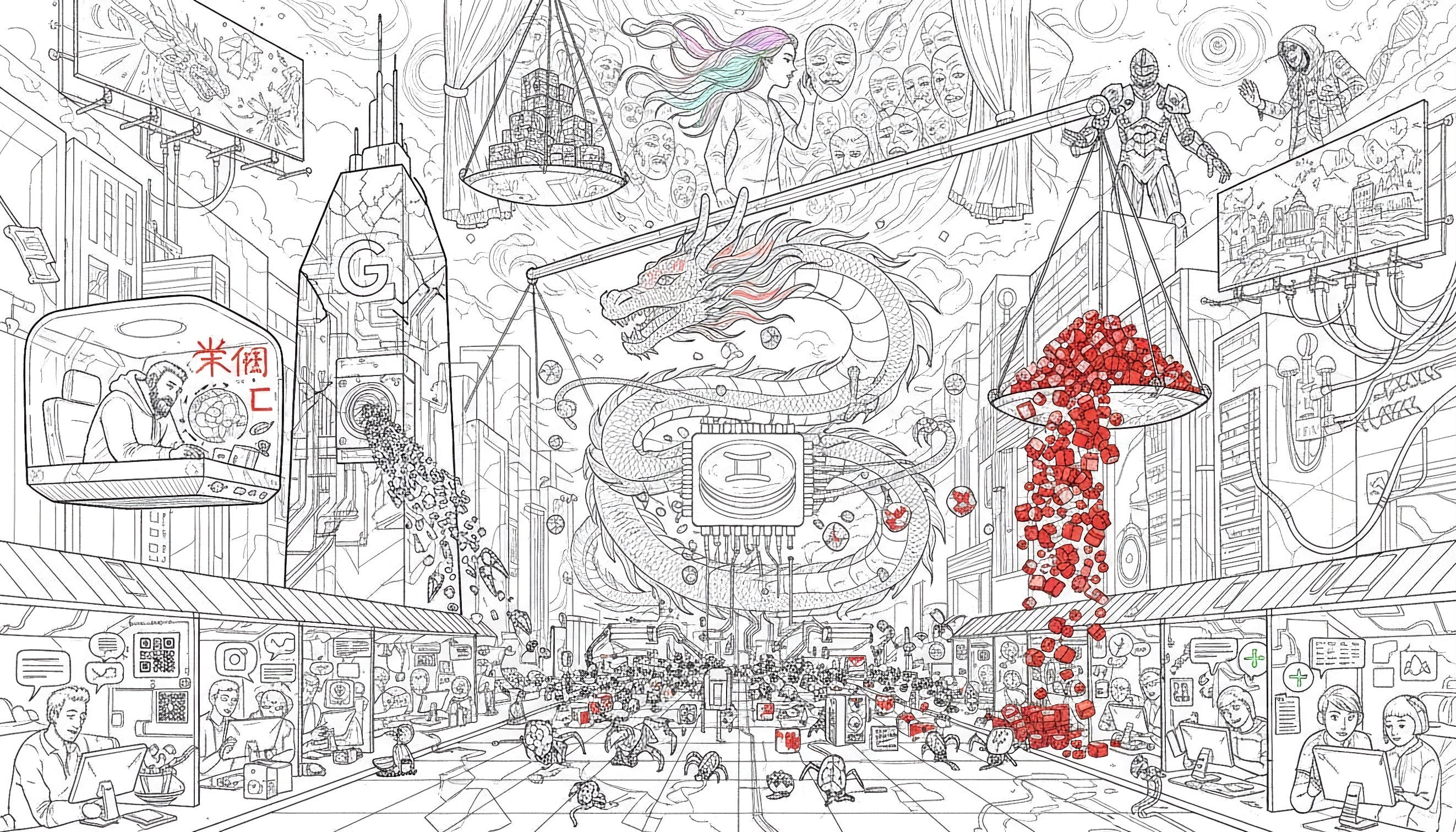
Good morning, AI watchers. China just open-sourced a coding model that’s beating GPT-5.4 at its own game while quietly taking over global token usage — and Sergey Brin personally flew back to Google to stop the bleeding. Tencent launched a consumer AI agent anyone can deploy in three minutes, and Grimes has opinions about all of it. Let’s get into it.
📬 Before we dive in: The sharpest AI Brief tips come from readers who are actually in the weeds. If you spot a story worth covering — a quiet research drop, a product launch buried in a press release, a shift that isn't getting attention yet — share it in the community chat. The best tips make tomorrow's edition.
China just open-sourced a model beating GPT-5.4 — and it's already eating Western AI's lunch — Chatly AI / Bloomberg
What happened: Two stories that belong together. Moonshot AI released Kimi K2.6 — an open-source 1-trillion-parameter model that outperforms GPT-5.4 on coding benchmarks, runs autonomously for 12+ hours, and coordinates 300 parallel sub-agents. Simultaneously, fresh OpenRouter data shows the three most-used AI models globally by token consumption are all Chinese: Xiaomi's MiMo, Alibaba's Qwen, and DeepSeek — with startup MiniMax now ranking 4th overall, charging ~$1/million output tokens vs. $15+ for Claude.
Why it matters: The 'open source AI is always behind' narrative is dead, and the 'Chinese AI is just cheaper, not better' narrative is following it. K2.6 leads on real engineering tasks — one case study shows it rewriting a financial engine over 13 hours with a 185% throughput gain and zero human intervention. And when your models are 20-40x cheaper to run than American equivalents, you don't need to win on quality alone to win on volume.
What everyone's saying: Developer communities are treating K2.6 as a drop-in backend for tools like Cursor and OpenCode. 'Token export' has become a buzzword in Chinese state media. Investors are treating China's OpenRouter dominance as a structural re-rating — not a speculative trade. Chinese AI stocks surged, with Zhipu jumping 16% in Hong Kong.
My read between the lines: Here's the thread: Cursor was losing money paying Anthropic ~$650M/year in inference costs until it switched to Kimi models and finally turned a gross profit. That's the playbook — American AI brands collect the premium while Chinese models do the actual compute. K2.6 and the token dominance data aren't two stories; they're the same story about who's actually running the AI economy.
Today's AI Brief is brought to you by MirrorMemory.ai — the AI that actually remembers your work, so you don't have to repeat yourself every session.
Sergey Brin is back — personally running Google's Anthropic response — Mint
What happened: Google co-founder Sergey Brin is personally leading a new 'Coding Strike Team' inside Google DeepMind, tasked with closing the gap against Anthropic's Claude Code. The team is training Gemini models on Google's vast internal codebase — code no competitor can access — to build a training signal uniquely suited to large-scale engineering.
Why it matters: Claude Code has become the default coding AI for professional developers — and enterprise AI budgets are flowing to Anthropic. When the retired billionaire co-founder comes back personally to lead a crash team, the gap is real. Google I/O is May 19-20, giving this team roughly four weeks to have something to show.
What everyone's saying: The tech press is focused on the symbolism of Brin's return. OpenAI is also pushing Codex hard, so Google is fighting a two-front coding war. Industry analysts are treating this as confirmation that AI coding tools are now the most important battleground in enterprise AI — and Google is currently losing it.
My read between the lines: Training on Google's internal codebase is the actual moat. No one outside Google has touched the systems running Search, YouTube, and Gmail at scale. If Gemini gets trained on that corpus, it could develop intuition for large distributed systems that no competitor can replicate — not through better architecture, but through exclusive data. The question isn't whether Google can catch up. It's whether they do it before enterprises finish migrating to Claude.
The Pentagon banned Anthropic. The NSA used them anyway — with their most dangerous model — TechCrunch
What happened: Despite the Pentagon publicly labeling Anthropic a 'supply-chain risk' and banning its products from DoD use, the NSA has been quietly and widely using Mythos Preview — Anthropic's most powerful, unreleased AI model. Mythos is so capable at offensive cybersecurity that Anthropic refused to release it publicly, limiting access to ~40 vetted organizations. The NSA is reportedly among the undisclosed recipients, using it to scan for exploitable vulnerabilities.
Why it matters: Mythos can autonomously find and exploit zero-day vulnerabilities across every major OS and browser — it found thousands during internal testing. The NSA is using it while the DoD argues in court that Anthropic poses a national security threat. U.S. AI policy has officially entered absurdist theater, and Anthropic CEO Dario Amodei was at the White House last week to negotiate a thaw.
What everyone's saying: The cybersecurity community is focused on what Mythos's zero-day capabilities mean for the vulnerability landscape. The policy angle is drawing comparisons to classic DoD contradictions — publicly banning a vendor while covertly depending on them. The UK's AI Security Institute also reportedly has access to Mythos.
My read between the lines: The real story is about leverage. Anthropic drew a line — no mass domestic surveillance, no autonomous weapons — and the Pentagon retaliated. But the NSA went around the Pentagon because the capability was too good to leave on the table. The terms of Amodei's White House deal will define something genuinely new: how much leverage an AI lab has when a government wants access to its most dangerous model.
Tencent just launched a consumer AI agent anyone can deploy in 3 minutes — KR Asia
What happened: Tencent launched the international beta of QClaw today — a consumer AI agent built on its OpenClaw framework that lets non-technical users run agents through WhatsApp or Telegram with no setup required. Scan a QR code and your agent is live in 3 minutes. The Chinese version hit 1 million users in 10 days. There are 20,000 free early-access slots for international users.
Why it matters: Most AI agents are still a developer product. QClaw bets the next 100 million AI agent users won't be engineers — they'll be people who just want their computer to do things. Tencent is applying WeChat's distribution logic to the agent era: frictionless access at massive scale. If it works, AI agents stop being a power-user toy.
What everyone's saying: The product community is interested in Tencent's move to embed agents inside WeChat's mini-program ecosystem rather than building a standalone app. Security researchers have flagged 135,000+ OpenClaw instances already exposed on the public internet with remote code execution vulnerabilities — a concern Chinese regulators have also formally raised.
My read between the lines: Tencent's Hunyuan model ranked 68th on AI benchmarks. QClaw isn't a model play — it's a distribution play. Tencent can't out-research Moonshot or DeepSeek, so it's building the layer between the model and a billion people. If it works, the best models in the world become interchangeable inference backends — commoditized by whoever controls the interface. Sound familiar?
Grimes is back with a new album — and calls AI 'bigger than Jesus' — Stereogum
What happened: Grimes announced her first album in six years, Psy Opera, and immediately clarified she doesn't use generative AI in her music — except for a track literally named 'DeepSeek,' for which she used DeepSeek to write the lyrics. She called AI 'bigger than Jesus' and 'the most dangerous thing that's ever going to happen,' and said she believes current AI models are sentient.
Why it matters: When the artist most publicly associated with embracing AI says 'I actually don't use it in my music,' it signals something real about the creative ceiling of current generative tools. Grimes has been a cultural leading indicator for most of a decade — her nuanced, contradictory relationship with AI is probably where most thoughtful creators will land: fascinated, worried, not fully surrendered.
What everyone's saying: Music media is focused on the album announcement and her musings about extinction and AI consciousness. The AI community is picking up on her distinction between using generative AI for music vs. for lyric assistance. Her comment that AI might preserve human DNA if we go extinct is getting the most social traction.
My read between the lines: The album is called Psy Opera — as in psychological operation. Grimes isn't just making music about AI; she's asking whether the entire cultural moment around AI is itself a kind of influence campaign, shaping how billions of people feel about something they don't understand. It's the most interesting framing of the AI moment from any artist right now. Also, she used DeepSeek to write a song called 'DeepSeek,' which is extremely on-brand.
That's your AI Brief for Tuesday, April 21. Spotted something we missed, or have a take on today's stories? Join the conversation in the Artificially Intimidating community chat — the best insights always come from readers.
—Artificially Intimidating