

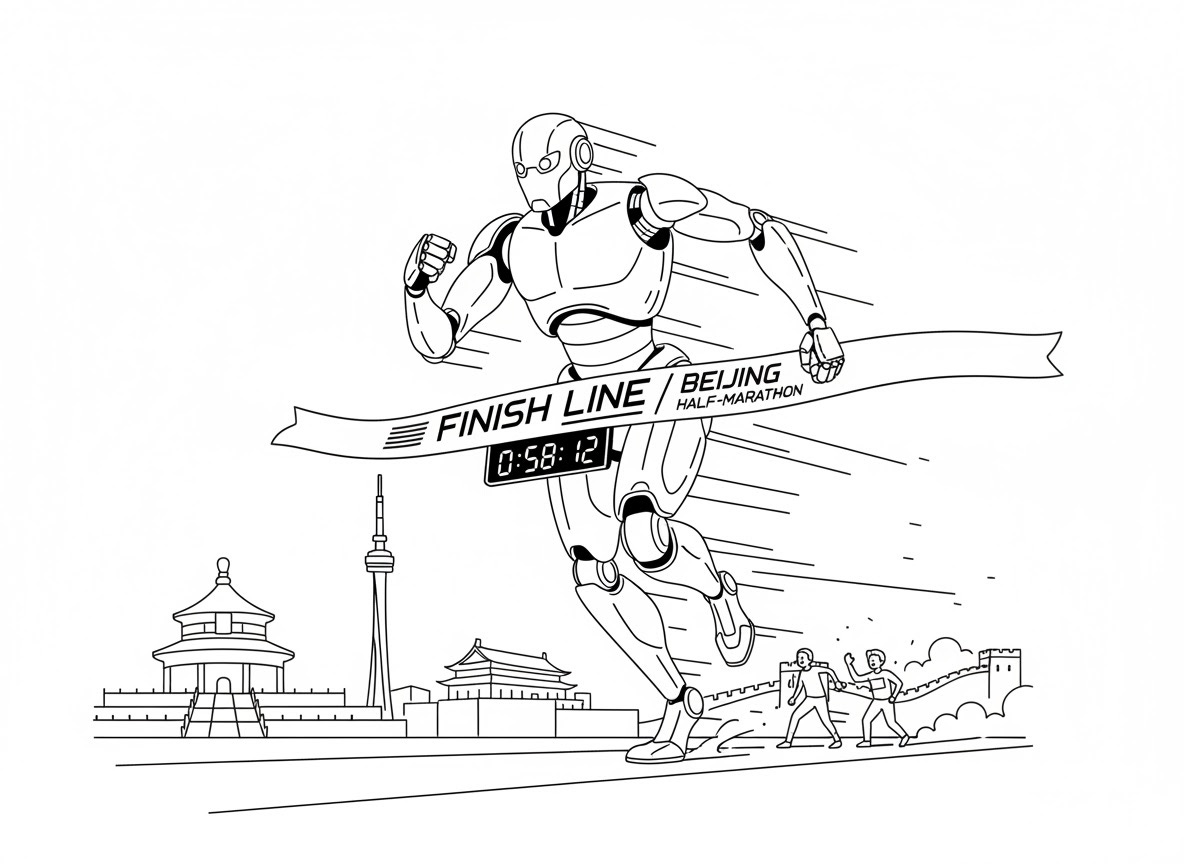
Good morning, AI watchers. Somewhere in Beijing this morning, a bipedal robot crossed a half-marathon finish line faster than any human ever has -- and that's not even the wildest thing that happened this week. Today we're covering everything from OpenAI building an AI pharmacist to Cloudflare handing every website owner a free bouncer for AI scrapers. The machines are getting faster, the subscriptions are getting stickier, and China is trying to figure out what happens when your digital twin has more rights than your actual one. Let's get into it.
China's Robot Just Broke the Human Half-Marathon Record
What happened: A humanoid robot named "Lightning," built by Honor's Monkey King team, won the 2026 Beijing Humanoid Robot Half-Marathon on April 19 with a net time of 50 minutes and 26 seconds. That's nearly seven minutes faster than the human world record of 57:20. Over 100 humanoid robots competed in the event.
Why it matters: This isn't a lab demo or a PR stunt on a treadmill -- it's an autonomous bipedal robot outperforming the best human athletes on an actual road course. If you've been wondering when robots would go from "can barely walk" to "faster than Olympians," the answer is apparently this weekend.
What everyone's saying: The robotics community is calling it a watershed moment for bipedal locomotion. The discourse is split between genuine awe at the engineering and questions about whether a wheeled course and ideal conditions make the comparison to human records misleading.
My read between the lines: The real story isn't the speed -- it's that 100+ humanoid robots showed up to race at all. A year ago, most of these companies were demoing robots that could sort of wave. Now they're running half-marathons in formation. China's humanoid robotics ecosystem isn't just catching up; it's building its own Olympics.
Source: YouTube / Beijing E-Town Humanoid Robot Half-Marathon
Today's AI Brief is brought to you by MirrorMemory.ai.
OpenAI Launches GPT-Rosalind for Drug Discovery
What happened: OpenAI released GPT-Rosalind, a specialized AI model built for life sciences research including drug discovery, genomics, and translational medicine. Named after scientist Rosalind Franklin, it's available as a research preview to enterprise partners including Amgen, Moderna, and the Allen Institute.
Why it matters: Drug development typically takes 10-15 years from target discovery to approval. GPT-Rosalind is designed to help researchers process massive volumes of literature and experimental data to surface connections humans might miss. If it works, it could meaningfully compress that timeline for real patients waiting for treatments.
What everyone's saying: The launch follows OpenAI's strategic alliance with Novo Nordisk and comes the same week as its continued push into vertical AI. Biotech analysts are cautiously optimistic but note that AI drug discovery has been "two years away" for about five years now.
My read between the lines: The naming is doing heavy lifting here -- invoking Rosalind Franklin signals scientific credibility, not chatbot vibes. But the real tell is the customer list. Amgen and Moderna aren't signing up for demos; they're stress-testing this against actual pipelines. OpenAI is betting that vertical models, not general-purpose ones, are where the enterprise money lives.
Source: Reuters
AI Subscriptions Surge 155% -- But Only 2% of Households Pay
What happened: New data from PNC Bank shows the share of U.S. households paying for generative AI subscriptions is up roughly 155% year-over-year. But the absolute number is still tiny -- only about 2% of all households currently subscribe. Most are paying around $20 per month, and subscriptions are averaging seven months of retention.
Why it matters: The growth rate sounds explosive until you realize we're going from almost-nobody to slightly-more-than-nobody. For comparison, about 25% of U.S. consumers pay for streaming subscriptions. AI tools are sticky once people start paying, but the vast majority of the country hasn't even tried the free tier yet.
What everyone's saying: Tech optimists see proof of a consumer market forming. Skeptics point out that growth is concentrated among upper-income users, suggesting AI subscriptions might be a luxury rather than a utility -- at least for now.
My read between the lines: Seven-month average retention at $20/month is genuinely impressive -- that's stickier than most SaaS products. The real question isn't whether AI subscriptions will grow; it's whether the industry can convert the 98% who haven't paid yet, or whether AI tools are destined to be the new premium cable -- beloved by those who have it, invisible to everyone else.
Source: CBS News / PNC Bank
Cloudflare Arms Every Website Against AI Scrapers
What happened: Cloudflare's AI Crawl Control is now available on all plans, including free. Website owners can block, allow, or even charge individual AI crawlers for scraping their content. The tool uses machine learning and behavioral analysis to identify AI bots -- including ones that disguise themselves as regular browsers.
Why it matters: If you run a website, AI crawlers may be scraping your pages thousands of times for every referral they actually send. Until now, most site owners had no visibility into this and no practical way to stop it. Cloudflare just handed every website on the internet a free dashboard and kill switch.
What everyone's saying: Publishers and content creators are celebrating. Cloudflare is framing this as a permission-based future where AI companies have to negotiate for access. The AI companies themselves have been conspicuously quiet about it.
My read between the lines: The "charge AI crawlers" option is the sleeper feature here. Cloudflare isn't just building a wall -- they're building a toll booth. If this catches on, it could create an entirely new revenue stream for content creators and fundamentally change the economics of training data. The web went from open-access to paywalled to ad-supported, and now it might be heading toward "AI companies pay rent."
Source: Cloudflare
China Writes the First Rules for AI Digital Humans
What happened: China's Cyberspace Administration (CAC) published draft regulations governing AI-generated "digital humans" -- virtual avatars that can look and sound like real people. The rules require clear labeling, consent for likeness use, anti-addiction protections for minors, and restrictions on content that threatens social stability. Public comment is open until early May.
Why it matters: Digital humans are booming in China's e-commerce, entertainment, and customer service sectors. But without rules, anyone can create a convincing virtual clone of a real person without their consent. These are among the first regulations anywhere in the world specifically targeting AI-generated human avatars.
What everyone's saying: Legal analysts note China's usual "develop first, regulate second" approach -- the industry has been operating in a gray zone for years, and these rules are catching up. Industry founders like Super Brain's Zhang Zewei call new regulation "inevitable" and largely welcome it.
My read between the lines: The West is still debating whether AI deepfakes should be labeled. China just skipped that conversation and went straight to "here are the rules for your entire digital human industry." Love or hate the approach, the regulatory gap between China and everyone else on AI governance is getting awkward. At some point, the rest of the world will have to decide whether to lead, follow, or just keep arguing about it.
Source: The Straits Times
That's your AI Brief for Saturday. Drop a link in our Telegram bot if you spot something we missed -- good tips make it into tomorrow's edition.
--Artificially Intimidating