

Good morning, AI watchers. If it feels like the ground shifted this week, that's because it did -- on about five axes at once. Anthropic is building a design studio inside a chatbot, OpenAI wants to cure cancer before it ships GPT-6, Stanford says China is basically breathing down America's neck in the AI race, and Perplexity would really like your Mac mini to never sleep again. Oh, and OpenAI's own economists think the robot apocalypse is... overstated? Today's brief has something for the optimists, the skeptics, and the people who just want to know if their job is safe. Let's get into it.
Anthropic Launches Claude Design, Ships Opus 4.7
What happened: Anthropic released two major products this week: Claude Design, a new AI-powered design tool that turns conversational prompts into polished prototypes, slide decks, and marketing collateral; and Claude Opus 4.7, its most capable generally available model, with improved coding, multimodal vision, and new cyber safeguards. Anthropic's CPO Mike Krieger quietly resigned from Figma's board days before the announcement.
Why it matters: If you've ever tried to explain a product idea to a designer and felt like you were playing Pictionary over Zoom, Claude Design is aimed squarely at that pain point. It lets non-designers create real visual work through conversation. Meanwhile, Opus 4.7 represents a step toward AI that checks its own homework -- the model proactively writes tests and verifies its output before handing it back.
What everyone's saying: The tech press is framing Claude Design as a direct shot at Figma and Canva. Anthropic insists it's complementary, not competitive -- but nobody's buying that when your CPO just left Figma's board. On the Opus 4.7 side, developers are noticing higher token consumption thanks to the new thinking patterns, even with Anthropic's increased rate limits.
The AI we're not saying out loud: The real story isn't Claude Design vs. Figma. It's that every major AI lab is moving up the stack from 'model provider' to 'full application builder,' directly entering categories owned by established software companies. The moat around SaaS tools was always the workflow, not the technology. When the technology can generate the workflow from a text prompt, that moat starts looking more like a puddle.
Source: TechCrunch | Anthropic
Today's AI Brief is brought to you by MirrorMemory.ai -- giving your AI a memory worth trusting.
OpenAI Bets Big on Biology With GPT-Rosalind
What happened: OpenAI launched GPT-Rosalind, a new reasoning model built specifically for life sciences research -- biology, drug discovery, and translational medicine. Early access partners include Amgen, Moderna, the Allen Institute, and Thermo Fisher Scientific. The release came alongside a new Life Sciences research plugin for Codex and a strategic partnership with Novo Nordisk.
Why it matters: Getting a drug from 'promising molecule' to 'pill you can take' currently takes 10-15 years and costs billions. If AI can meaningfully compress that timeline by surfacing connections in data that humans miss, we're talking about medicines reaching patients years sooner. This is AI applied to a problem where faster genuinely means lives saved.
What everyone's saying: Bloomberg is positioning this as OpenAI vs. Google in the life sciences AI race. The pharma industry is cautiously optimistic -- Eli Lilly, Moderna, and others have been building AI partnerships for years, and a purpose-built reasoning model is a step beyond generic chatbot-as-research-assistant.
The AI we're not saying out loud: OpenAI is quietly building an empire of domain-specific models -- GPT-5.4-Cyber for security, now GPT-Rosalind for biology. The 'one model to rule them all' era might be ending in favor of specialized frontier models that actually know their field. Also worth noting: the biosecurity researchers warning that models trained on biological data could be misused aren't wrong, and that tension isn't going away.
Stanford Says China Nearly Closed the AI Gap
What happened: Stanford's Human-Centered AI Institute released its 2026 AI Index report, revealing that the performance gap between US and Chinese AI models has compressed to just 2.7% -- down from double-digit leads as recently as 2023. The US still dominates private investment ($285.9 billion vs. China's $12.4 billion), but China leads in AI patents, publications, and industrial robot installations.
Why it matters: For years, the narrative was 'America builds the best AI models, period.' That's no longer a safe assumption. If you're a policymaker, investor, or just someone who cares about where AI development is headed, the Stanford report is a wake-up call that the competitive landscape has fundamentally shifted -- and it happened faster than anyone expected.
What everyone's saying: The headline stat everyone's fixated on is that ByteDance's best model trails Anthropic's Claude by just 39 Arena points. Investment analysts are already shifting exposure away from the assumption of durable US dominance. The report also found that generative AI hit 53% adoption in just three years -- faster than the PC or the internet.
The AI we're not saying out loud: China's investment numbers are almost certainly understated. The Stanford report notes that government guidance funds deployed an estimated $184 billion into AI firms between 2000-2023 -- money that doesn't show up in 'private investment' comparisons. When you add that to the equation, the 23x US investment lead looks a lot more like a 3x lead with different accounting.
Source: Stanford HAI | Fortune
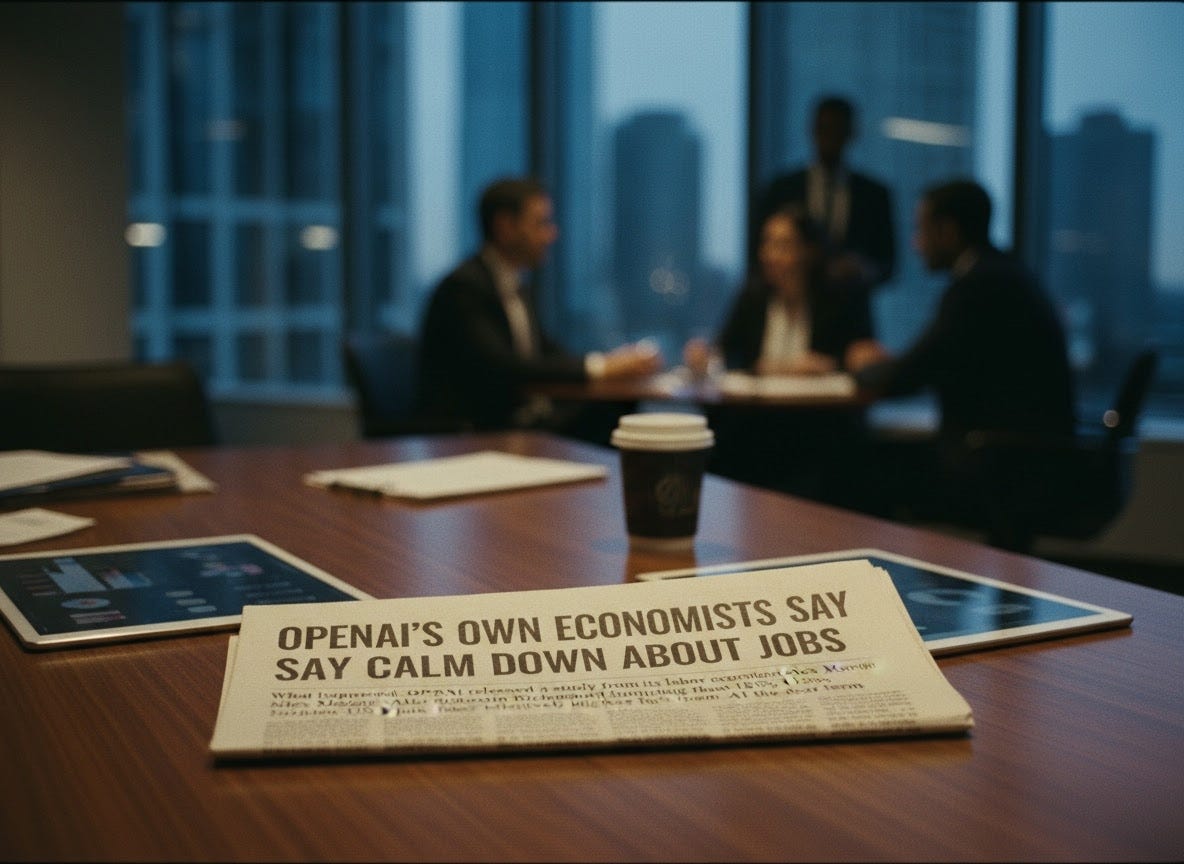
OpenAI's Own Economists Say Calm Down About Jobs
What happened: OpenAI released a study from its labor economist Alex Martin Richmond finding that 18% of US jobs face 'relatively higher risk' from AI in the near term -- but that reorganization and expansion are more likely outcomes than outright job losses. The study argues that AI exposure is a 'weak predictor of immediate labor market pressure' because actual AI usage still lags far behind what's theoretically possible.
Why it matters: If you've been anxious about AI taking your job, this offers some nuance. Even in the most AI-exposed occupations, there's a massive gap between 'a machine could theoretically do parts of this' and 'a machine is actually doing parts of this.' The capability exists on paper; the adoption hasn't caught up.
What everyone's saying: Critics are pointing out the obvious conflict of interest -- of course the company selling AI wants you to think it won't take your job. Supporters note the methodology is solid: comparing actual ChatGPT usage hours against theoretical task automation rates reveals a genuine 'capability overhang' that hasn't converted to displacement yet.
The AI we're not saying out loud: The word 'yet' is doing a lot of heavy lifting in this study. A 66-percentage-point gap between theoretical and realized exposure in high-risk jobs doesn't mean those jobs are safe -- it means the wave hasn't hit shore. When adoption curves go exponential, 'it hasn't happened yet' is the most dangerous form of comfort. Ask Blockbuster.
Source: Morningstar/MarketWatch | OpenAI Report (PDF)
Perplexity Wants Your Mac to Be an AI Agent
What happened: Perplexity launched Personal Computer, an always-on AI assistant that runs locally on your Mac -- managing files, controlling native apps like iMessage and Calendar, and browsing the web autonomously. It's designed to run continuously on a dedicated Mac (especially a Mac mini) and is available exclusively to Perplexity Max subscribers at $200/month.
Why it matters: This is one of the first major AI products that wants to live on your actual computer rather than in a browser tab. Instead of copying and pasting between your AI chat and your real tools, Perplexity is betting you'll let an AI agent directly access your files, apps, and messages. It's the difference between an assistant you talk to and an assistant that sits at your desk.
What everyone's saying: The tech press is drawing comparisons to OpenClaw (the viral open-source AI agent from Peter Steinberger, who just joined OpenAI). The $200/month price tag is raising eyebrows -- that's 10x the cost of most AI subscriptions. But Perplexity is positioning this as a productivity tool for power users, not a chatbot upgrade.
The AI we're not saying out loud: Apple and Perplexity are getting awfully cozy -- first the Perplexity-powered search features, now a Mac-native AI agent that requires Apple hardware. Apple Intelligence hasn't exactly set the world on fire, so letting a third party build the 'smart' layer on top of Apple's hardware play might be the quiet partnership that actually matters. Also: '$200/month for an AI that reads your iMessages' is either the future of productivity or a privacy nightmare dressed in a turtleneck. Possibly both.
Source: Dataconomy
That's your AI Brief for Friday. Drop a link in our Telegram bot if you spot something we missed -- good tips make it into tomorrow's edition.
--Artificially Intimidating