

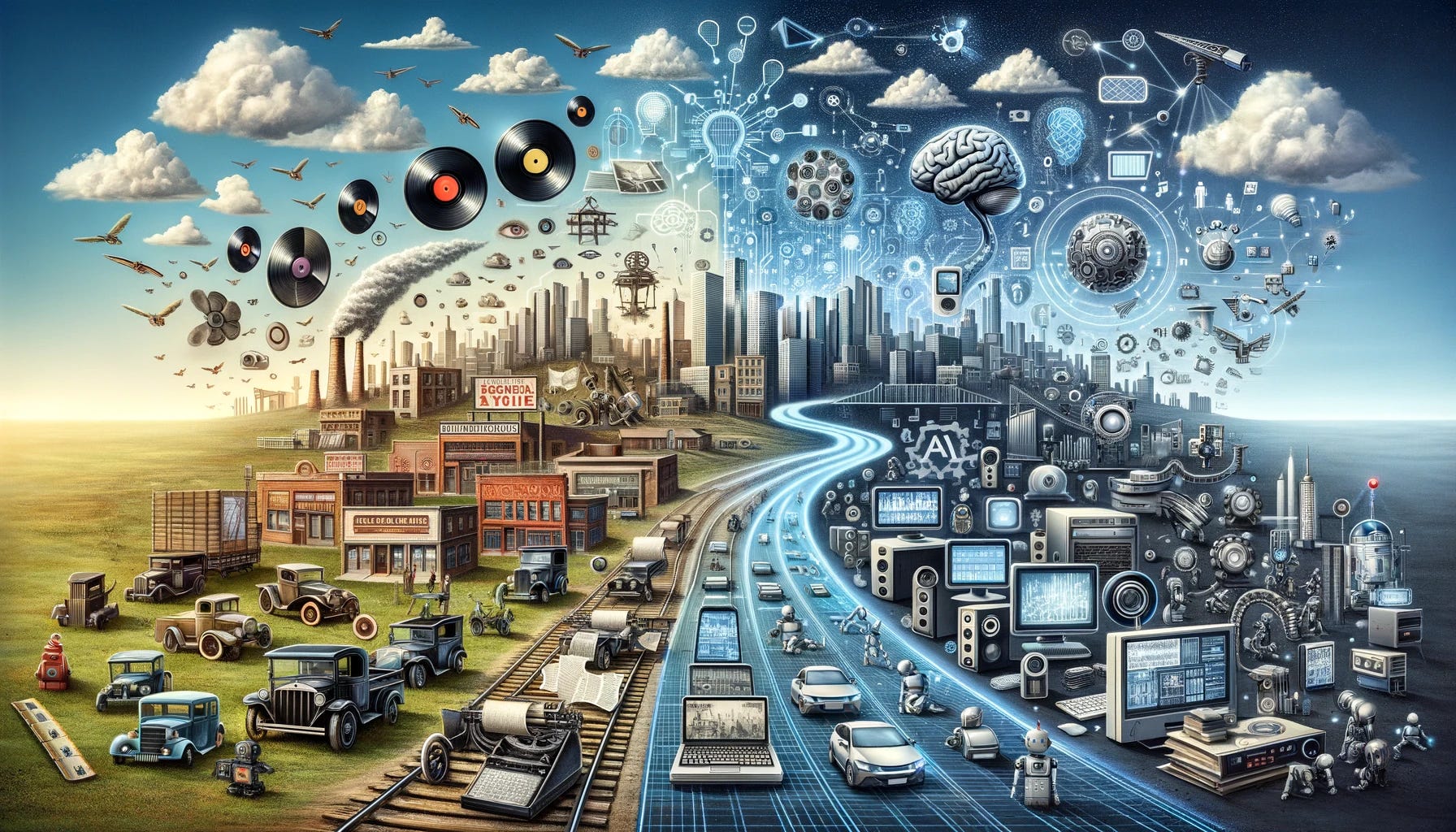
As artificial intelligence advances, it's transforming not just how we digitize information, but how we automate and enhance processes in every industry. But with these advancements come ethical and societal questions that we must address to ensure a responsible and equitable future.
In the early days of the digital revolution, journalist and entrepreneur Kara Swisher famously stated, "Everything that can be digitized will be digitized." This prediction has certainly come true, as we've witnessed the transformation of industries like music, movies, and news media from physical to digital formats. But as we've moved into the era of artificial intelligence (AI), Swisher's quote has taken on new meaning. AI has not only accelerated the digitization of information but also enabled the automation and enhancement of various tasks and processes. In this piece, we'll explore how AI has impacted the past, present, and potential future of digitization.
Past Decade (2010-2020): AI has been integrated into our lives in subtle ways, often without us realizing it:
Personalized recommendations: AI algorithms power recommendations on platforms like Netflix, Spotify, and Amazon, suggesting movies, music, and products based on our past preferences.
Image and voice recognition: AI has been used in smartphone cameras and voice assistants like Siri and Google Assistant to recognize faces, objects, and understand spoken commands.
Online customer support: Many websites and apps use chatbots powered by AI to provide 24/7 customer support, answering questions and resolving issues.
Current Era (2021-present): AI continues to evolve rapidly and is being used in a wide range of applications:
Language models: AI models like GPT and BERT can generate human-like text, translate languages, and even write code, revolutionizing content creation and communication.
Autonomous vehicles: Self-driving cars, drones, and robots are becoming more common, using AI to navigate, avoid obstacles, and perform tasks.
Healthcare: AI is assisting in drug discovery, early disease detection, and even personalized medicine, improving patient outcomes.
Future Speculation (2021-2031): AI will continue to advance and transform many aspects of our lives:
Augmented and virtual reality: AI will enhance AR/VR experiences, creating more immersive and realistic environments for gaming, education, and remote work.
General AI: Researchers are working towards developing AI systems that can perform a wide range of tasks, just like a human, leading to widespread automation and potential job displacement.
Ethics and regulation: As AI becomes more integrated into society, ethical concerns and regulations will become increasingly important, ensuring that AI is used responsibly and for the benefit of humanity.
This is just a glimpse into the past, present, and potential future of AI, but the possibilities are vast and constantly evolving.
As we've seen, AI has already made significant strides in digitizing, automating, and enhancing various aspects of our lives, from personalized recommendations to autonomous vehicles and healthcare innovations. As we move into the next decade, AI will likely continue to evolve and transform many more industries and applications. While the future of AI is exciting, it also presents ethical and societal challenges that we must address. As Kara Swisher's quote evolves to reflect the era of AI, we must ensure that the technology is developed and used responsibly to create a better, more equitable world for all.